Cosmic Tapeworms: How 40-Ton Mini Black Holes Nest Inside Dead Stars and Gorge on Dark Matter
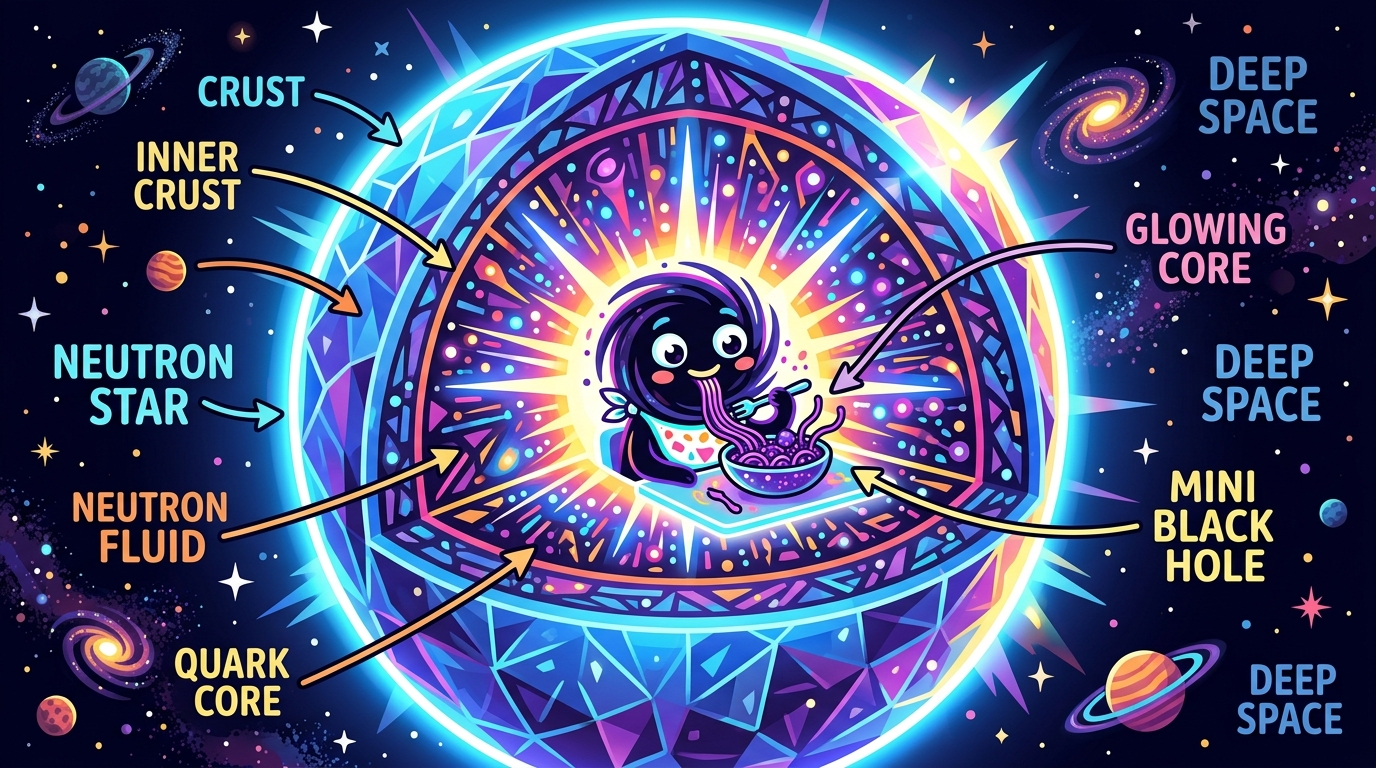
If you thought tapeworms in your gut were horrifying, wait until you hear what might be lurking inside dense celestial bodies. In a mind-bending preprint taking the astrophysics community by storm, theoretical physicists calculated that miniature, 40-ton black holes could be nesting inside neutron stars and white dwarfs, feasting on dark matter and slowly digesting their stellar hosts from the inside out!
Under standard General Relativity and quantum mechanics, a 40-ton black hole should not exist for more than a tiny fraction of a second. According to Stephen Hawking's famous 1974 prediction, black holes radiate energy via Hawking radiation. The smaller a black hole is, the hotter it burns and the faster it evaporates. A microscopic black hole weighing 40 metric tons (roughly the mass of a large loaded cement truck, shrunk down far smaller than a single proton) should detonate into an eye-searing flash of gamma rays in less than a nanosecond.
🕳️ The Endoparasite Survival Strategy
So how could such an infinitesimal singularity survive in the cold vacuum of modern space? By turning into an endoparasite inside the densest stellar corpses in the universe:
- Dark Matter Funnel: As compact stars spin through galactic halos, their crushing gravitational fields pull in and trap asymmetric or composite heavy dark matter particles into their central cores.
- Gravitational Collapse: When the central pool of dark matter hits critical mass, it collapses under its own gravity into a microscopic black hole kernel.
- The Buffet That Beats Evaporation: Immersed in an ultra-dense bath of nuclear-density neutrons and dark matter fuel, the baby black hole gorges on matter faster than Hawking radiation can boil it away.
Once the intake of dark matter and surrounding stellar degenerate matter exceeds Hawking's evaporative loss, the black hole stabilizes in mass. It becomes a permanent celestial parasite.
Over millions or billions of years, this microscopic vacuum cleaner slowly slurps away at the heart of the neutron star. Eventually, the parasite hits an exponential growth phase, devouring the entire host star from within in a silent, cataclysmic collapse that leaves behind an unusually light solar-mass black hole without a supernova explosion!
🔭 Catching the Cosmic Cannibalism
Astronomers are now gearing up next-generation gravitational wave detectors and X-ray observatories to scan dense star clusters for missing neutron stars and telltale thermal glitches that betray a microscopic black hole snacking on dark matter inside a stellar core.
The next time you gaze up at the night sky and admire the sparkling dead embers of ancient stars, remember: some of them might have a 40-ton quantum parasite chewing quietly in their bellies!
You might also like

Earth Put on Headphones: Physicists Turn the Entire Planet into a Dark Matter Radio
Why build a billion-dollar underground particle detector when Mother Earth already gave us an 8,000-mile magnetic resonant cavity? Japanese physicists just used Earth's ionosphere to hunt for ghost-like ultralight axions and dark photons.

The 10-Billion-Year-Old Voicemail: Webb and MeerKAT Catch the Most Distant Radio Flash in Cosmic History
Astronomers have detected FRB 20240304B, a fast radio burst that traveled over 10 billion years across the universe, shattering cosmic distance records and proving ancient baby galaxies loved loud fireworks.

Fishing for Cosmic Ghosts at the South Pole: How a Giant Ice Cube Won the 2026 Nobel Prize in Physics
The 2026 Nobel Prize in Physics goes solely to Francis Halzen for melting 86 giant holes into two miles of Antarctic ice, turning the frozen continent into the world's weirdest telescope to catch elusive cosmic neutrinos.