Earth Was an Extreme Localvore: Why Geologists Have No Idea Where Our Water Came From
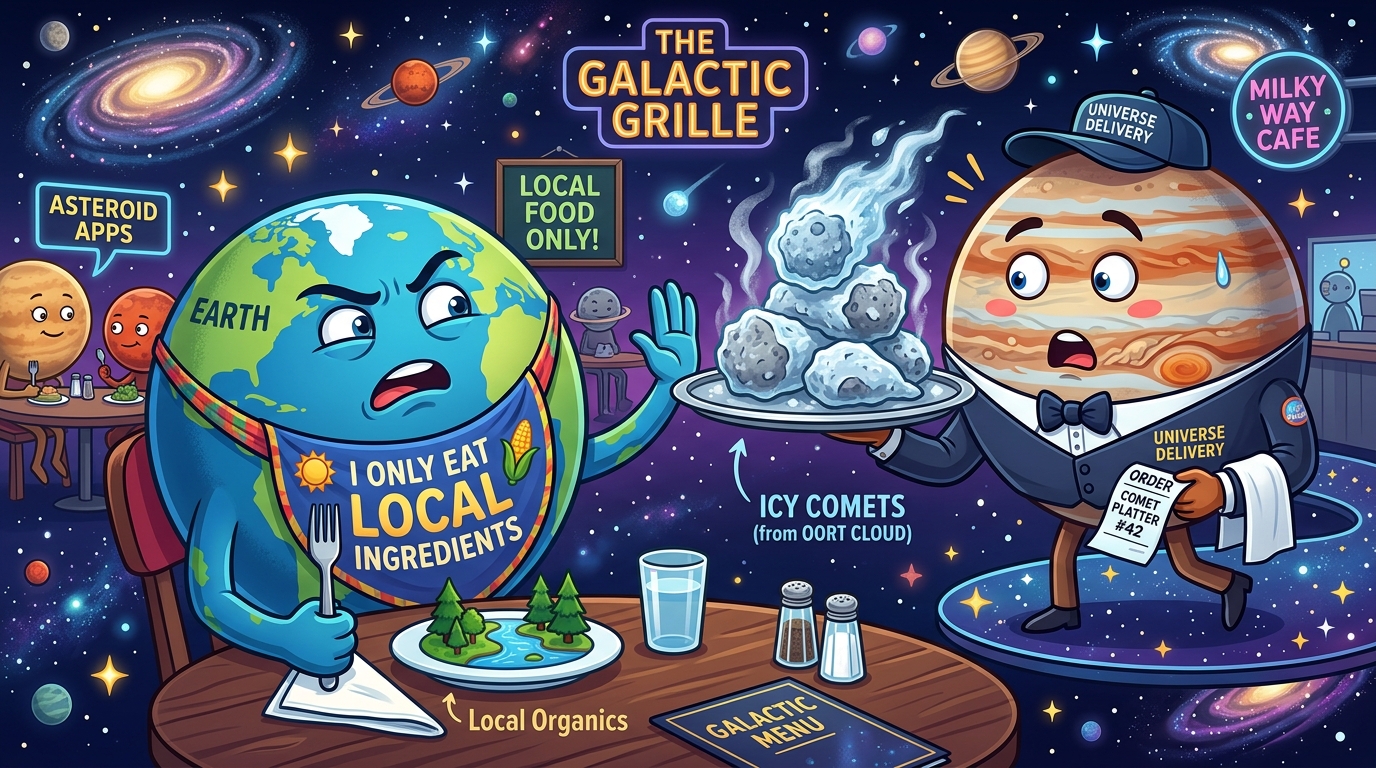
For decades, high school science textbooks and slick TV documentaries have comforted us with a neat, tidy bedtime story about how our planet got its blue oceans: baby Earth was a dry, molten cinder until benevolent icy comets and water-soaked asteroids from the cold outer solar system crash-landed like an interplanetary Uber Eats order, filling up our swimming pools. It turns out that story was completely wrong.
In an explosive paper published in Nature Astronomy, planetary scientists Paolo Sossi and Dan Bower from ETH Zurich conducted an exhaustive forensic audit of Earth’s chemical DNA. By analyzing isotopic ratios across ten distinct chemical elements, they reached a jaw-dropping conclusion: Earth was built almost exclusively from local, inner-solar-system materials. Less than 2%—and possibly literally 0%—of our planet’s mass came from beyond Jupiter.
🌊 The 100% Local Planet: ETH Zurich Study Key Findings
Earth was the solar system's most dedicated "farm-to-table" planet:
- The 10-Element Fingerprint: Researchers examined isotopes of elements including silicon, titanium, chromium, iron, nickel, molybdenum, and ruthenium across meteorites, Mars, and asteroid Vesta.
- Zero Outer Deliveries: Textbook models claimed 6% to 40% of Earth’s mass arrived via water-rich carbonaceous chondrites from the outer solar system. The isotopic reality? Under 2%.
- Jupiter the Bouncer: As young Jupiter rapidly ballooned into a gas giant, its immense gravity carved a physical gap in the protoplanetary disk, acting as an unyielding cosmic bouncer that prevented outer ice-rocks from drifting inward.
- The Mystery Deepens: The inner solar system near the young Sun was supposedly a scorching, bone-dry furnace where volatile water could never condense. Yet here we are, covered in 1.38 billion cubic kilometers of ocean water.
The core issue is that every meteorite family has an unforgeable isotopic signature—a cosmic passport stamp showing whether it formed inside or outside Jupiter’s orbit. Carbonaceous chondrites, the wet rocks long credited with providing Earth's oceans and carbon, carry unmistakable outer-system isotopes.
When the ETH Zurich team ran high-precision statistical models comparing Earth's mantle with the meteorite record, the carbonaceous contribution collapsed to statistical noise. Earth didn't order take-out from the outer solar system; it dined exclusively on whatever hot pebbles were sitting right on its doorstep.
🍹 So Where Did the Cosmic Cocktail Come From?
If outer asteroids didn't deliver the oceans, planetary scientists are left with some wild possibilities:
- Homebrewed Water: Inner solar system dust grains might have locked up hydrogen and hydroxyl groups inside crystal lattices much closer to the Sun than previously believed possible.
- The Magma Reaction: Primordial hydrogen from the solar nebula may have reacted directly with oxygen-rich molten rock in baby Earth’s magma ocean, synthesizing water right here on the stove.
- Lost Ingredients: Earth's chemical fingerprint doesn't match any known meteorite surviving today, meaning the planet may have devoured unique protoplanetary building blocks that have since gone completely extinct.
This paradigm shift ripples far beyond our own solar system. If planets don't require delicate gravitational nudges to deliver water from icy distant fringes, habitable worlds might be far more common across the Milky Way than previously calculated. Rocky exoplanets orbiting near their stars might naturally cook up their own oceans through internal chemistry rather than waiting for an asteroid bombardment lottery.
So next time you take a sip of water or go for a swim at the beach, give Earth some credit for its culinary pride. Our home planet didn't need icy comets delivered from the edge of nowhere—it was an unapologetic locavore that brewed its own ocean cocktail right here at home.
You might also like
Oklahoma's Ames Meteor Crater Knocked 100 Million Years Off Its Age After Getting Caught With Recycled Fossils
High-precision uranium-lead zircon dating reveals Oklahoma's Ames impact crater was formed 370 million years ago—nearly 100 million years later than believed—kicking it out of Earth's hypothetical Saturn-ring club.

When You Try to Pick a Peaceful Campsite on Google Maps and Stumble into a 390-Million-Year-Old Asteroid Impact
A Canadian camper scouting for quiet vacation spots on Google Maps accidentally discovered a massive 25-kilometer Devonian meteor crater in Quebec, proving that space rocks make great holiday destinations.

Ice Hot Enough to Melt Steel: How Physicists Recreated the Electric Slush of Uranus and Neptune
French physicists crushed water inside diamond anvils past 2 million atmospheres and heated it to 1,527°C—creating superionic hexagonal close-packed ice. It's solid oxygen trapping a flowing river of liquid protons, proving deep planetary ice is an electric inferno.