The Subterranean Ultrasound: AI Listened to 2 Million Earthquake Waves and Found Six Continent-Sized Mystery Zones
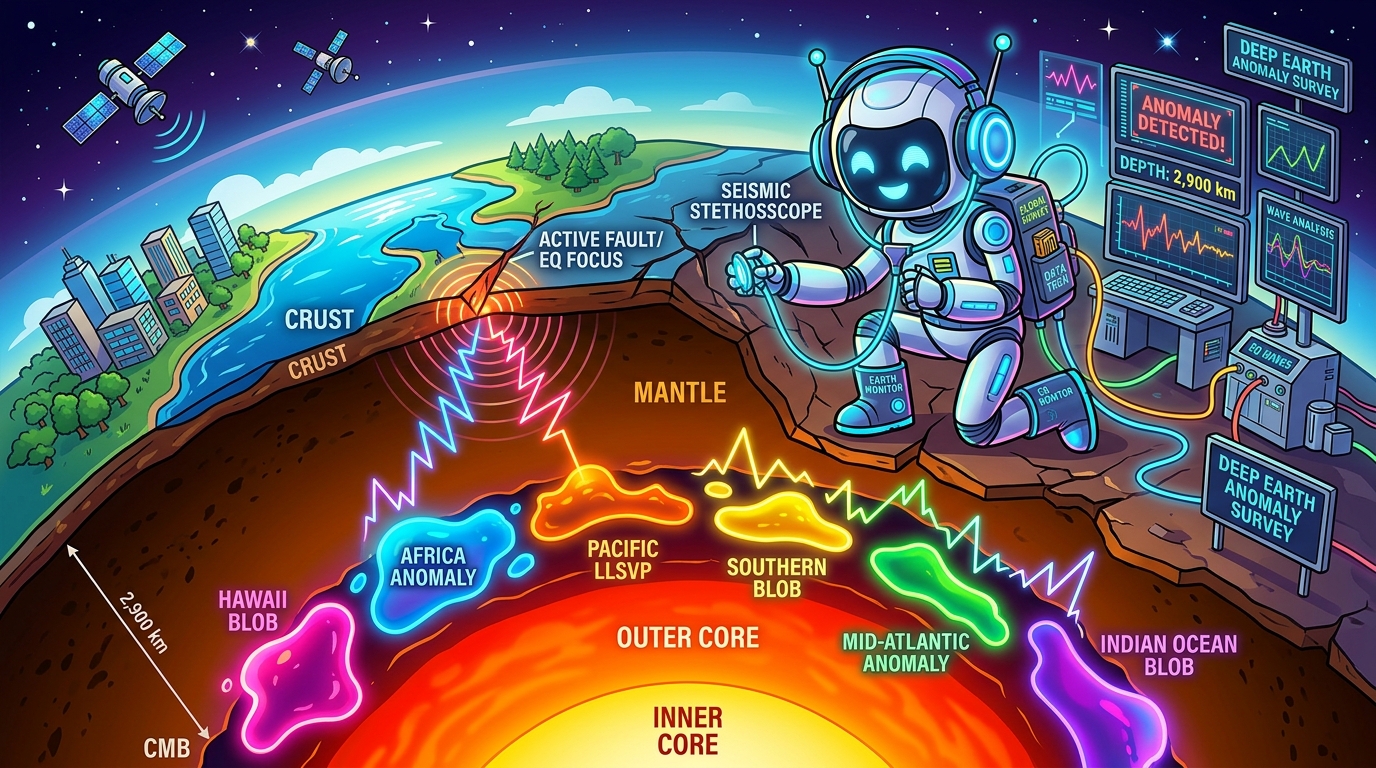
While science fiction writers love dreaming about hollow Earths and secret underground civilizations, real geophysicists just pulled off something even weirder. By training a deep-learning neural network to act as a planetary stethoscope listening to over two million earthquake recordings, researchers just uncovered six continent-sized mystery structures lurking 2,900 kilometers beneath our feet.
The study, published in the Journal of Geophysical Research: Solid Earth, targeted one of the most enigmatic frontiers in planetary science: the Core-Mantle Boundary (CMB). This is where Earth's solid silicate rock mantle crashes directly into a churning, blistering ocean of liquid iron outer core. It is a zone with temperature drops steeper than the surface of the Sun, yet because it sits thousands of kilometers beneath rock, we cannot send a probe down there.
📡 Listening for the "Whispers" of the Core
To peer through thousands of miles of solid rock, geophysicists rely on seismic echoes known as PKP precursors. When massive earthquakes strike, sound waves dive through the mantle, pierce the outer core, and bounce back. But tiny anomalies along the boundary scatter faint precursor echoes that arrive seconds before the main wave:
- Two Million Waveforms: The team fed seismograms recorded globally from 1990 to 2024 into a convolutional deep-learning model.
- 174,929 Precursor Signals: The AI detected nearly 175,000 pristine PKP precursor echoes—shattering the entire catalog of signals collected over the last century by more than an order of magnitude.
- Six Continent-Scale Belts (B1–B6): The echoes clustered into six gigantic, continuous scattering zones wrapping beneath North America, Eurasia, the South Atlantic, Africa, the Pacific, and Antarctica.
Before this AI breakthrough, seismologists had only caught fleeting glimpses of these deep subterranean anomalies, sparking decades of fierce debate over whether they were isolated volcanic plumes or mere sensor noise.
Now, the high-resolution AI map reveals they are organized into continuous, continent-spanning ribbons. What are they made of? The leading hypotheses suggest they could be the ancient graveyards of subducted oceanic tectonic plates that sank billions of years ago, or dense chemical slag heaps left behind when the young Earth's primordial magma ocean first crystallized.
🌋 Earth's Deep-Seated Heating Elements
These six mystery zones aren't just passive underground scenery; they act like colossal thermal blankets dictating how core heat escapes into the mantle. In turn, they regulate the giant mantle convection currents that push continents around, build mountain ranges, and fuel supervolcanoes.
So the next time you feel completely grounded on solid terra firma, remember: you are walking on a rocky crust floating above six continent-sized geological titans whispering secrets to Earth's molten iron heart!
You might also like
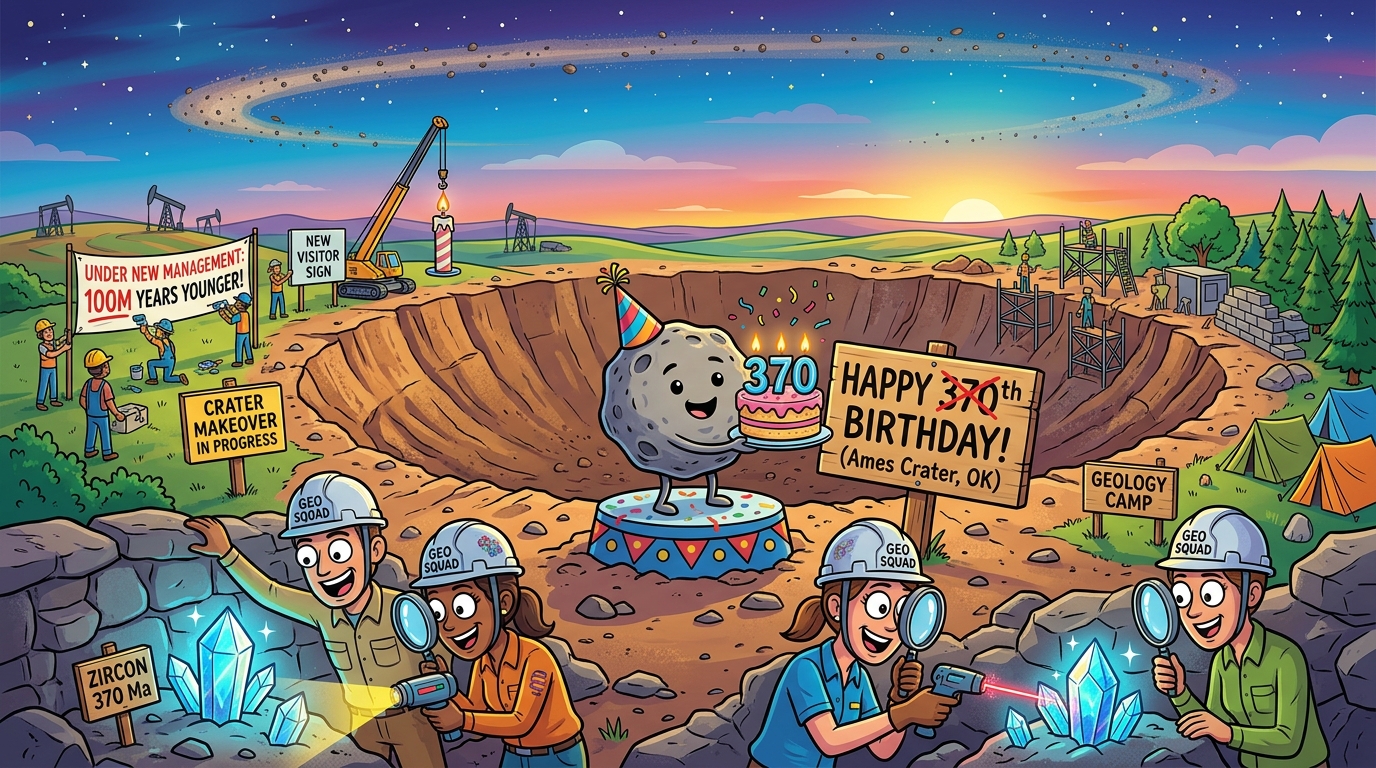
Oklahoma's Ames Meteor Crater Knocked 100 Million Years Off Its Age After Getting Caught With Recycled Fossils
High-precision uranium-lead zircon dating reveals Oklahoma's Ames impact crater was formed 370 million years ago—nearly 100 million years later than believed—kicking it out of Earth's hypothetical Saturn-ring club.
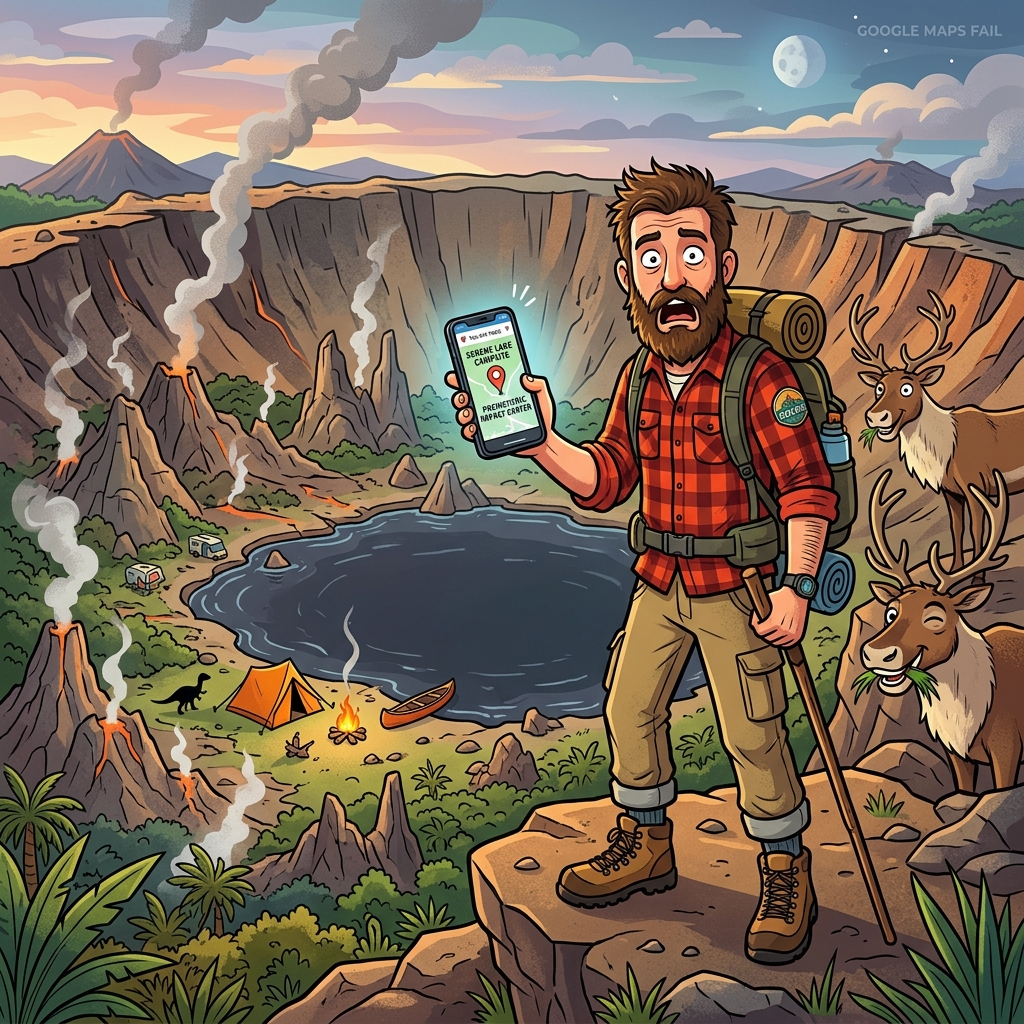
When You Try to Pick a Peaceful Campsite on Google Maps and Stumble into a 390-Million-Year-Old Asteroid Impact
A Canadian camper scouting for quiet vacation spots on Google Maps accidentally discovered a massive 25-kilometer Devonian meteor crater in Quebec, proving that space rocks make great holiday destinations.

Earth Was an Extreme Localvore: Why Geologists Have No Idea Where Our Water Came From
ETH Zurich planetary scientists proved Earth was forged almost 100% from inner Solar System materials, with less than 2% coming from outer asteroids. That completely detonates the textbook theory that icy comets brought our oceans—leaving geologists scratching their heads.