Quantum Flash Mob: Distant Time Crystals Spontaneously Synchronize Across a Microchip

If you place a dozen mechanical metronomes on a wobbly wooden board and let them tick randomly, they will eventually synchronize into an eerie, uniform rhythm. Now imagine doing that without the wooden board, at absolute-zero temperatures, using exotic states of quantum matter separated by cosmic distances in the microscopic world.
In a mesmerizing study published in Nature Communications, quantum physicists led by Prof. Alex Greilich at TU Dortmund University demonstrated that multiple continuous time crystals residing inside a semiconductor crystal can spontaneously synchronize their ticking beats. Even when separated by up to 40 micrometers—a yawning abyss in the quantum realm that is more than a thousand times the physical size of each individual oscillator—the crystals effortlessly fall into step like an impeccably rehearsed dance troupe.
⏳ What On Earth Is a Time Crystal Anyway?
Normal crystals repeat their atomic structure across space; time crystals repeat their physical state across time forever without consuming energy:
- Defying Thermal Equilibrium: First proposed by Nobel laureate Frank Wilczek in 2012, a time crystal is a quantum system whose ground state oscillates periodically in time, breaking temporal translation symmetry.
- Perpetual Quantum Ticking: Unlike a battery-powered kitchen clock that runs down when unplugged, a continuous time crystal ticks eternally in its lowest energy state without emitting or dissipating waste heat.
- The Dortmund Semiconductor: The German team engineered continuous time crystals within an indium gallium arsenide (InGaAs) semiconductor, locking together millions of electron and nuclear spins into perpetual, rhythmic quantum wobbles.
Due to subtle microscopic imperfections and localized magnetic environments across any microchip, you would expect separate time crystals formed at different spots on the chip to oscillate at slightly different frequencies. One should tick like a frantic jazz drummer, while another hums like a lazy pendulum.
Instead, when the German team probed two separate time-crystal regions illuminated by distinct laser spots, something magical happened. As the crystals interacted, their conflicting frequencies pulled toward each other, snapped into lockstep, and merged into a single, unified harmonic frequency.
📡 The Secret Wireless Quantum Bridge
How did two clumps of quantum spins chat across 40 micrometers of empty semiconductor real estate? They sent microscopic messengers:
- Spin-Polarized Electron Couriers: When lasers hit the semiconductor, they create spin-polarized conduction electrons. These electrons don't sit still—they diffuse rapidly through the material like tiny quantum couriers.
- Nonlinear Coupling: As these spin couriers travel between the two distant crystal zones, they continuously exchange spin momentum with the host atomic nuclei, forging an invisible, nonlinear feedback loop.
- Spontaneous Entrainment: This dynamic spin highway forces both time crystals to compromise on their natural tempo, locking them into an unshakeable collective rhythm.
This isn't just a party trick for quantum physicists with ultra-fast pulsed lasers. Synchronized arrays of time crystals offer an unprecedented platform for building ultra-precise quantum clocks, error-resistant quantum simulators, and non-volatile spin memory devices. As it turns out, even the most bizarre quantum states of the universe can't resist joining a synchronized flash mob.
You might also like
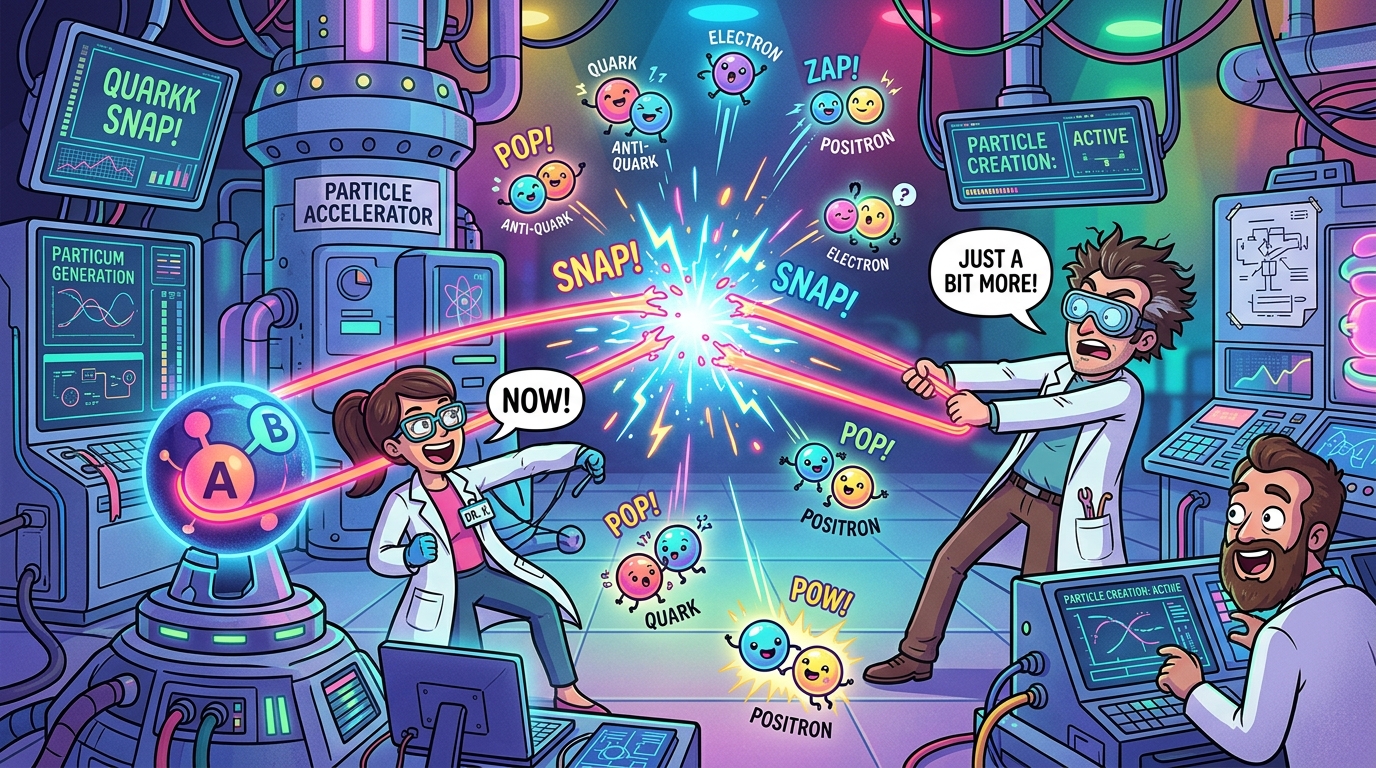
Snapping the Cosmic Rubber Band: Duke Physicists Use 13 Ions to Make Matter Pop Out of Nothing
Physicists at the Duke Quantum Center built a 13-trapped-ion quantum computer to simulate string-breaking dynamics. When you stretch the quantum bond between subatomic particles, the tension snaps—forcing the vacuum to spontaneously materialize brand-new particle pairs out of thin air.

Fishing for Cosmic Ghosts at the South Pole: How a Giant Ice Cube Won the 2026 Nobel Prize in Physics
The 2026 Nobel Prize in Physics goes solely to Francis Halzen for melting 86 giant holes into two miles of Antarctic ice, turning the frozen continent into the world's weirdest telescope to catch elusive cosmic neutrinos.

The Moon's Far Side Preserved 1,000°C Magnetic Hard Drives in Natural Glass Beads
Scientists analyzing Chang'e-6 lunar soil discovered rare high-temperature gamma-iron trapped inside impact glass beads, creating microscopic magnetic fossils that remember the Moon's ancient dynamo.