Snapping the Cosmic Rubber Band: Duke Physicists Use 13 Ions to Make Matter Pop Out of Nothing
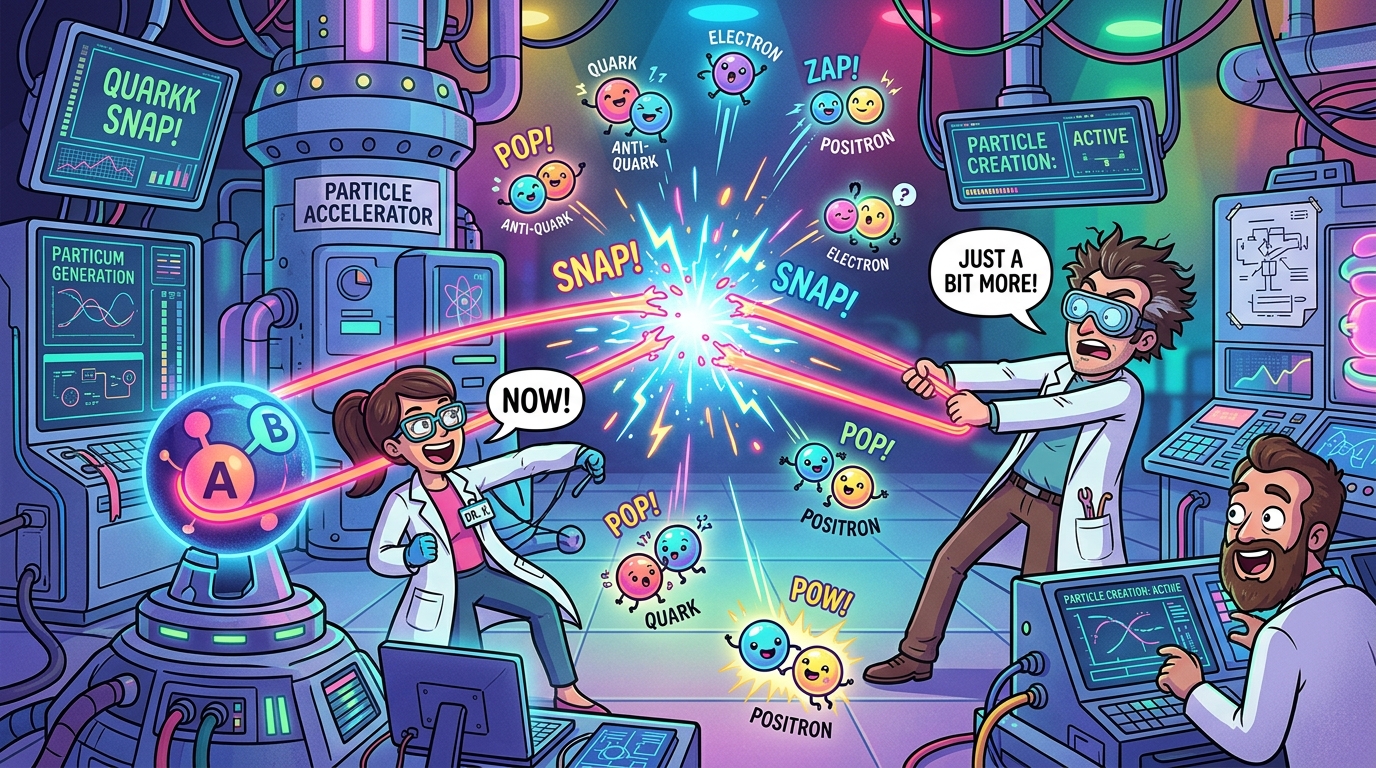
If you pull a rubber band too hard, it snaps in half and stings your finger. But if you pull two quarks apart, the universe undergoes a complete existential meltdown. It refuses to let a quark exist alone so aggressively that it literally rips brand-new matter into physical existence just to make sure nobody stays single.
In a landmark paper published in Nature Physics, researchers at the Duke Quantum Center (DQC) led by pioneer Christopher Monroe successfully observed this mind-bending phenomenon in real-time. By orchestrating a high-precision chain of 13 trapped ytterbium ions laser-cooled in a vacuum chamber, the team simulated string-breaking dynamics—the foundational process that created the building blocks of atomic matter fractions of a second after the Big Bang.
⚛️ The Quantum Tug-of-War: How String-Breaking Works
In everyday physics, pulling things apart makes their gravitational or electromagnetic attraction weaker. Inside an atomic nucleus, strong force physics does the exact opposite:
- The Gluon Flux Tube: Quarks are held together by a tight bundle of gluon field lines—essentially an unbreakable subatomic rubber band with constant tension, roughly equivalent to hanging a 14-ton truck from a pinhead.
- The $E=mc^2$ Snap: As you drag quarks apart, potential energy skyrockets linearly. Eventually, it becomes energetically cheaper for the universe to convert that raw tension into mass ($m = E/c^2$) than to let the rubber band stretch any further.
- Instant Duplication: The string snaps! But instead of two free quarks, a new quark-antiquark pair spontaneously pops out of the vacuum, capping each broken end. You wanted one solitary quark? Tough luck, now you have two pairs.
For decades, observing this microscopic drama directly was deemed impossible because real quarks snap apart in less than $10^{-23}$ seconds inside violently chaotic particle colliders like CERN’s Large Hadron Collider. Enter Duke’s 13-ion quantum simulator. By programming individual trapped ions with ultra-stable UV laser beams, the physicists mapped the 1D Schwinger model (quantum electrodynamics in one dimension) onto the quantum spins of the ions.
What they witnessed overturned standard textbook intuition. Rather than snapping randomly or uniformly across the center of the string, the quantum simulator revealed an unexpected "edge-driven" breaking mechanism. The cosmic tension shattered at the boundaries first, causing particle-antiparticle pairs to cascade inwards like a zipper uncoupling from both sides.
🔮 Why 13 Atoms Beat a Multi-Billion-Dollar Supercomputer
Why did physicists build a custom trapped-ion rig instead of running the calculations on the world's most powerful supercomputers?
- The Sign Problem Nightmare: Classical computers crash into a mathematical brick wall called the "quantum sign problem" when calculating real-time dynamic evolution of gauge fields.
- Nature Simulating Nature: Richard Feynman famously predicted that the only way to model quantum field theories is with actual quantum hardware. Thirteen entangled ions did in seconds what exascale supercomputers couldn't calculate in weeks.
- Early Universe Laboratory: By tweaking laser parameters, physicists can now dial back the clock to the primordial quark-gluon soup that filled the cosmos just microseconds after creation.
The success of Duke’s experiment proves that quantum simulators aren't just theoretical toys or cryptographic machines—they are full-fledged desktop particle colliders capable of probing the deepest mysteries of space, time, and mass.
So the next time life stretches your patience to the absolute breaking point, just remember: at the subatomic level, whenever things get too tense to handle, the universe doesn't give up—it just manifests brand new reality out of thin air.
You might also like

Quantum Flash Mob: Distant Time Crystals Spontaneously Synchronize Across a Microchip
Physicists at TU Dortmund University watched separate quantum time crystals lock into the exact same ticking tempo across 40 micrometers—over 1,000 times their own size. Bridged by diffusing electron spins, this spontaneous quantum choreography breaks new ground for future quantum processors.
Nuclear Reactors Glow with 'Ghost Particles' Even When Shut Off: Physics Detects Antineutrino Afterglow
In a breakthrough published in Physical Review Letters, the Double Chooz experiment detects a faint stream of antineutrinos leaking from offline nuclear reactors and spent fuel pools, creating the ultimate non-proliferation spy tool.

Fishing for Cosmic Ghosts at the South Pole: How a Giant Ice Cube Won the 2026 Nobel Prize in Physics
The 2026 Nobel Prize in Physics goes solely to Francis Halzen for melting 86 giant holes into two miles of Antarctic ice, turning the frozen continent into the world's weirdest telescope to catch elusive cosmic neutrinos.