Don't Iron That Graphene! Scientists Turn Atomic Wrinkles into Tiny Batteries
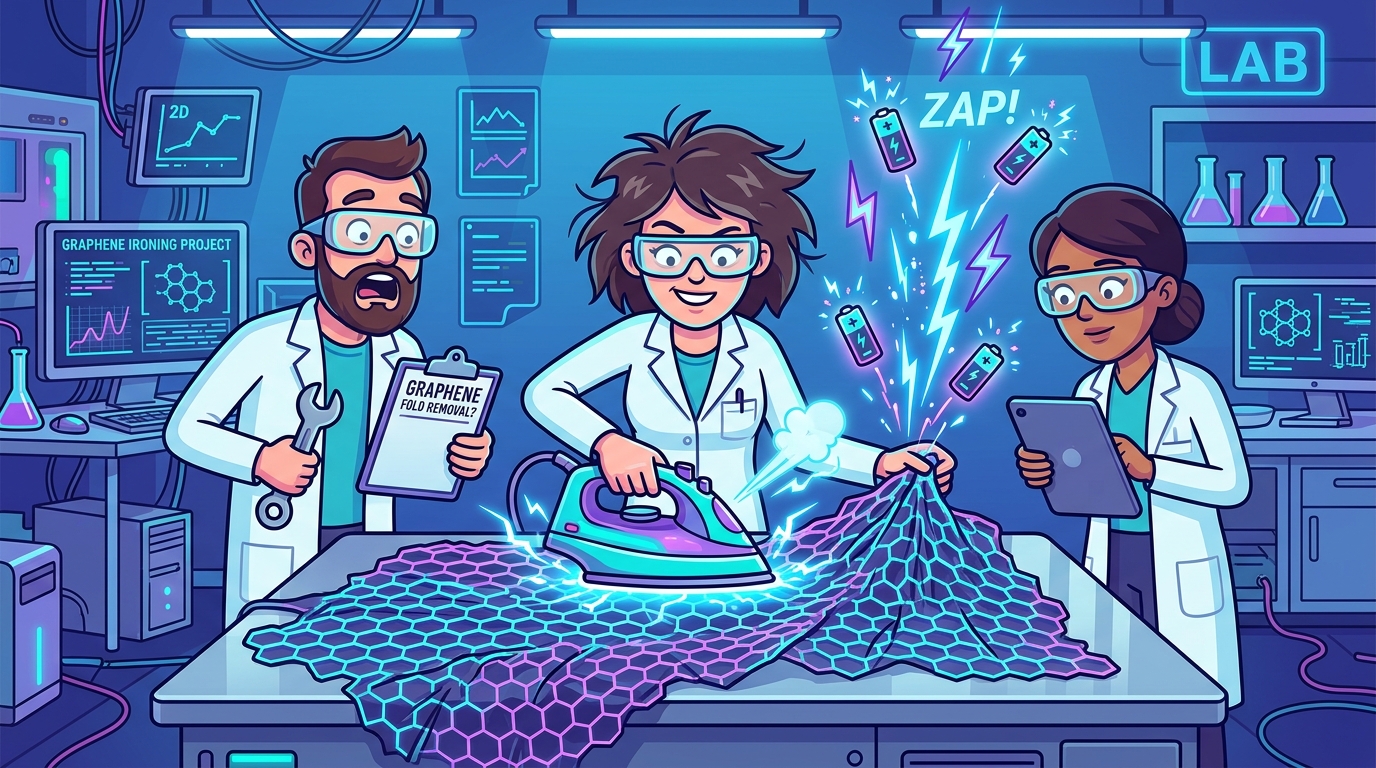
If you hate ironing your shirts in the morning, materials science has finally validated your lifestyle: crumpling things turns out to be an incredible source of free electrical energy.
For the past two decades, nanotechnologists obsessively tried to make graphene—a single-atom-thick sheet of carbon atoms arranged in a honeycomb lattice—as flat and defect-free as possible. Every tiny wrinkle or crease was viewed as an embarrassing manufacturing flaw that needed to be smoothed out.
A team of physicists at Rice University, led by materials scientist Pulickel Ajayan, just proved everyone had it completely backwards. In a study published in Advanced Materials, the researchers discovered that atomic-scale wrinkles in graphene spontaneously generate powerful electric fields through a phenomenon known as flexoelectricity.
⚡ How a Wrinkle Becomes a Battery
When you sharply fold a two-dimensional sheet of carbon atoms over a curved substrate (like molybdenum disulfide), the intense curvature shifts the electron cloud toward one side of the bend. This atomic-scale distortion creates a permanent charge separation—positive on one side, negative on the other—behaving exactly like the positive and negative terminals of a microscopic AA battery.
Until now, modifying the electrical properties of semiconductors required "chemical doping"—sprinkling foreign, expensive atoms into the crystal lattice, which often degrades the material's strength. Flexoelectric wrinkles mean engineers can now tune microchips simply by origami-folding the material into specific shapes.
🔋 The Future of Self-Powered Nanodevices
- Strain-Gated Transistors: Microprocessors that turn on and off based on physical bending rather than external voltage gates.
- Zero-Power Wearable Sensors: Medical patches that harvest energy directly from your skin's microscopic vibrations and body motion.
- Autonomous Nanobots: Micro-robots powered indefinitely by the natural folds of their own flexible carbon skins.
So the next time someone criticizes your unironed laundry, inform them with academic poise that you are merely optimizing the flexoelectric polarization of your wardrobe.
You might also like

Quantum Flash Mob: Distant Time Crystals Spontaneously Synchronize Across a Microchip
Physicists at TU Dortmund University watched separate quantum time crystals lock into the exact same ticking tempo across 40 micrometers—over 1,000 times their own size. Bridged by diffusing electron spins, this spontaneous quantum choreography breaks new ground for future quantum processors.
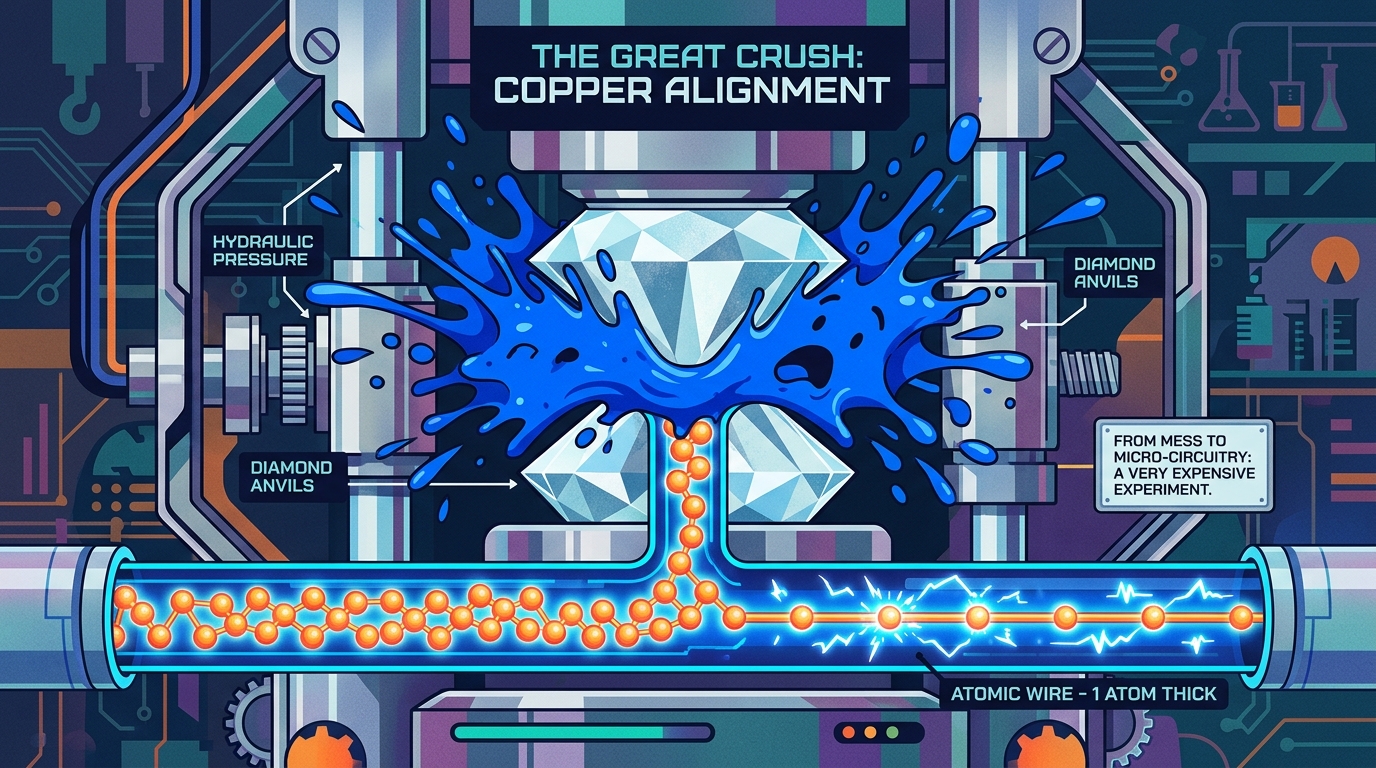
The 4,000-Atom Conga Line: How Crushing Blue Paint at 21 GPa Made the World's Longest Atomic Wire
Materials scientists squeezed everyday blue paint pigment inside diamond anvils with 210,000 atmospheres of pressure, forcing copper atoms into an unprecedented 4,000-atom-long, single-atom electrical wire!

Scientists Built Microscopic Laser-Steered UFOs That Abduct Living Bacteria
German physicists created sub-micron nanorobots 50 times thinner than human hair that use polarized light beams to hunt, capture, and transport living bacteria like miniature alien tractor beams.