The Cosmic Speed Brake: Why Solar Sails Hit a Relativistic Laser Wall at 75% Speed of Light
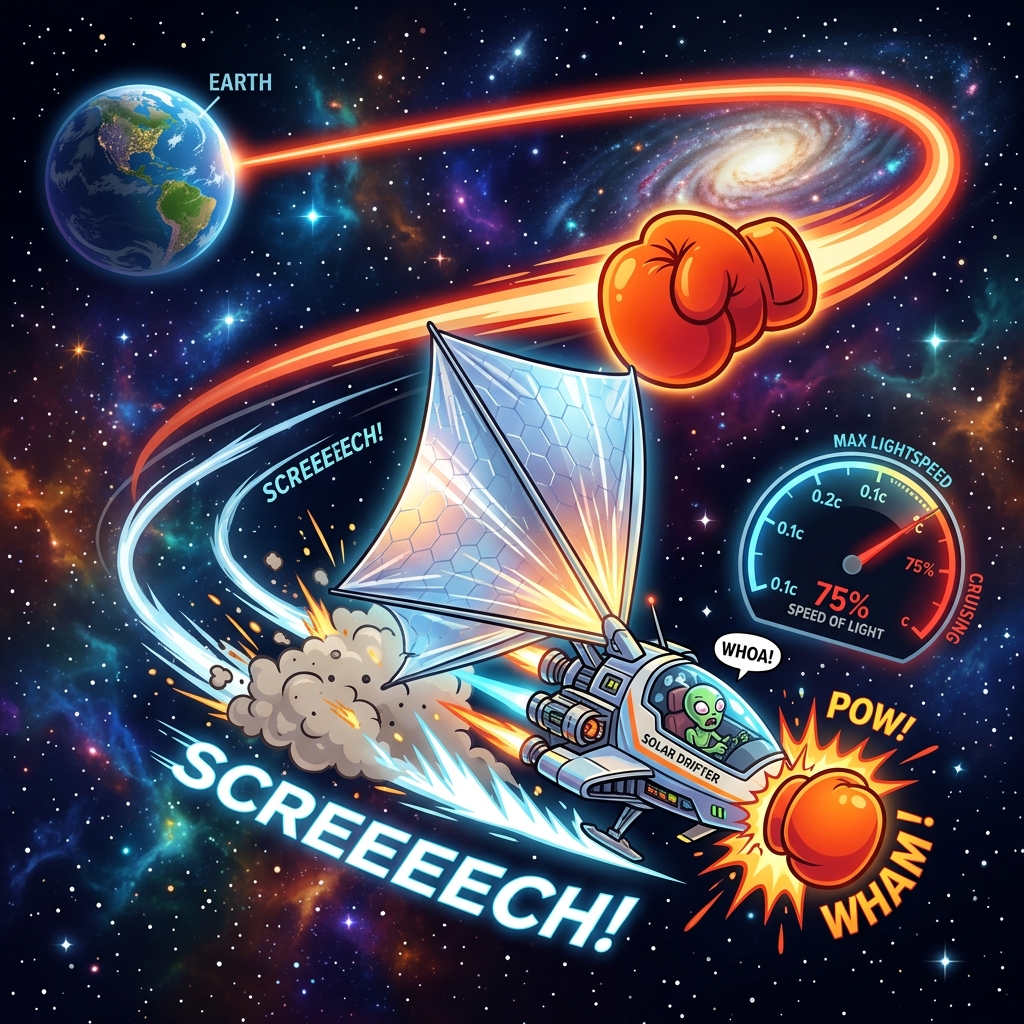
Sci-fi has always promised that if you build a giant laser and point it at an ultra-reflective gossamer sail, you can zip across the galaxy at the speed of light. But Einstein’s universe just filed a copyright strike on our interstellar road trip dreams: push your lightsail past 75% the speed of light, and your own thruster laser turns into a giant cosmic brake pad.
In a breakthrough physics study, researchers Chao Shen and Jiaze Li from the Harbin Institute of Technology calculated the extreme relativistic dynamics of laser-propelled lightsails. What they uncovered is a hilarious, counter-intuitive catch-22 woven straight into the fabric of special relativity.
🛑 When Push Becomes Pull
Normally, light striking a sail pushes it forward through three mechanisms: raw momentum from incident photons, mirror-like specular reflection, and diffuse scattering. But when the sail screams past 0.75c (75% the speed of light), relativistic optical aberration tilts diffusely scattered light rays forward in the sail's frame of reference—meaning re-emitted photons act as an aerodynamic drag force pushing backward!
Why does reaching for Alpha Centauri suddenly feel like driving with the parking brake on?
- The Relativistic Headwind: As the sail approaches light speed, incoming laser photons get Doppler-shifted into ultra-low-energy wavelengths, drastically weakening the forward push while aberration maximizes the backward drag from scattered light.
- Diminishing Returns on Firepower: Cranking up laser wattage from Earth won’t simply blast through the barrier. Past 75% of light speed, an increasing fraction of that gargantuan energy bill is spent fighting your own scattered photons.
- The 0.75c Speed Limit: While net acceleration doesn't drop strictly to zero, the propulsion efficiency plummets so violently that 75% of light speed becomes a practical "soft ceiling" for laser-sail transit.
💡 Can We Outsmart Einstein?
Don't cancel your trip to Proxima Centauri just yet. Physicists suggest future lightsails could be crafted from metamaterials and photonic crystal lattices engineered to suppress diffuse scattering and exploit aberration angles to auto-center the craft inside the beam.
Until then, it’s comforting to know that the universe has built-in cosmic speed traps. Even in deep vacuum with no air resistance, physics will literally bend your own headlights backward to make sure you don't speed!
You might also like
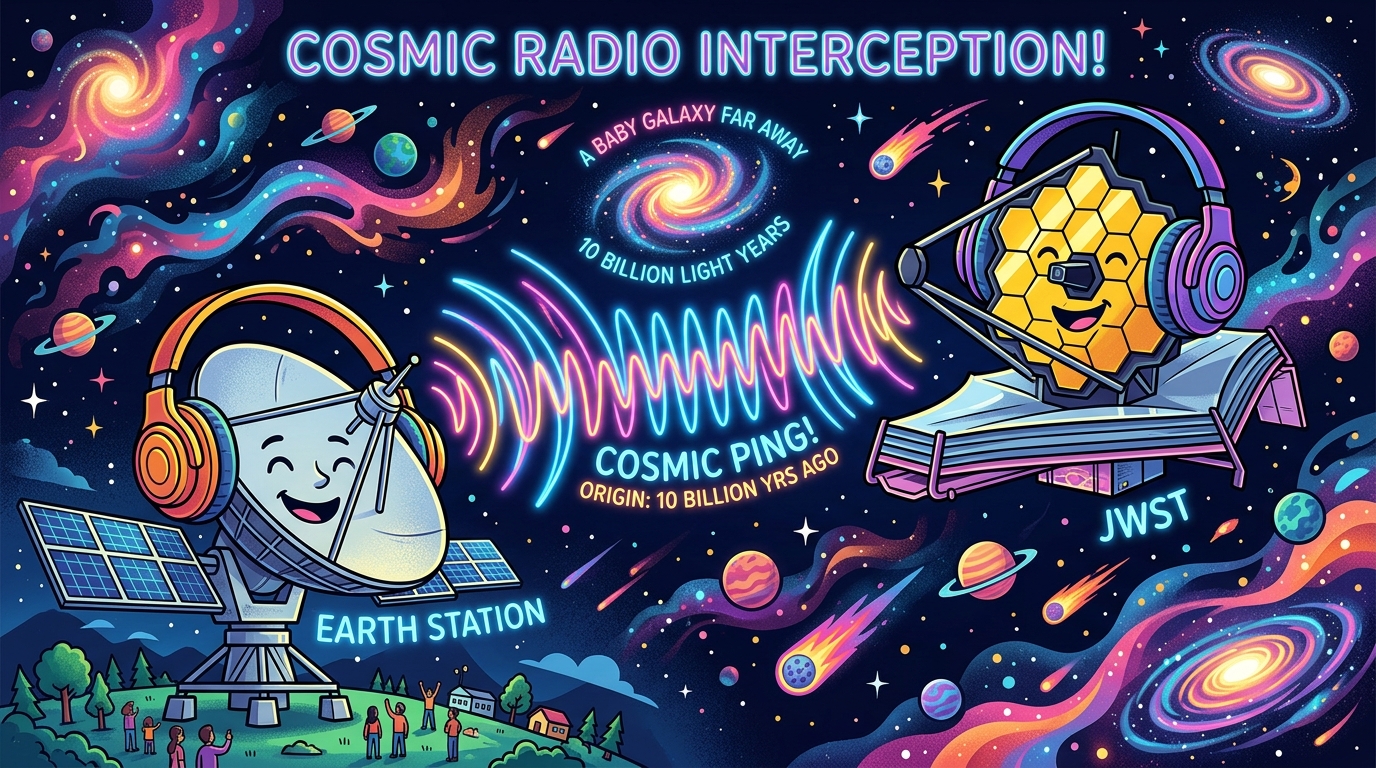
The 10-Billion-Year-Old Voicemail: Webb and MeerKAT Catch the Most Distant Radio Flash in Cosmic History
Astronomers have detected FRB 20240304B, a fast radio burst that traveled over 10 billion years across the universe, shattering cosmic distance records and proving ancient baby galaxies loved loud fireworks.
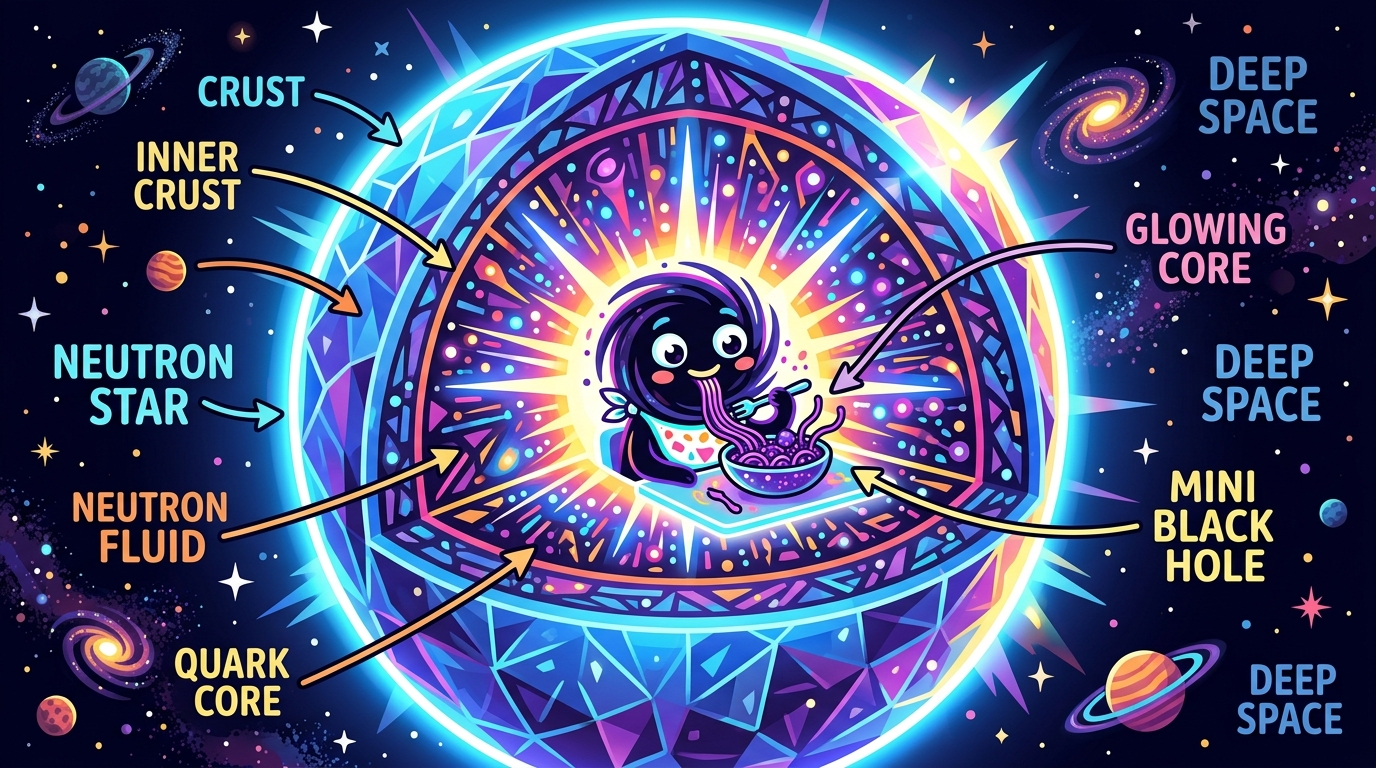
Cosmic Tapeworms: How 40-Ton Mini Black Holes Nest Inside Dead Stars and Gorge on Dark Matter
Theoretical physicists uncovered a bizarre astrophysical phenomenon: tiny 40-ton black holes could form inside dense neutron stars, surviving Hawking radiation by continuously devouring captured dark matter like celestial parasites!

Earth Put on Headphones: Physicists Turn the Entire Planet into a Dark Matter Radio
Why build a billion-dollar underground particle detector when Mother Earth already gave us an 8,000-mile magnetic resonant cavity? Japanese physicists just used Earth's ionosphere to hunt for ghost-like ultralight axions and dark photons.