JWST Catches 'Black Hole Star': A Cosmic Monster Wearing a Giant Puffer Jacket

What do you get when a supermassive black hole gets chilly in the early universe? It wraps itself in a hydrogen puffer jacket the size of our entire solar system and pretends to be the brightest star in cosmic history.
In a breakthrough published in Nature, astrophysicists analyzing deep-field infrared data from the James Webb Space Telescope (JWST) have officially cataloged a brand-new class of celestial oddity: the "Black Hole Star" (cataloged as MoM-BH*-1). Located roughly 660 million years after the Big Bang, this cosmic titan emits over 100 billion times more energy than any regular star known to modern physics.
🔭 The Secret Under the Hydrogen Trench Coat
Standard stars shine via peaceful nuclear fusion inside their cores. MoM-BH*-1 does nothing of the sort. At its center lurks a voracious 100,000-solar-mass black hole gorging on surrounding matter. The sheer gravitational energy heats up a colossal outer cocoon of dense gas, creating the illusion of a single colossal star from trillions of light-years away.
For years, astronomers were baffled by what they termed "little red dots" in Webb's deep surveys—cosmic objects that looked too small to be galaxies yet far too luminous to be stars. Spectroscopic analyses revealed an exceptionally deep Balmer break, confirming that these objects aren't powered by trillions of faint stars, but rather a single monstrous engine trapped inside a gas cocoon.
💡 Solving Cosmology's Greatest Weight-Gain Mystery
Cosmologists have long scratched their heads over how billion-solar-mass black holes appeared so quickly after the dawn of time without violating the Eddington limit. MoM-BH*-1 serves as the crucial missing link: super-Eddington "quasistars" that grew at breakneck speeds while camouflaged in plain sight.
So if you ever feel like you're not shining bright enough at work, just remember: you don't need nuclear fusion—you just need a giant coat and a completely insatiable appetite for cosmic matter.
You might also like
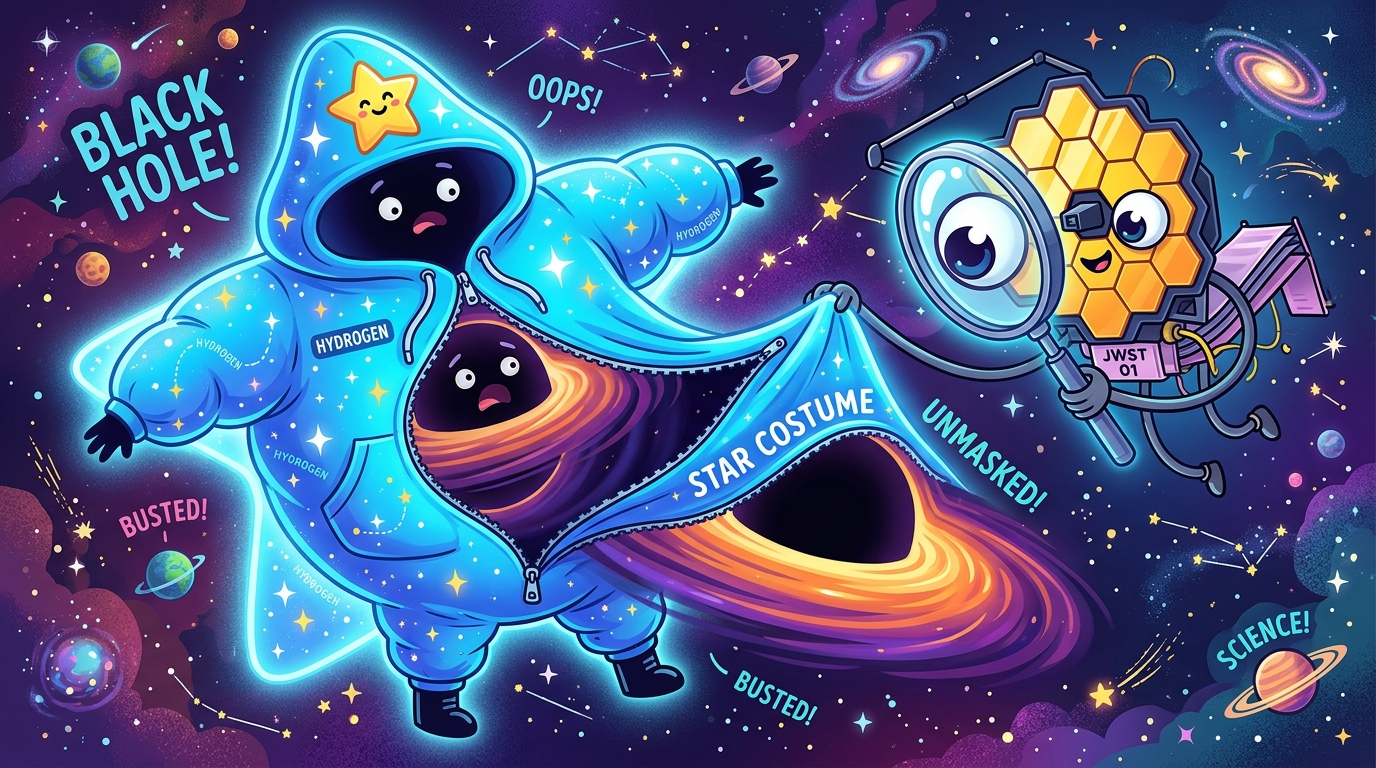
Cosmic Imposter: JWST Unmasks a 100,000-Solar-Mass Black Hole Cosplaying in a Giant Hydrogen Onesie
Astronomers using the James Webb Space Telescope spotted MoM-BH*-1, an early universe monster: a 100,000-solar-mass black hole cloaked in a puffy hydrogen envelope that mimics a supergiant star and outshines our sun by 100 billion times!
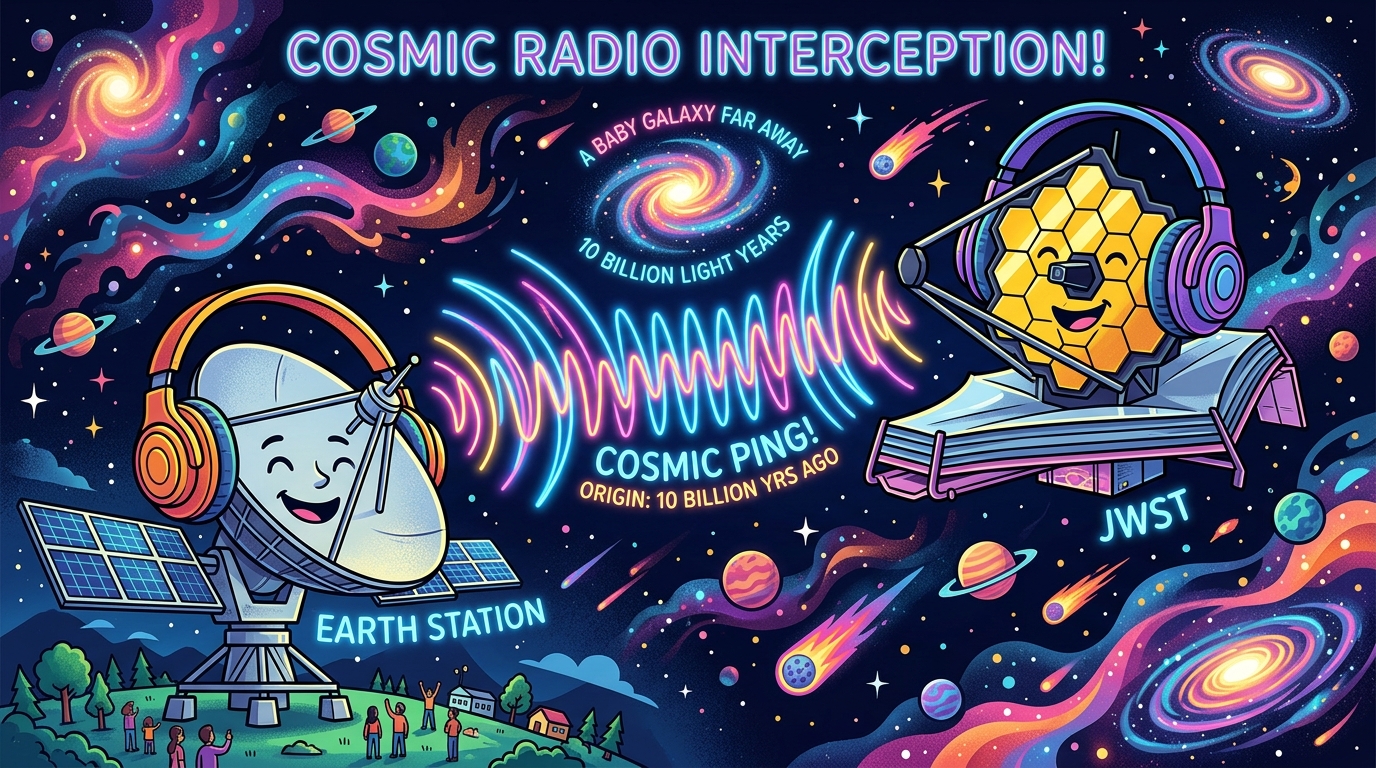
The 10-Billion-Year-Old Voicemail: Webb and MeerKAT Catch the Most Distant Radio Flash in Cosmic History
Astronomers have detected FRB 20240304B, a fast radio burst that traveled over 10 billion years across the universe, shattering cosmic distance records and proving ancient baby galaxies loved loud fireworks.

Cosmic Monster Trucks: JWST Catches 21 Teenage Alien Solar Systems Smashing Planets into Vaporized Glass
The James Webb Space Telescope peeked inside 21 rare 'extreme debris disks' and caught teenage solar systems playing planetary dodgeball, vaporizing Mars-sized worlds into glowing clouds of silica glass.