Cosmic Eavesdropping: MeerKAT Radio Telescope Tunes into 5-Billion-Year-Old Hydrogen Whispers
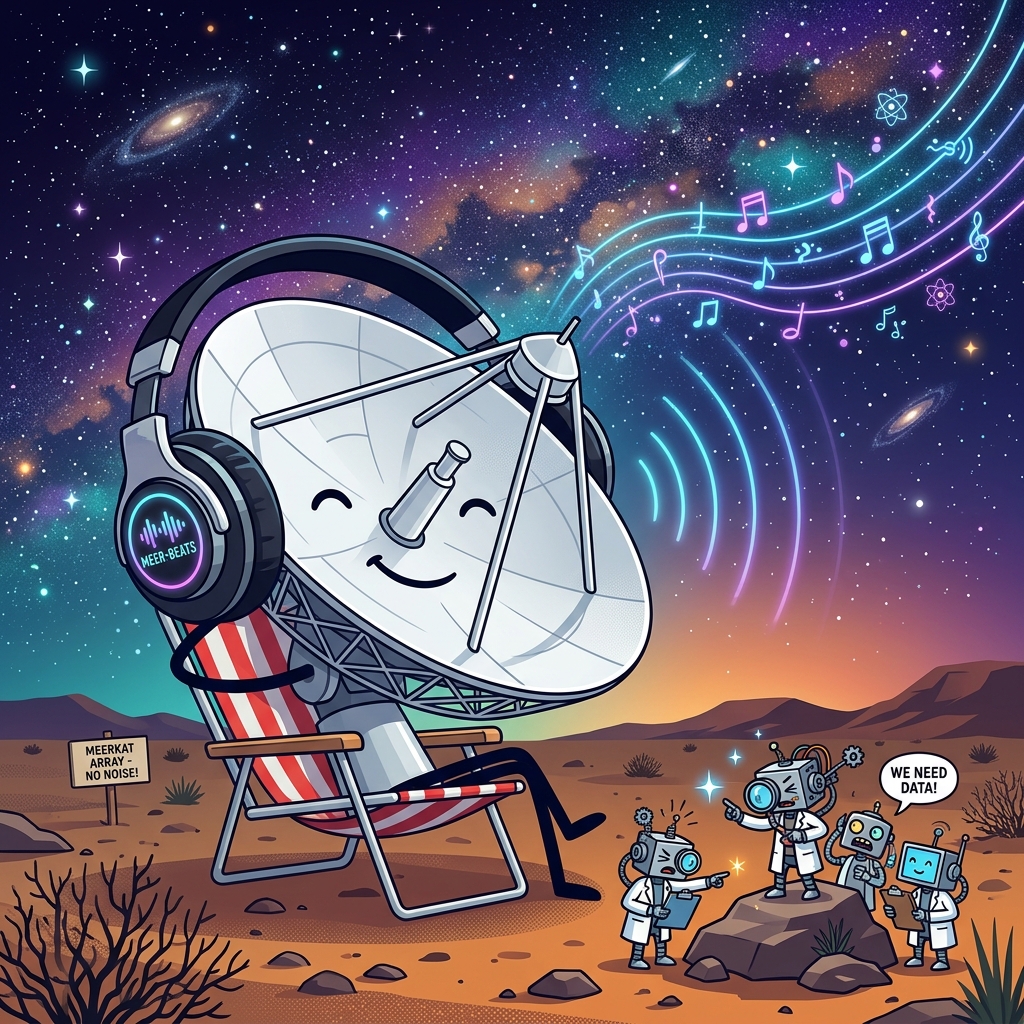
For centuries, astronomers have observed the universe like nervous party photographers—obsessively taking portrait headshots of every single galaxy in the room. But South Africa’s MeerKAT radio telescope just proved there is a much cooler way to survey the cosmos: put on giant headphones, lean back, and tune into the 5-billion-year-old chorus humming through the darkness.
In a breakthrough published in The Astrophysical Journal Letters, an international collaboration led by researchers from the University of Manchester and the University of the Western Cape pulled off a major cosmological milestone. Using 96 hours of archival observations from the MeerKAT array in the Karoo desert, the team achieved the first direct, standalone detection of neutral hydrogen (H I) from 4 to 5 billion years ago (redshifts $z = 0.32$ and $z = 0.44$) without needing a cheat sheet from optical galaxy surveys.
📻 What is Hydrogen Intensity Mapping?
Instead of spending months zooming in on faint, microscopic pinpricks of light to catalog galaxies one by one, Hydrogen Intensity Mapping treats galaxies like noisy stadium crowds. It measures the combined 21-centimeter radio glow of neutral hydrogen gas filling vast swathes of cosmic space, creating a coarse-grained 3D map of the universe's matter density at lightning speed.
Why is the astronomical community buzzing over this radio triumph?
- No Optical Crutches Allowed: Previous detections relied on "cross-correlation"—stacking radio data on top of known optical galaxy coordinates. MeerKAT did this completely solo, proving radio dishes can map the deep universe autonomously.
- Unlocking the Cosmic Web: Neutral hydrogen is the fundamental building block of stars and gas reservoirs. Mapping its collective distribution reveals the invisible gravitational scaffolding woven by dark matter and dark energy.
- The SKA Revolution Begins: MeerKAT is the 64-dish trailblazer for the upcoming SKA-Mid (Square Kilometre Array), which will expand into the most powerful radio observatory on Earth, peering back to the dawn of the first stars.
🎧 The Intergalactic Stadium Chant
Think of it this way: trying to map the cosmos by counting individual galaxies is like trying to understand the vibe of a football match by interviewing 80,000 spectators one by one. MeerKAT simply opened the stadium doors and listened to the roar of the crowd.
So next time someone tells you to focus on the fine details, remind them of MeerKAT. Sometimes, ignoring individual drama and tuning into the collective hum of the universe is the smartest way to see the big picture!
You might also like
The 10-Billion-Year-Old Voicemail: Webb and MeerKAT Catch the Most Distant Radio Flash in Cosmic History
Astronomers have detected FRB 20240304B, a fast radio burst that traveled over 10 billion years across the universe, shattering cosmic distance records and proving ancient baby galaxies loved loud fireworks.
CosmoCube: Why Scientists Are Sending a Suitcase to Hide Behind the Moon for 40 Minutes of Peace and Quiet
Cambridge astrophysicists revealed plans for CosmoCube—a suitcase-sized satellite designed to hide behind the lunar far side for 40 minutes every orbit. Its goal? Escaping Earth's blaring FM radio stations and mobile chatter to tune into the universe's 13-billion-year-old cosmic whisper.

Weighing the Big Bang's Soup: Telescopes Measure Universe's First 5 Minutes Helium to 0.5%
Astronomers pointed the twin-eyed Large Binocular Telescope at 15 pristine galactic fossils for 130 hours to measure the exact amount of helium forged in the first five minutes of the Big Bang with three times greater precision than ever before.