CosmoCube: Why Scientists Are Sending a Suitcase to Hide Behind the Moon for 40 Minutes of Peace and Quiet
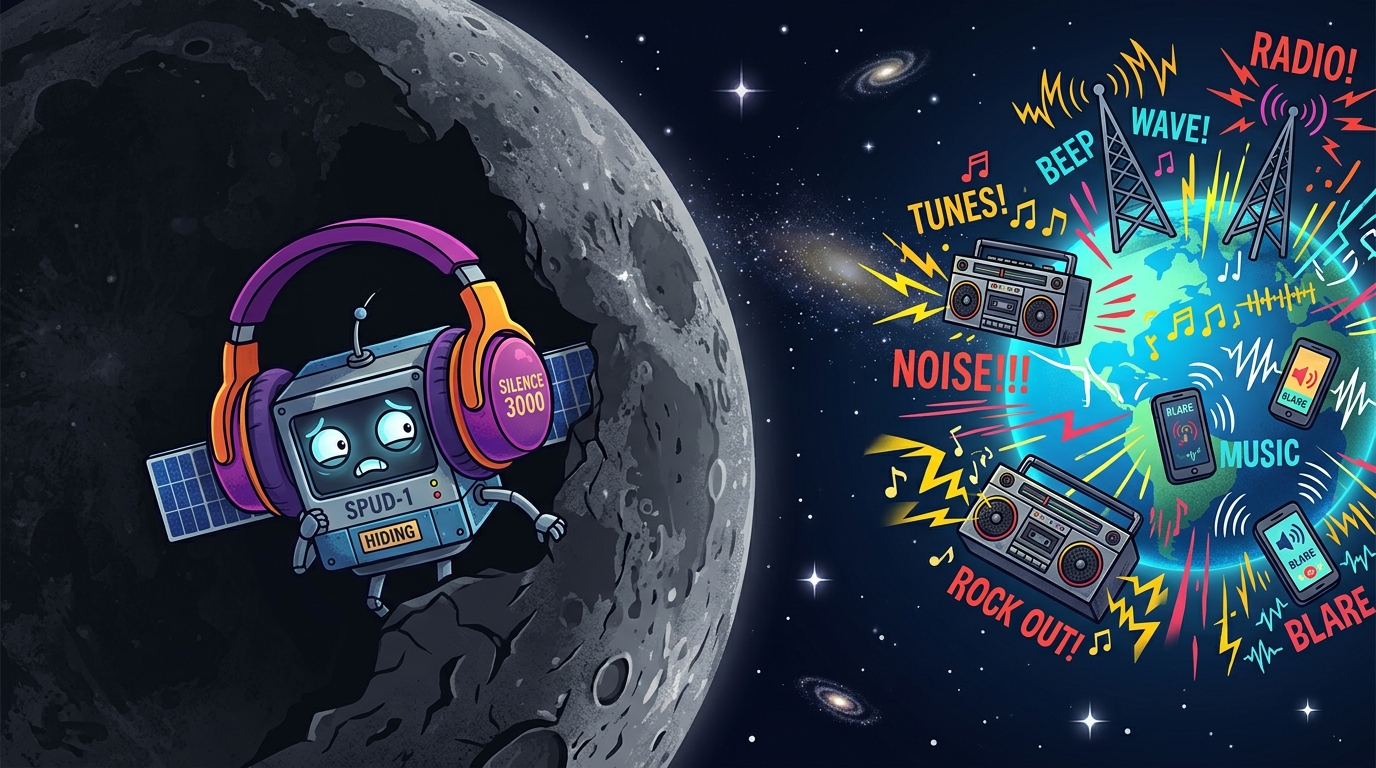
Anyone who has ever tried to meditate in an open-plan office while a coworker takes a speakerphone meeting knows the pain: true silence simply does not exist on Earth anymore. But if you think your noisy neighbors are annoying, imagine trying to eavesdrop on the birth of the first stars while 8 billion people blast pop radio, GPS signals, and Bluetooth podcasts straight into the upper atmosphere.
Astrophysicists from the University of Cambridge’s Cavendish Laboratory have officially had enough. In a proposal detailed in Nature Astronomy and supported by the UK Space Agency, researchers unveiled the roadmap for CosmoCube—a pint-sized, suitcase-scale lunar orbiter whose entire operational strategy can be summarized as: sprint behind the Moon and put on massive cosmic noise-cancelling headphones.
📻 The Ultimate Noise-Cancelling Mission: CosmoCube Fast Facts
Why go all the way to lunar orbit to build a glorified antenna? Because Earth simply won't stop talking:
- Suitcase Architecture: Packing high-precision radio spectrometers into a CubeSat form factor, CosmoCube weighs mere tens of kilograms yet carries a retractable dipole antenna designed to catch faint cosmic signals.
- The 40-Minute Sanctuary: In its two-hour lunar orbit, CosmoCube spends roughly 40 blissful minutes shadowed by 3,500 kilometers of solid Moon rock, completely shielded from terrestrial radio interference.
- The Cosmic Dark Ages: It hunts for the legendary 21-centimeter line—the ultra-faint radio glow emitted by primordial neutral hydrogen roughly 150 to 500 million years after the Big Bang, before stars ever ignited.
- Terrestrial Cacophony: Earth's ionosphere refracts low-frequency radio waves under 30 MHz, while terrestrial FM transmitters generate background noise up to 100,000 times brighter than the signals CosmoCube is hunting.
For decades, cosmologists have referred to the period between the Big Bang's afterglow and the birth of the first primordial stars as the Cosmic Dark Ages. It is arguably the most mysterious chapter in our universe’s biography. During this era, cold clouds of neutral hydrogen floated peacefully across the void, silently whispering a faint 21-centimeter radio signal stretched by cosmic expansion into long, low-frequency wavelengths.
The catch? If you try pointing a radio telescope at those frequencies from Earth, you won't hear the symphony of creation. You will hear local FM Top 40 stations, air traffic control towers, maritime radar beacons, and someone's smart refrigerator uploading firmware diagnostics. To make matters worse, Earth's upper ionosphere behaves like a funhouse mirror, bouncing, bending, and blocking low-frequency radio waves entirely.
🌑 Why the Lunar Far Side is the Galaxy’s Best Quiet Car
The Moon’s far side is the quietest patch of real estate in the inner Solar System:
- 70,000 Trillion Metric Tons of Baffle: With the entirety of the Moon sitting between the satellite and Earth, every radio tower, cell phone, and radar installation on our noisy blue marble is blocked.
- No Atmospheric Distortion: Free from Earth's turbulent atmosphere and ionized plasma sheets, radio waves arrive crisp and uncorrupted.
- The "Sprint and Record" Protocol: CosmoCube powers on its delicate detectors the moment it plunges into the Moon's shadow, records pure ancient cosmos data, and then rushes back into sunlight to beam compressed findings home.
The engineering challenges are non-trivial. Spacecraft orbiting the Moon endure brutal thermal cycles, swinging from baking sunlight to cryogenic darkness in minutes. Furthermore, miniaturizing an antenna and cryogenic-calibrated receivers into a shoebox satellite requires microscopic precision so the probe’s own onboard electronics don’t drown out the faint cosmic hum it traveled 384,000 kilometers to hear.
CosmoCube joins an international push towards lunar far-side radio astronomy, alongside missions like NASA's LuSEE-Night and India's PRATUSH experiment. As humanity covers Earth with even more mega-constellations and 6G towers, the Moon is swiftly becoming our species' last sanctuary for quiet contemplation.
So next time your podcast cuts out or you get trapped in an elevator listening to bad techno, take comfort in knowing that somewhere out there, Cambridge astrophysicists are packing a cosmic suitcase, preparing to send it behind the Moon just to get forty uninterrupted minutes of sweet, sweet celestial silence.
You might also like
The 10-Billion-Year-Old Voicemail: Webb and MeerKAT Catch the Most Distant Radio Flash in Cosmic History
Astronomers have detected FRB 20240304B, a fast radio burst that traveled over 10 billion years across the universe, shattering cosmic distance records and proving ancient baby galaxies loved loud fireworks.

Cosmic Monster Trucks: JWST Catches 21 Teenage Alien Solar Systems Smashing Planets into Vaporized Glass
The James Webb Space Telescope peeked inside 21 rare 'extreme debris disks' and caught teenage solar systems playing planetary dodgeball, vaporizing Mars-sized worlds into glowing clouds of silica glass.

The Zombie Star That Blew Up in 1181 AD Left Behind Cosmic Strings of Pearls
Astronomers turning the Gemini North telescope toward supernova remnant Pa 30 discovered that the infamous 'zombie star' from 1181 AD didn't just survive its own blast—its cosmic dandelion explosion is threaded with glowing pearls.