Saturn Got Bored With Its Hexagon, So Its South Pole Spun Up a 10-Sided Decagon
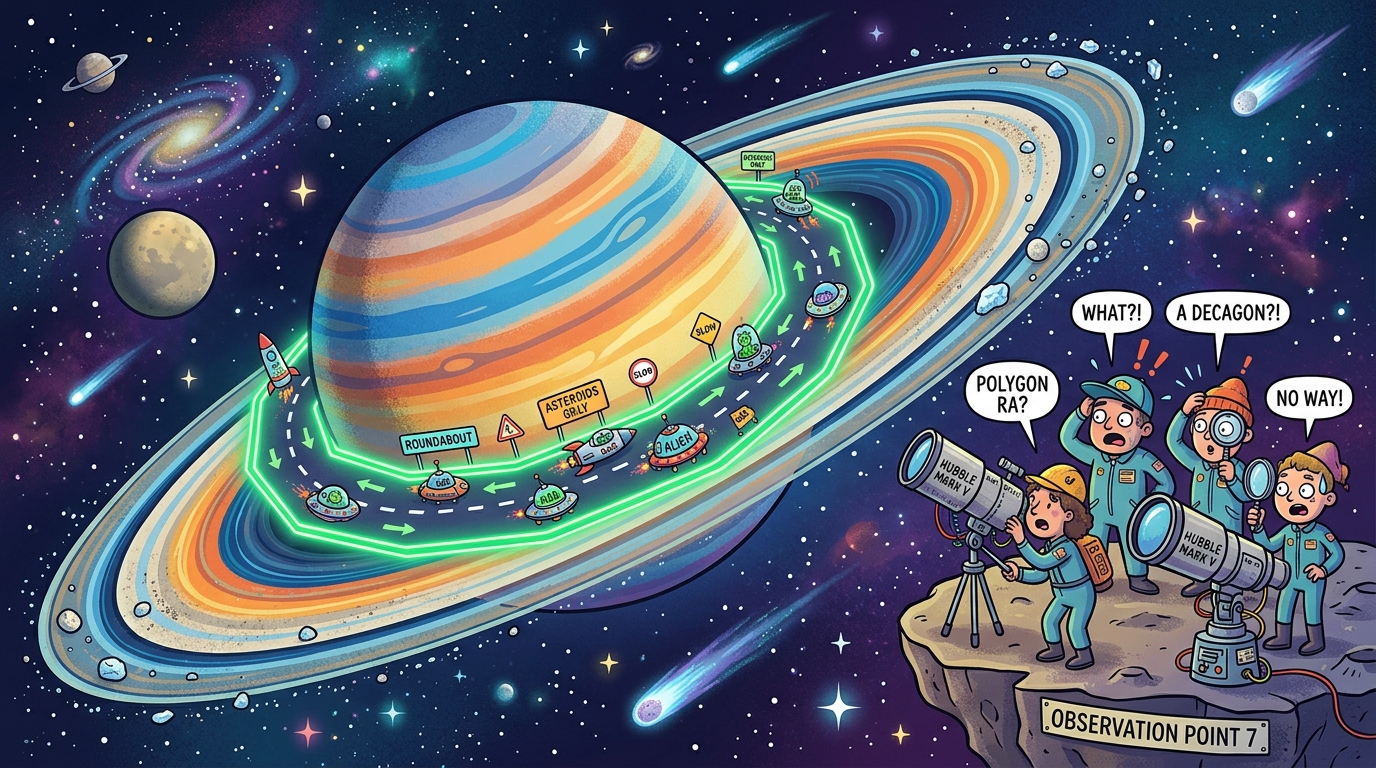
Just when humanity thought it had gas giant geometry figured out, Saturn decided that six sides was amateur hour. Behold the cosmic upgrade nobody ordered: a giant, 10-sided atmospheric decagon casually spinning around the planet's south pole.
For more than four decades, Saturn has been the undisputed hipster of the solar system thanks to the bizarre six-sided hexagon spinning endlessly at its north pole. Discovered by the Voyager probes in the 1980s and mapped in glorious detail by Cassini, the northern hexagon was treated as nature's one-of-a-kind geometric oddity. But while astronomers were obsessively gazing north, Saturn's southern hemisphere was quietly cooking up its own polygonal flex.
🪐 The 10-Sided Southern Roundabout
In a study published in Science Advances, an international team led by Professor Agustín Sánchez-Lavega of the University of the Basque Country, alongside researchers from NASA's Goddard Space Flight Center and UC Berkeley, revealed the unexpected structure:
- Hubble's OPAL Sleuthing: By analyzing long-term atmospheric imaging from Hubble's Outer Planet Atmospheres Legacy (OPAL) program dating back to 2023, scientists spotted faint geometric disturbances that gradually crystallized into an undeniable 10-sided wave.
- Absurd Planetary Scale: Each individual side of this atmospheric decagon stretches longer than the entire diameter of Earth—roughly 13,000 kilometers per edge.
- A Drifting Decagon: Unlike the northern hexagon, which sits nearly locked in place relative to Saturn's interior, this southern decagon is migrating eastward along a 70°S jet stream at a steady cruising speed of about 10 km/h (6 mph).
- Dynamic Evolution: Rather than a static, billion-year-old monument, Hubble caught this multi-tiered wave actively forming, strengthening, and evolving in real time.
How does a spinning ball of hydrogen and helium turn clouds into crisp polygons? The answer lies in the wild world of Rossby waves—the same large-scale atmospheric meanders that guide jet streams on Earth. But while Earth's meandering jet streams produce gently curving fronts and occasional rainy weekends, Saturn's hyper-fast planetary rotation and deep shear currents pinch the waves into rigid geometric shapes.
When fluid dynamics researchers simulate these jet streams in spinning lab tanks, harmonic resonances naturally produce triangles, hexagons, octagons, and decagons depending on fluid depth and wind shear. Saturn apparently decided it was tired of showing off only mode-6 harmonics and toggled its southern hemisphere straight to mode-10.
📐 Why This Baffles Planetary Scientists
The discovery upends decades of planetary meteorology assumptions:
- Hemispheric Asymmetry: Cassini observed the south pole between 2004 and 2017 and saw a swirling hurricane vortex, but no decagon. This proves Saturn's deep polar winds can spontaneously reorganize into new geometric modes over decade-long seasonal cycles.
- Amateur Spotters Credited: The paper specifically noted that sharp-eyed amateur astrophotographers were among the first to flag subtle kinks in the southern jet stream in 2024, prompting Hubble to investigate closer.
- The Ultimate Geometry Class: If Saturn keeps this up, its next seasonal equinox might roll out a dodecagon just to test our math vocabulary.
So if your day feels messy and unorganized, take comfort in knowing that somewhere nearly a billion miles away, Saturn is maintaining pristine ten-sided geometric symmetry across hundreds of thousands of miles of roaring ammonia clouds.
You might also like

Oklahoma's Ames Meteor Crater Knocked 100 Million Years Off Its Age After Getting Caught With Recycled Fossils
High-precision uranium-lead zircon dating reveals Oklahoma's Ames impact crater was formed 370 million years ago—nearly 100 million years later than believed—kicking it out of Earth's hypothetical Saturn-ring club.

Enceladus Is Running an Interstellar Smoothie Bar That Pre-Sorts Alien Life for NASA
Saturn's icy moon doesn't just spew water into space—it slowly freezes, crashes, and shatters ocean droplets into pre-concentrated ice grains so future probes won't have to dig through cosmic slush.

Meet Elias 2-24 b: The Cosmic Toddler Caught Devouring Dust in Its Protoplanetary Crib
Astronomers reanalyzed archival Keck and ALMA data to discover Elias 2-24 b, the youngest exoplanet ever spotted at under 1 million years old. Clocking in at Jupiter's mass, this celestial newborn is already terrorizing its solar nursery 450 light-years away.