The Great Worm Pub Crawl: Scientists Win Ig Nobel for Sorting Drunk Worms in an Obstacle Maze
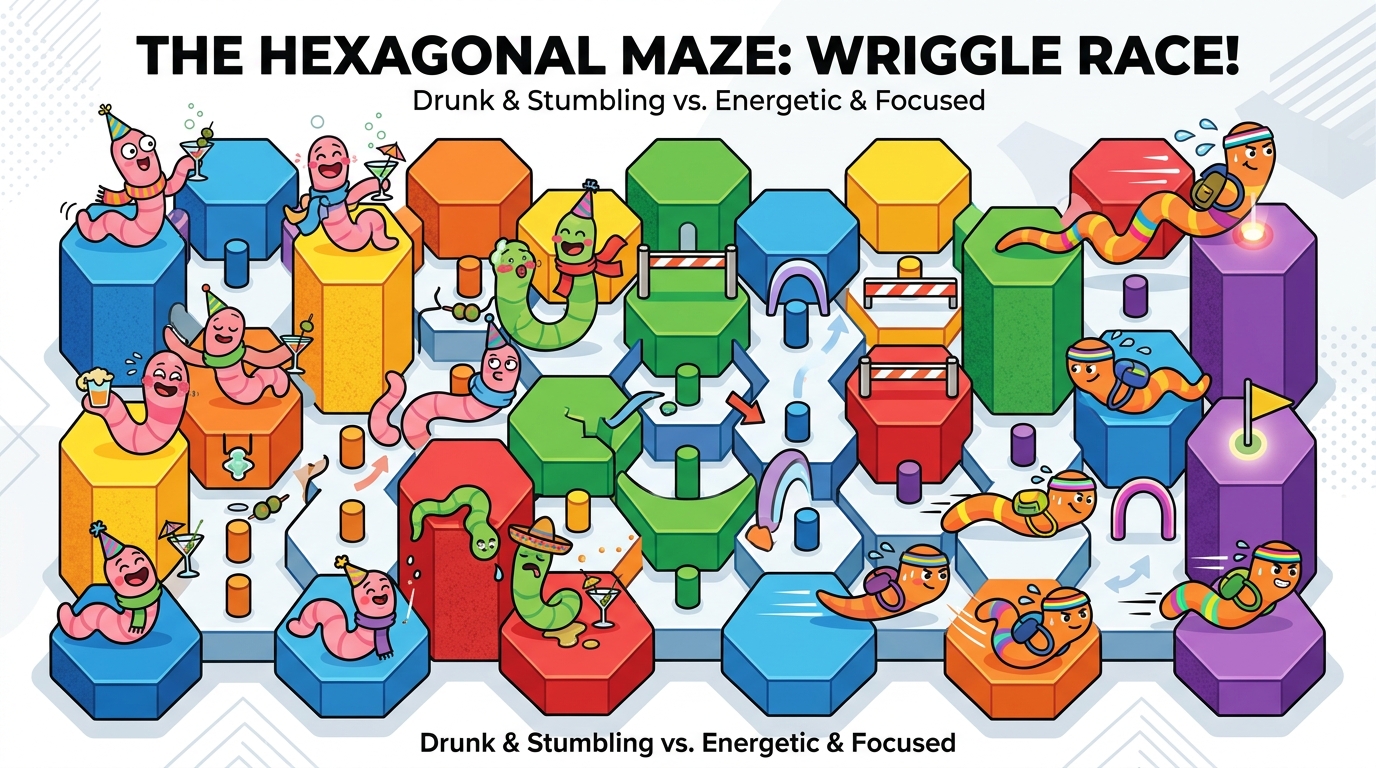
If you've ever tried leaving a crowded pub at 2 AM after three pints of IPA, you already understand the fundamental physics problem that just won a team of Dutch researchers a coveted Ig Nobel Prize: alcohol ruins your ability to navigate obstacles.
In a breakthrough published in Science Advances, a team of soft-matter physicists from the University of Amsterdam—led by researcher Tess Heeremans alongside Antoine Deblais, Daniel Bonn, and Sander Woutersen—tackled a grand challenge in physics. The question wasn't how to split the atom or calculate dark energy. It was: Can you use chemistry chromatography to sort drunk worms from sober worms?
🍺 Happy Hour in the Petri Dish: The 5% Ethanol Protocol
To understand how flexible, self-propelled chains (known in physics as "active polymers") move through porous media, the team recruited thousands of Tubifex tubifex—slender aquatic sludge worms that naturally tangle into living knots:
- The Cocktail Menu: Half the worms were treated to a relaxing bath in a 4.5% to 5% ethanol solution—roughly the ABV of a standard Dutch pilsner.
- Color-Coded Chaos: The tipsy worms were dyed blue, while their designated-driver, stone-cold sober peers were dyed red as the control group.
- Dorm Room Science: Because COVID-19 lockdowns shuttered the university labs halfway through the study, Heeremans literally carted the entire microfluidic obstacle apparatus back to her student apartment to run worm pub crawls in her living room.
Next came the gauntlet. The researchers fabricated a micro-channel maze packed with a dense hexagonal grid of brass and polymer pillars—essentially a macroscopic pinball table designed for squirming invertebrates.
🏁 The Results: Sober Sprints vs. Inebriated Loitering
When released together into the pillar array under laminar fluid flow, the difference in navigational competence was immediate and humbling:
- Sober Worms Sprinted: The energetic, undiluted red worms undulated furiously, slipping past the hexagonal pillars like seasoned slalom skiers and exiting the maze in record time.
- Drunk Worms Loitered: The blue worms, thoroughly blitzed on ethanol, moved in lethargic loops, wrapped themselves affectionately around the obstacle posts, and drifted lazily, taking significantly longer to reach the exit.
- Flawless Separation: Just like a chemical chromatography column sorts molecules by molecular weight, the physical maze sorted the worms purely by metabolic activity and sobriety level.
While dosing invertebrates with lager and building miniature obstacle courses sounds like the ultimate Saturday night prank, the physics behind it has serious real-world clout. Understanding how "active matter"—particles that generate their own kinetic energy, like swimming sperm cells, biopolymer filaments, or microscopic drug-delivery nanobots—navigates tight porous environments is crucial for designing self-sorting medical micro-devices.
The research netted the Amsterdam team the 2024 Ig Nobel Prize in Chemistry at MIT, celebrating science that first makes you laugh, and then makes you think. And for everyone else? It's definitive empirical proof that if you have to navigate a maze of pillars, don't pre-game first.
You might also like
The Great Molecular Arm Wrestle: Why the 2026 Nobel Prize in Chemistry Won't Shake Your Right Hand
The 2026 Nobel Prize in Chemistry honors Henri B. Kagan and Kenso Soai for cracking homochirality—explaining how a microscopic nudge can cause one mirror-image molecule to mercilessly bully its twin out of existence.
Fishing for Cosmic Ghosts at the South Pole: How a Giant Ice Cube Won the 2026 Nobel Prize in Physics
The 2026 Nobel Prize in Physics goes solely to Francis Halzen for melting 86 giant holes into two miles of Antarctic ice, turning the frozen continent into the world's weirdest telescope to catch elusive cosmic neutrinos.
The Moon's Far Side Preserved 1,000°C Magnetic Hard Drives in Natural Glass Beads
Scientists analyzing Chang'e-6 lunar soil discovered rare high-temperature gamma-iron trapped inside impact glass beads, creating microscopic magnetic fossils that remember the Moon's ancient dynamo.