The Great Molecular Arm Wrestle: Why the 2026 Nobel Prize in Chemistry Won't Shake Your Right Hand
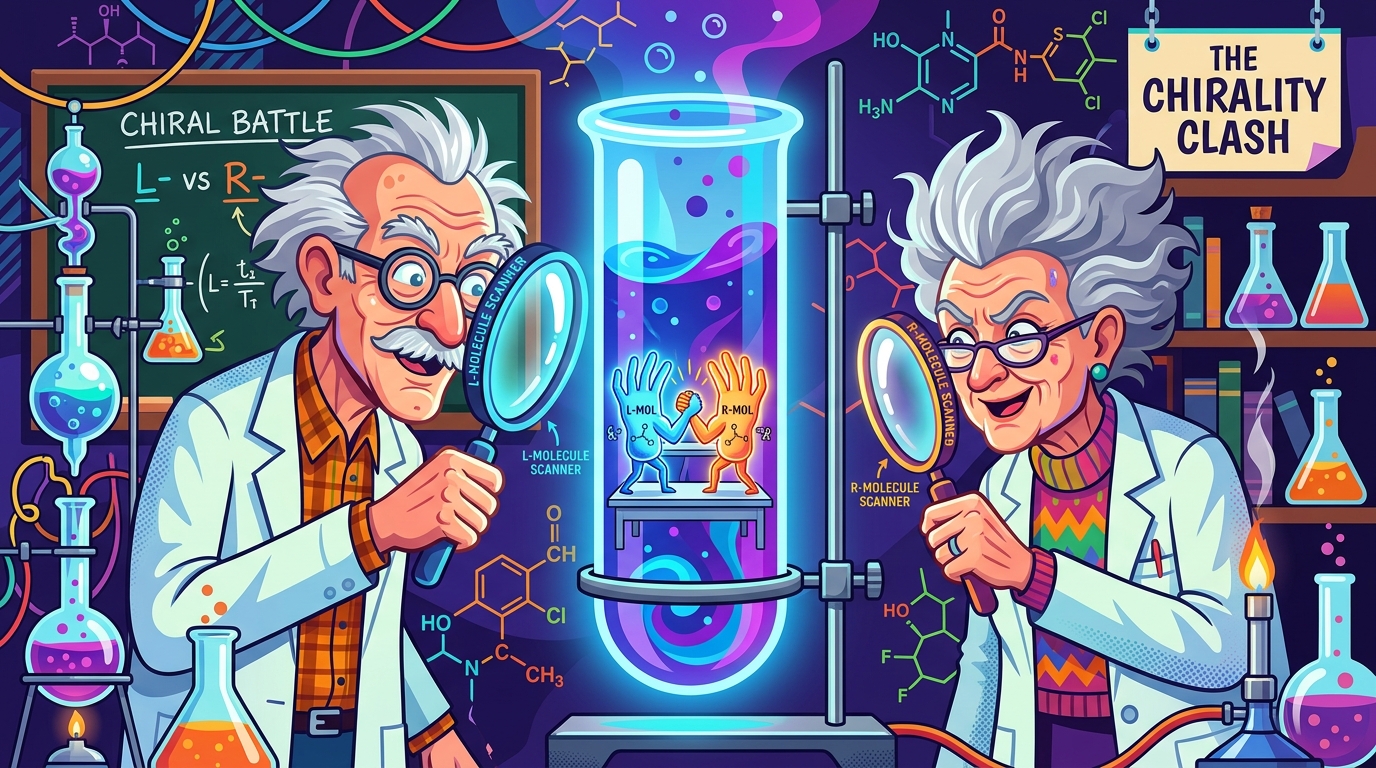
Try putting your left foot into a right boot. It’s awkward, painful, and looks absurd. Yet, for four billion years, every single living organism on planet Earth—from deep-sea bacteria to astrophysicists—has stubbornly refused to wear both gloves: biology builds proteins exclusively out of left-handed amino acids and DNA out of right-handed sugars.
For well over a century, chemists stared at their beakers in existential confusion: if typical chemical synthesis produces a boring, symmetrical 50/50 coin flip of left and right molecules, why did primordial Earth declare total war on right-handed proteins? On October 7, 2026, the Royal Swedish Academy of Sciences awarded the 2026 Nobel Prize in Chemistry jointly to Henri B. Kagan (Université Paris-Sud, France) and Kenso Soai (Tokyo University of Science, Japan) for proving exactly how tiny molecular biases snowball into absolute biological tyranny.
🥊 The Mirror-Image Showdown: What Kagan & Soai Cracked
In chemistry, mirror-image molecules are called enantiomers. They look identical, boil at the exact same temperature, and weigh the same. But biological receptors are picky: one mirror-image can be a miracle medicine while its twin can be useless or catastrophic.
- Kagan's Non-Linear Avalanche: Before Henri Kagan's breakthrough, dogma stated that if your catalyst was only 10% pure, your product would only be 10% biased. Kagan proved chemistry doesn't play linear: opposing mirror molecules can form inactive heterodimers (molecular handcuffs), leaving the slight majority unhindered to crank out over 99% pure chiral products!
- The Legendary Soai Reaction: Kenso Soai took things from clever to miraculous. In 1995, he discovered an asymmetric autocatalytic reaction where the product catalyzes its own creation. Even if you start with an imperceptible 0.00005% chiral excess (or just circular polarized light from a dying star), the reaction snowballs into 100% single-handed domination.
- The Primordial Blueprint: Their work finally gave humanity a credible, experimentally verified roadmap for how life on a neutral prebiotic Earth could spontaneously break symmetry and become 100% "homochiral."
Think of it like a crowded stadium where 50,001 people want to wear blue hats and 49,999 want to wear red hats. Instead of a mild purple compromise, Kagan and Soai discovered that molecules start peer-pressuring each other so aggressively that within five minutes, every single human in the stadium is wearing a blue hat and burning all red apparel in the parking lot.
Beyond philosophizing about cosmic origins, their discoveries form the bedrock of modern pharmaceutical design. Nearly every blockbuster drug today—from antiviral compounds and cholesterol statins to precision oncology treatments—relies on chiral catalysts that manufacture purely the healing molecule without the toxic or useless twin.
🧪 Why Your Body Cares Which Way Molecules Twist
Molecular chirality isn't an abstract classroom concept—it is literally life and death:
- Limonene Scent Test: One mirror version smells like fresh, zesty oranges; its identical mirror twin smells like sharp pine turpentine.
- The Thalidomide Warning: In the 1950s, one enantiomer cured morning sickness, while the opposite enantiomer caused severe birth defects. Kagan and Soai gave chemists the tools to make enantiopure medicines with extreme fidelity.
- Universal Lefty Club: Every enzyme in your body is chiral. If you ate a steak made entirely of right-handed amino acids, your digestive enzymes couldn't break it down—you'd starve with a full stomach.
So next time you tie your shoelaces or high-five your buddy with your right hand, remember that beneath the skin, your molecules are unapologetic lefties who fought a billion-year chemical arm wrestle to ensure you exist today.
You might also like
The Great Worm Pub Crawl: Scientists Win Ig Nobel for Sorting Drunk Worms in an Obstacle Maze
University of Amsterdam physicists got thousands of aquatic worms tipsy on beer-strength ethanol, built a tiny hexagonal pegboard maze, and proved that sober worms make vastly superior life choices.

Fishing for Cosmic Ghosts at the South Pole: How a Giant Ice Cube Won the 2026 Nobel Prize in Physics
The 2026 Nobel Prize in Physics goes solely to Francis Halzen for melting 86 giant holes into two miles of Antarctic ice, turning the frozen continent into the world's weirdest telescope to catch elusive cosmic neutrinos.
Turning Neurons into Disco Lights: How Green Algae Bagged the 2026 Nobel Prize in Medicine
The 2026 Nobel Prize in Physiology or Medicine goes to Karl Deisseroth, Peter Hegemann, and Georg Nagel for inventing optogenetics—hijacking pond scum proteins to control living brain cells with laser beams.