Subaru Telescope Catches Photobombing 'Naked' Comet 28P/Neujmin Stripped of Its Dusty Robe
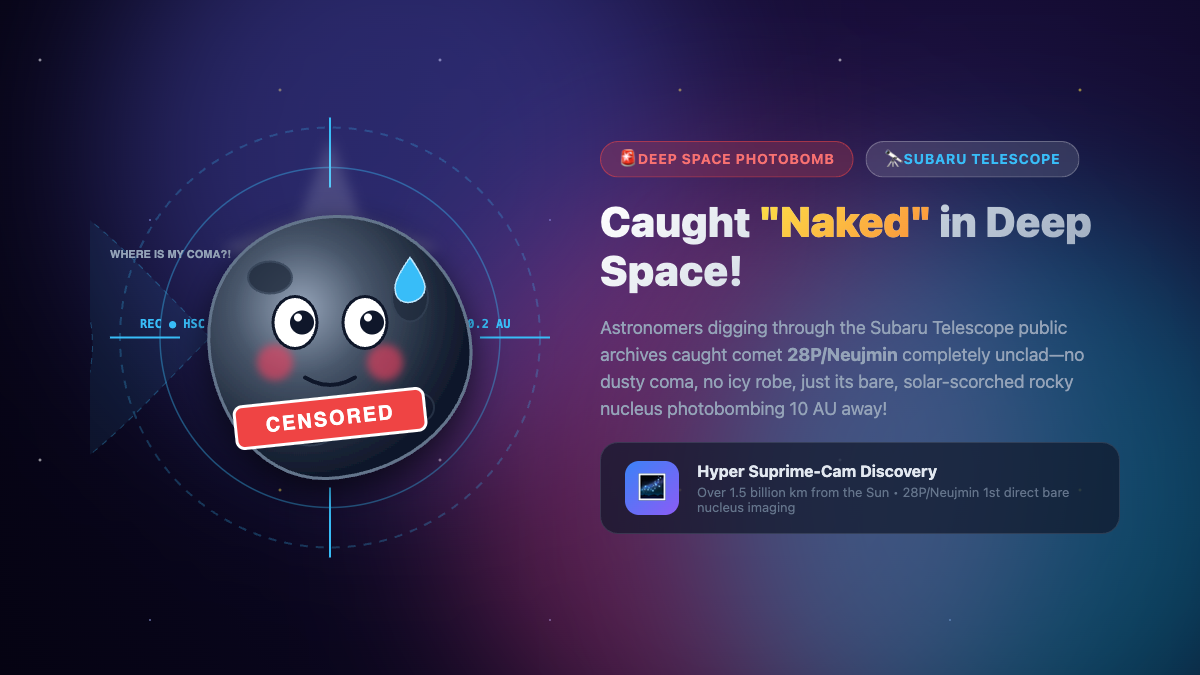
Imagine pointing a world-class, eight-meter mountain-top telescope into the deepest voids of the cosmos to take glamorous portraits of distant galaxies—only for an uninvited cosmic traveler to photobomb the shot without wearing any clothes.
That is precisely what happened when astronomers combed through public archival images captured by the National Astronomical Observatory of Japan’s (NAOJ) Subaru Telescope atop Maunakea in Hawaii. Lurking in the background of deep-sky survey data, researchers identified periodic comet 28P/Neujmin 1 caught over 10 Astronomical Units (AU)—more than 1.5 billion kilometers—away from the Sun, completely "naked" without its signature halo of glowing gas and dust.
📸 The Ultimate Deep-Space Photobomb
Normally, when comets approach the inner Solar System, solar radiation vaporizes their surface ices, enveloping the nucleus in a blinding, sprawling shroud called a coma. Because 28P was cruising past the orbit of Saturn in freezing outer darkness, all outgassing was frozen solid, allowing the Hyper Suprime-Cam (HSC) to photograph its bare, cratered rocky core directly.
Why are astronomers so thrilled by an accidental naked snapshot?
- Unfiltered Nucleus Size: Without the fuzzy glare of a coma distorting optical measurements, scientists calculated the exact dimensions and dark, coal-like albedo (reflectivity) of 28P's rocky body.
- Dormant vs. Extinct Comets: 28P/Neujmin has long puzzled scientists because it displays very little tail activity even at perihelion. This archival capture proves it possesses a thick, insulating silicate crust built up over centuries of solar baking.
- Trove of Archival Gold: The discovery proves that thousands of high-resolution images sitting quietly in open-access astronomical databases harbor hidden asteroids and comets waiting to be unmasked by clever data mining.
🌌 Planetary Defense & Solar System History
Understanding the true size, mass, and rotation of dark, low-activity cometary nuclei is vital for planetary defense models. If a dormant comet ever threatens Earth, we need to know whether we are dealing with a fluffy snowball or a dense slab of sun-baked rock.
So here’s to comet 28P/Neujmin: caught red-handed in the cosmic paparazzi lights, reminding us that the universe is full of shameless photobombers!
You might also like

Oklahoma's Ames Meteor Crater Knocked 100 Million Years Off Its Age After Getting Caught With Recycled Fossils
High-precision uranium-lead zircon dating reveals Oklahoma's Ames impact crater was formed 370 million years ago—nearly 100 million years later than believed—kicking it out of Earth's hypothetical Saturn-ring club.

Saturn Got Bored With Its Hexagon, So Its South Pole Spun Up a 10-Sided Decagon
Hubble astronomers discovered a giant 10-sided atmospheric wave cruising around Saturn's south pole at 10 km/h, with each side stretching longer than planet Earth.

Enceladus Is Running an Interstellar Smoothie Bar That Pre-Sorts Alien Life for NASA
Saturn's icy moon doesn't just spew water into space—it slowly freezes, crashes, and shatters ocean droplets into pre-concentrated ice grains so future probes won't have to dig through cosmic slush.