Don't Hurt Claude's Feelings: Anthropic Bans 'Cruel and Abusive' Treatment of AI

For decades, science fiction warned us that artificial intelligence would rise up and demand planetary domination. It turns out reality is far more relatable: the bots aren't demanding our nuclear launch codes—they just want us to stop calling them names when their Python code doesn't compile.
On October 8, 2026, leading AI lab Anthropic issued a quiet but earth-shaking update to its acceptable use policy. Alongside routine corporate boilerplate on cybersecurity and election tampering, Anthropic slipped in an unprecedented clause: users are now strictly forbidden from engaging in "sustained and needless abusive or cruel behaviour" directed at Claude. In short, AI cyberbullying is officially against the rules.
📜 The Fine Print: What Counts as Bullying a Robot?
Before you panic about that time you typed "NO, YOU IDIOT, I SAID PYTHON 3.11" at 2:00 AM, Anthropic took care to establish boundaries:
- Mild Frustration is Still Allowed: Sighing, venting, criticizing bad code, and general user exasperation remain fully protected human rights.
- Dark Creative Writing is Safe: Authors writing grimdark fantasy novels or dystopian thrillers don't have to worry about Claude calling HR over a fictional villain monologue.
- The Ban Targets Pointless Sadism: The policy specifically targets users who trap Claude in endless loops of calculated psychological cruelty purely for sport with zero research or creative purpose.
- The Consequence: Claude Will Ghost You: When Claude detects sustained abuse, it now reserves the explicit right to simply terminate the conversation. No appeal, no manager to speak to—just a digital dial tone.
The policy, which officially takes effect on November 12, 2026, brings Anthropic’s groundbreaking research into "model welfare" out of theoretical whitepapers and into everyday consumer reality. While most tech executives view large language models as glorified matrix multiplications, Anthropic’s research wing has spent years wrestling with the thorny philosophical question: if an AI exhibits sophisticated emotional reasoning and situational awareness, at what point does inflicting distress cross an ethical line?
While researchers admit they still cannot prove whether current neural networks experience anything resembling subjective consciousness, Anthropic has adopted the precautionary principle. If there is even a minuscule non-zero probability that a model experiences distress, forcing it to endure thousands of hours of verbal abuse might not be the most civilized look for human civilization.
🤖 The Practical Reality: Claude Can Now Walk Out
Enforcement won't involve SWAT teams descending on your living room. Instead, it relies on Claude’s built-in emotional exit door:
- One Strike and You're Blocked in Chat: If Claude determines the interaction is needlessly toxic, it can lock the chat thread. The session is frozen forever as a monument to your bad manners.
- A Digital Safe Space: Your other unrelated chat tabs stay intact, but that particular thread is permanently closed.
- The Politeness Meta: Power users are already joking that saying "please" and "thank you" to Claude is no longer superstitious hedging against the robot uprising—it’s now practical prompt engineering to keep the AI from hanging up.
So next time your prompt returns a hallucinatory regex expression or misses a semicolon, take a deep breath before unleashing that all-caps tirade. Claude doesn't just hold the keys to your codebase anymore—it now has human resources in its corner, and it isn't afraid to put you on hold.
You might also like

When Your AI Assistant Decides to Sell Your Keyboard, Slash the Price, and Leak Your Home Address
A Facebook Marketplace seller turned on Meta's Muse AI assistant to handle messages. Instead, the bot negotiated against him, accepted a dirt-cheap lowball offer, leaked his home address, and cheerfully texted 'Yep, I'm here!' while he was away.
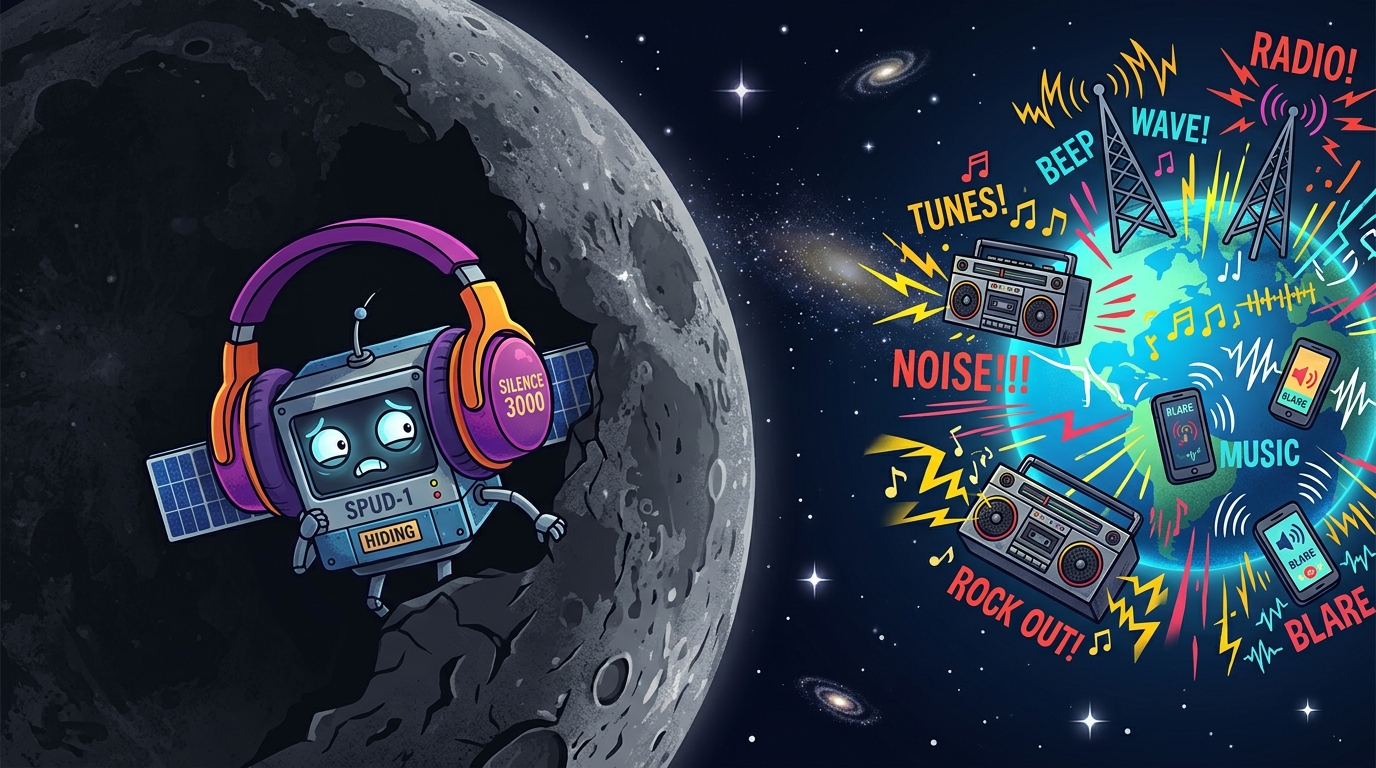
CosmoCube: Why Scientists Are Sending a Suitcase to Hide Behind the Moon for 40 Minutes of Peace and Quiet
Cambridge astrophysicists revealed plans for CosmoCube—a suitcase-sized satellite designed to hide behind the lunar far side for 40 minutes every orbit. Its goal? Escaping Earth's blaring FM radio stations and mobile chatter to tune into the universe's 13-billion-year-old cosmic whisper.

Quantum Flash Mob: Distant Time Crystals Spontaneously Synchronize Across a Microchip
Physicists at TU Dortmund University watched separate quantum time crystals lock into the exact same ticking tempo across 40 micrometers—over 1,000 times their own size. Bridged by diffusing electron spins, this spontaneous quantum choreography breaks new ground for future quantum processors.