With a Little Help from My Peer Reviewers: Why Scientists Can't Stop Quoting The Beatles
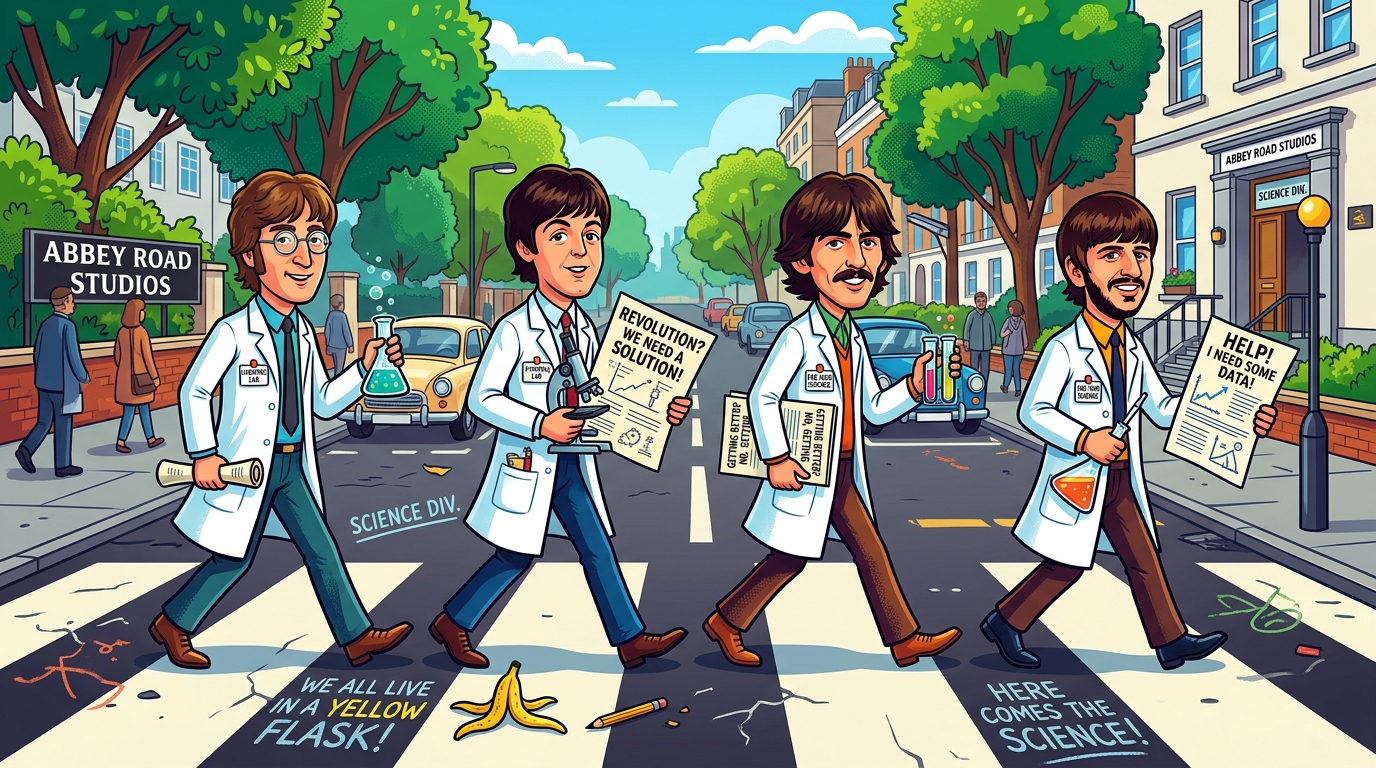
If you ever thought academic research papers were sober, stone-faced monuments to unfeeling objectivity, you haven't been paying attention to their titles. On September 9, 2026, researchers at the Delft University of Technology published a magnificent study in PLOS One proving that scientists across the globe share one uncontrollable addiction: shoehorning Beatles lyrics and shameless rock-and-roll puns into their peer-reviewed papers.
Armed with natural language processing and LLMs, researchers Gabriel Budel, Rob Kooij, and Michiel Tjepkema combed through decades of academic publications in the Scopus database. What they uncovered was a staggering cultural invasion: at least 2,237 exact Beatles song titles and nearly 1,000 shameless lyrical puns lurking in the halls of serious academia.
🎸 The Fab Four's Greatest Academic Hits
Elvis Presley managed 196 paper references, and Michael Jackson scraped together 65. The Beatles? Over 1,500 for their top 10 songs alone:
- "The Long and Winding Road" (798 papers): The undisputed king of academic cliché, used whenever a professor wants to describe any experiment that took longer than two weeks.
- "With a Little Help from My Friends" (209 papers): The go-to title for papers involving symbioses, collaborative algorithms, or begging co-authors for citations.
- "Here, There and Everywhere" (129 papers): Ubiquitous in ecology, epidemiology, and quantum physics whenever something is found... well, everywhere.
The puns get gloriously unhinged. Medical researchers published "The lung and winding road: Inflammation-driven platelet reactivity in Long Covid." Cancer oncologists penned "Ticket to divide: m6A reader YTHDC1 drives acute myeloid leukemia proliferation." And in a searing critique of healthcare policy, geriatric specialists asked: "Will you still need me, will you still screen me, when I'm past 64?"
There is even a paper proudly titled "Everybody's got something to hide except me and my patented monkey." If John Lennon were alive today, he would undoubtedly demand co-author royalties.
🧪 All You Need Is Grants
The researchers noted that the pun epidemic has outpaced the overall growth rate of scientific literature since the 1970s. Why? Because when you spend four grueling years in a basement lab staring at protein gels under fluorescent lighting, sometimes a cheesy Beatles pun in the title is the only thread keeping your sanity together.
You might also like
The Great Molecular Arm Wrestle: Why the 2026 Nobel Prize in Chemistry Won't Shake Your Right Hand
The 2026 Nobel Prize in Chemistry honors Henri B. Kagan and Kenso Soai for cracking homochirality—explaining how a microscopic nudge can cause one mirror-image molecule to mercilessly bully its twin out of existence.
Fishing for Cosmic Ghosts at the South Pole: How a Giant Ice Cube Won the 2026 Nobel Prize in Physics
The 2026 Nobel Prize in Physics goes solely to Francis Halzen for melting 86 giant holes into two miles of Antarctic ice, turning the frozen continent into the world's weirdest telescope to catch elusive cosmic neutrinos.
Turning Neurons into Disco Lights: How Green Algae Bagged the 2026 Nobel Prize in Medicine
The 2026 Nobel Prize in Physiology or Medicine goes to Karl Deisseroth, Peter Hegemann, and Georg Nagel for inventing optogenetics—hijacking pond scum proteins to control living brain cells with laser beams.