Meet GJ 3090 b: The Sub-Neptune Driving Backwards Down a One-Way Celestial Highway
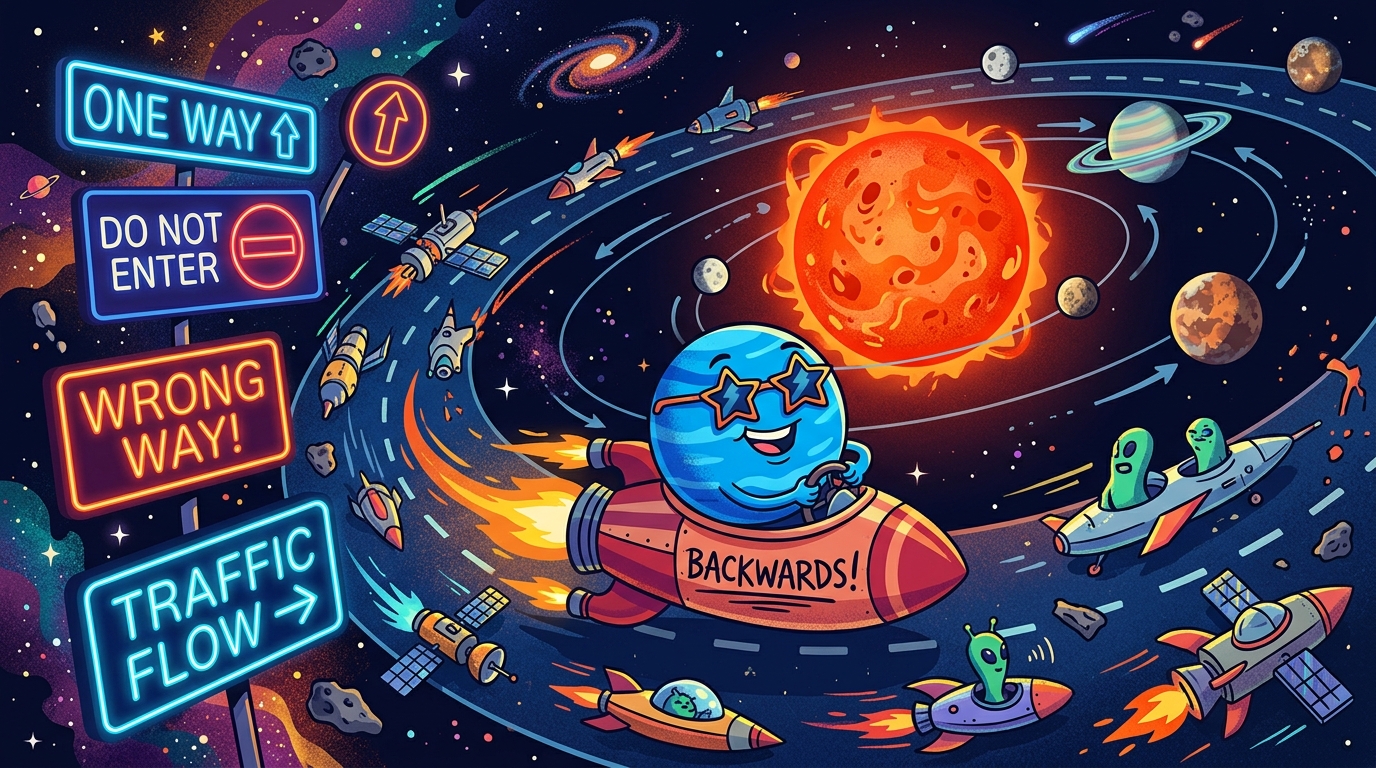
Imagine joining a bustling six-lane roundabout where every single car is gracefully cruising clockwise—except for one lime-green hatchback flooring the accelerator in reverse while blasting disco music. Welcome to the planetary system of GJ 3090.
According to a sensational study published in Astronomy & Astrophysics, an international team of astronomers using the Near-InfraRed Planet Searcher (NIRPS) spectrograph on the European Southern Observatory's 3.6-meter telescope at La Silla, Chile, has detected a cosmic outlaw. Exoplanet GJ 3090 b is an energetic sub-Neptune orbiting an M dwarf star in a bizarre, unapologetic retrograde orbit—meaning it charges around its host star in the exact opposite direction to the star’s own rotation.
🚀 Planet Specs & The 136° Flip
GJ 3090 b isn't just slightly tilted like Earth on an awkward Monday morning. It has completely flipped the script:
- The Dimensions: It boasts roughly 2.2 times Earth's radius and packs about 4.5 times Earth's mass, putting it comfortably in the elusive "sub-Neptune" sweet spot.
- The Speedrun Orbit: It whips around its cool red dwarf host star once every 2.85 Earth days, experiencing a brand new New Year celebration twice a week.
- The Extreme Tilt: Spectroscopic transit observations revealed a true 3D spin-orbit angle (obliquity) of 136 degrees. In orbital mechanics, anything over 90 degrees qualifies as driving the wrong way down a one-way street.
In the standard textbook model of astrophysics, every star and its accompanying planetary brood condense out of the exact same swirling pancake of gas and dust. Conservation of angular momentum dictates that unless something catastrophic happens, everyone should revolve in harmonious synchrony, like ducklings paddling behind their mother.
Occasionally, astronomers do find retrograde planets. But in virtually every previous case, there was an obvious culprit: a massive, bullying gas giant lurking further out that triggered the Kozai-Lidov resonance, or a chaotic game of interplanetary gravitational billiards that kicked the smaller planet into an upside-down orbit.
🔍 The Mystery: Where Is the Gravitational Bully?
When the NIRPS team looked around the GJ 3090 system to see who shoved this sub-Neptune into reverse, they found... dead silence.
- No Giant Siblings: Deep radial velocity measurements revealed zero massive outer gas giants within several astronomical units.
- No Stellar Accomplice: There is no companion star gravitationally harassing the system from the outside.
- An Only Child Rebel: GJ 3090 b appears to have chosen this chaotic backwards life entirely on its own, leaving theorists scratching their heads.
So how does a lone planet end up orbiting backwards around a small red dwarf? Astronomers are now entertaining wilder possibilities, such as a "two-stage" accretion disk where the baby star gobbled up a second, misaligned cloud of interstellar gas rotating in the opposite direction after forming its first batch of material.
Whatever the culprit, GJ 3090 b stands as an inspiring monument to doing your own thing, refusing to follow the crowd, and cruising through the cosmos in full reverse.
You might also like

Meet Elias 2-24 b: The Cosmic Toddler Caught Devouring Dust in Its Protoplanetary Crib
Astronomers reanalyzed archival Keck and ALMA data to discover Elias 2-24 b, the youngest exoplanet ever spotted at under 1 million years old. Clocking in at Jupiter's mass, this celestial newborn is already terrorizing its solar nursery 450 light-years away.
The 10-Billion-Year-Old Voicemail: Webb and MeerKAT Catch the Most Distant Radio Flash in Cosmic History
Astronomers have detected FRB 20240304B, a fast radio burst that traveled over 10 billion years across the universe, shattering cosmic distance records and proving ancient baby galaxies loved loud fireworks.
Cosmic Monster Trucks: JWST Catches 21 Teenage Alien Solar Systems Smashing Planets into Vaporized Glass
The James Webb Space Telescope peeked inside 21 rare 'extreme debris disks' and caught teenage solar systems playing planetary dodgeball, vaporizing Mars-sized worlds into glowing clouds of silica glass.