Heisenberg Was Right: Magnetars Turn 'Empty Space' into a Quantum Prism
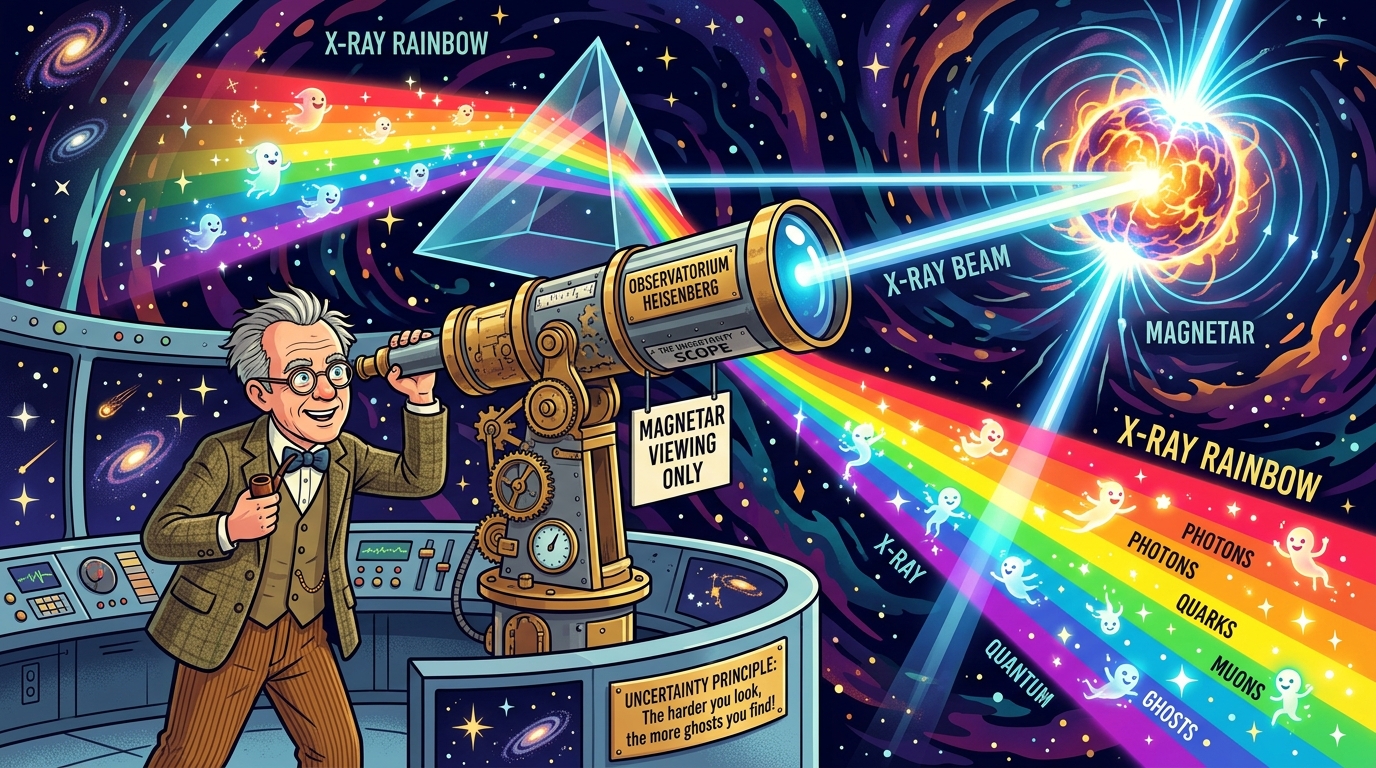
In 1936, quantum pioneer Werner Heisenberg and Hans Euler made a claim that sounded like pure science fiction: they argued that the absolute vacuum of space isn't truly empty, and if you squeeze it with enough magnetic force, pure nothingness will bend light like a glass magnifying lens.
Ninety years later, an international team of astrophysicists pointing NASA’s IXPE (Imaging X-ray Polarimetry Explorer) space telescope at a hyper-magnetic dead star known as magnetar 1E 1547.0-5408 has finally proven them right. Empty space is not empty—it is a seething soup of ghost particles that acts like a celestial prism.
🔮 The 80% Polarization Discovery
Published in Nature, observations revealed that X-ray photons shooting away from the magnetar reach polarization levels of up to 80%. Standard classical physics predicts zero polarization in a vacuum. The only way this happens is if the quantum vacuum itself physically refracts the light—a phenomenon called vacuum birefringence.
How Do You Turn Nothingness into Glass?
In classical physics, a vacuum is just... nothing. Empty real estate where photons travel in straight lines without interruption.
Quantum Electrodynamics (QED) paints a much wilder picture. The vacuum is constantly bubbling with pairs of virtual electrons and positrons that pop into existence, exist for a quadrillionth of a second, and annihilate each other.
Around a magnetar—where magnetic fields are over 1 trillion times stronger than Earth’s—these fleeting virtual particles are forcibly lined up like microscopic compass needles. When an X-ray beam flies through this energized "empty" space, it splits into two different polarization paths traveling at slightly different speeds, exactly like sunlight passing through a calcite crystal prism.
🌌 Why This Changes Our View of the Universe
- No Free Lunch in Physics: Even the absolute coldest, emptiest void of deep space possesses physical refractive properties.
- Testing Extreme Physics: We cannot recreate trillion-Gauss magnetic fields on Earth; magnetars serve as nature's ultimate free quantum laboratories.
- Heisenberg's Scorecard: Add another point to the 1930s quantum theorists who figured this out with pencil and paper nearly a century before we had the space telescopes to look.
So next time you stare into the dark void between the stars, remember: you’re not looking at nothing. You’re looking through a cosmic kaleidoscope powered by invisible ghost particles.
You might also like
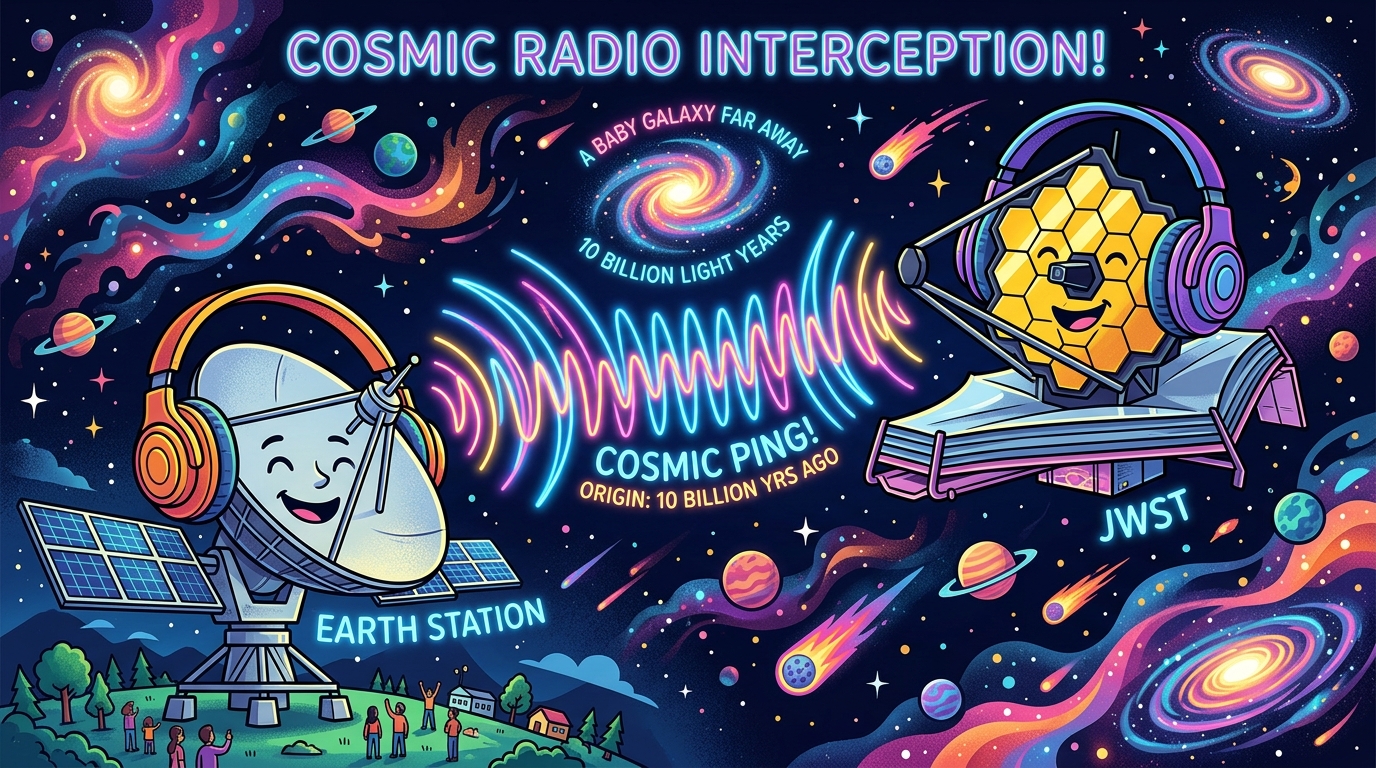
The 10-Billion-Year-Old Voicemail: Webb and MeerKAT Catch the Most Distant Radio Flash in Cosmic History
Astronomers have detected FRB 20240304B, a fast radio burst that traveled over 10 billion years across the universe, shattering cosmic distance records and proving ancient baby galaxies loved loud fireworks.

The Quantum Pisa Drop: Physicists Split an Atom and Dropped Half to Test Einstein's Ghost
In 1589, Galileo supposedly dropped cannonballs from the Tower of Pisa. In 2026, physicists built a 'Quantum Galileo' device that split an atom's wave function in two—holding one half in midair while dropping the other—to test general relativity at the quantum scale!
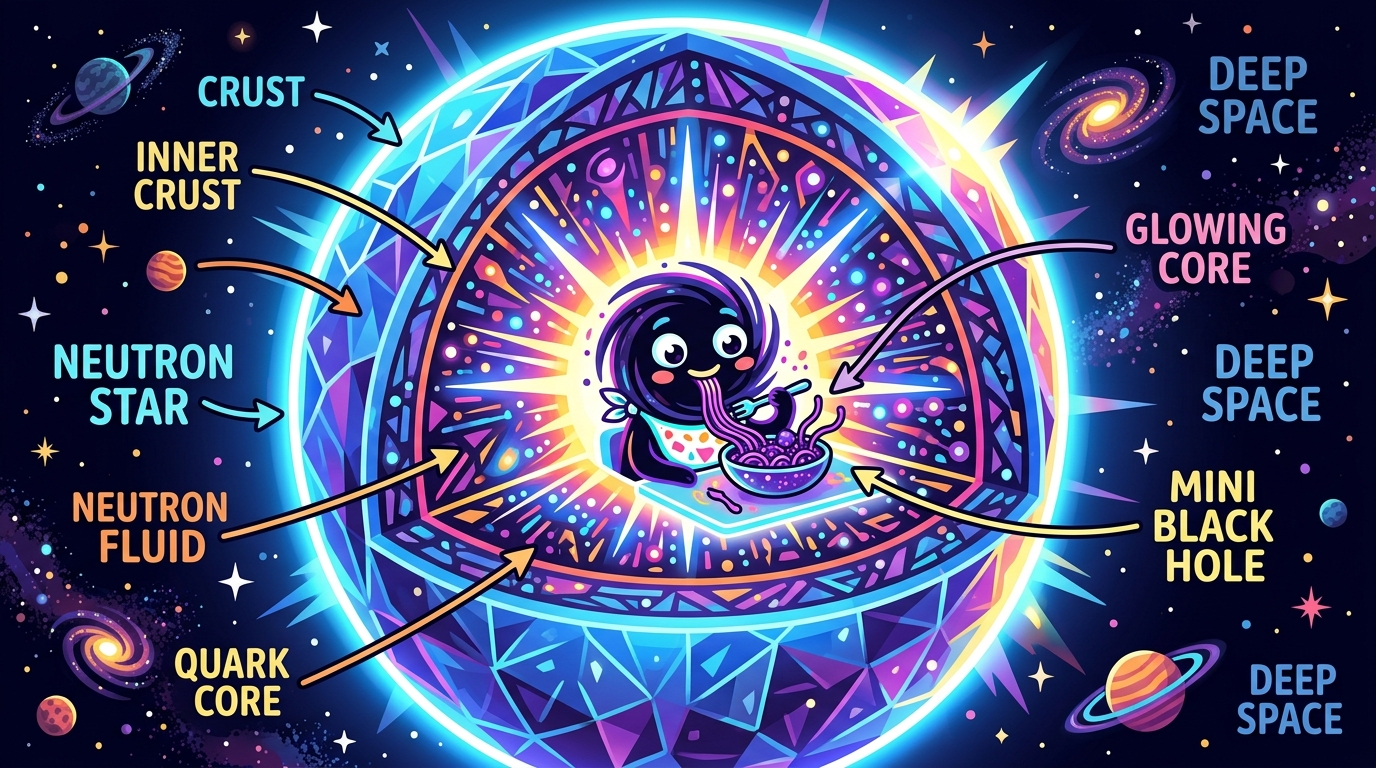
Cosmic Tapeworms: How 40-Ton Mini Black Holes Nest Inside Dead Stars and Gorge on Dark Matter
Theoretical physicists uncovered a bizarre astrophysical phenomenon: tiny 40-ton black holes could form inside dense neutron stars, surviving Hawking radiation by continuously devouring captured dark matter like celestial parasites!