The Quantum Pisa Drop: Physicists Split an Atom and Dropped Half to Test Einstein's Ghost

Legend has it that in 1589, Galileo Galilei climbed to the top of the Leaning Tower of Pisa and dropped two cannonballs of different masses to prove that gravity pulls everything equally. Fast forward 437 years, and physicists have upgraded the experiment to the ultimate level of quantum absurdity: they built a machine that splits a single atom in half, holds one half motionless in midair, drops the other half under gravity, and reunites them to see if Albert Einstein was still right.
Published in Science Advances, the breakthrough was achieved by an international collaboration of quantum physicists from Ben-Gurion University of the Negev, the University of Ulm, and the University of Oxford. Dubbing their creation the "Quantum Galileo Interferometer," the researchers took on one of physics’ most stubborn civil wars: the clash between Einstein's smooth General Relativity and the chaotic realm of Quantum Mechanics.
⚛️ How to Drop Half an Atom
Before you call the bomb squad, no atomic nuclei were smashed. This is pure quantum superposition:
- Near Absolute Zero: Rubidium atoms were laser-chilled to a fraction of a microkelvin above absolute zero to freeze their chaotic thermal vibrations.
- The Wave-Function Slice: A tailored microwave pulse split the atom's probability wave function into two simultaneous realities.
- The Quantum Freeze: One path of the wave function was locked in place using ultra-precise magnetic traps, hovering stationary relative to Earth.
- The Free Fall: The second path was left completely untethered to plummet freely in Earth’s gravitational field.
- The Recombination Ripple: When reunited, the two paths produced an interference pattern measuring the tiny gravitational phase shift down to mind-boggling precision.
The core question was whether Einstein's Equivalence Principle—the bedrock assumption that gravitational acceleration is independent of an object's internal structure—still holds when an object is smeared across quantum superposition.
The verdict? Einstein wins yet again. The phase difference between the stationary "half" and the falling "half" matched relativistic predictions with exquisite fidelity. Even when a particle is having an existential identity crisis and existing in two places at once, gravity still treats both halves with exact mathematical fairness.
🪂 The Ultimate Case of FOMO
Imagine being a rubidium atom split into two parallel realities: half of you is trapped doing a boring stationary wall-sit in a magnetic trap, while the other half gets to go skydiving through Earth's gravitational field. When they meet back up, the interference pattern is basically the falling half bragging about how much fun it had.
Beyond proving Einstein right for the millionth time, this tabletop "Quantum Galileo" technique paves the way for ultra-sensitive navigational gravity sensors that can map subterranean caverns, detect oil reserves, or spot stealth submarines without relying on GPS.
You might also like

Fishing for Cosmic Ghosts at the South Pole: How a Giant Ice Cube Won the 2026 Nobel Prize in Physics
The 2026 Nobel Prize in Physics goes solely to Francis Halzen for melting 86 giant holes into two miles of Antarctic ice, turning the frozen continent into the world's weirdest telescope to catch elusive cosmic neutrinos.
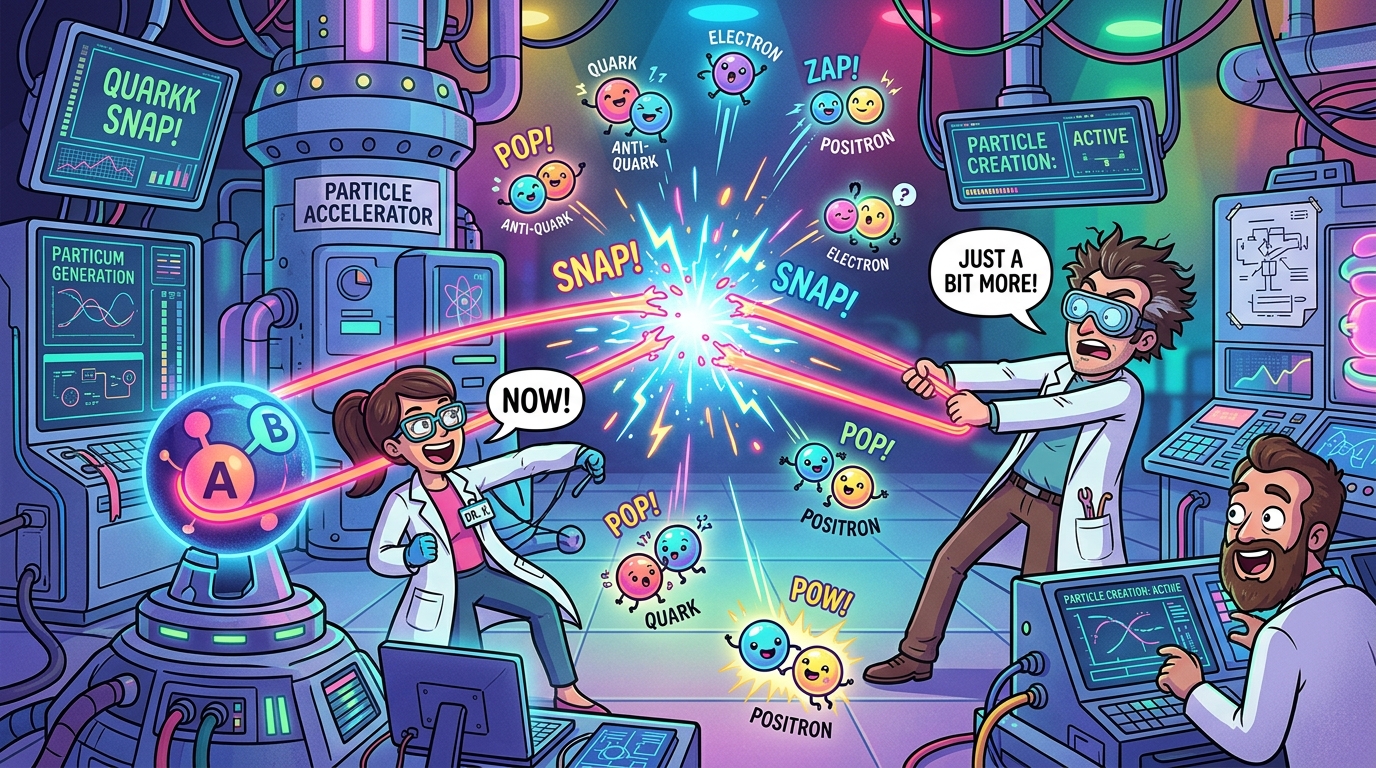
Snapping the Cosmic Rubber Band: Duke Physicists Use 13 Ions to Make Matter Pop Out of Nothing
Physicists at the Duke Quantum Center built a 13-trapped-ion quantum computer to simulate string-breaking dynamics. When you stretch the quantum bond between subatomic particles, the tension snaps—forcing the vacuum to spontaneously materialize brand-new particle pairs out of thin air.

Quantum Flash Mob: Distant Time Crystals Spontaneously Synchronize Across a Microchip
Physicists at TU Dortmund University watched separate quantum time crystals lock into the exact same ticking tempo across 40 micrometers—over 1,000 times their own size. Bridged by diffusing electron spins, this spontaneous quantum choreography breaks new ground for future quantum processors.