Cosmic Wardrobe Malfunction: JWST Catches Asteroid Chariklo's Rings Radically Shifting Opacity in Real Time

If you ever assumed the Solar System’s jewelry collection was permanently locked in a quiet cosmic display case, asteroid Chariklo is here to casually shatter your astronomical illusions.
Until recently, the prevailing wisdom among astrophysicists was that planetary rings were sluggish, venerable structures that take millions of years to evolve. Saturn's rings might be slowly draining into the planet over geological eons, but on the timescale of human civilizations, rings were supposed to sit there looking pretty. But in a study published in Science Advances, researchers using the James Webb Space Telescope (JWST) caught the outer Solar System’s oddest mini-world pulling off a rapid, dynamic wardrobe swap that has left dynamicists rubbing their eyes in disbelief.
🪐 The Tale of the Asteroid with Hula Hoops
Meet 10199 Chariklo, the king of the Centaurs—a class of hybrid celestial wanderers cruising between Saturn and Uranus:
- The 2013 Shocker: Back in 2013, astronomers were stunned when a star occultation revealed that tiny, 250-km-wide Chariklo was encircled by two razor-thin, icy rings (nicknamed Oiapoque and Chuí). Minor planets weren't supposed to have rings at all!
- The JWST Check-in: In late 2022, astronomers aimed JWST's ultra-sensitive NIRCam at another occultation. Comparing the fresh infrared data with measurements from 2017, the team expected static confirmation. What they got was a complete optical reshuffle.
- The Inner Ring Got Dense: The inner ring's optical depth spiked, becoming roughly 50% more opaque than earlier observations.
- The Outer Ring Evaporated: Meanwhile, the companion outer ring pulled a disappearing act, becoming approximately 60% more transparent and faint.
How does an asteroid's ring system completely flip its optical profile in less than a single decade? That is the million-dollar cosmic question. Led by researchers at the Instituto de Astrofísica de Andalucía (IAA-CSIC), the international team evaluated multiple tantalizing hypotheses. One scenario suggests a rogue boulder or micro-shepherd moon collided with the inner ring, pulverizing larger chunks into an impenetrable cloud of fine dust that blocks more starlight. Another theory proposes that gravitational tug-of-wars or orbital resonances are actively siphoning icy pebbles from the outer ring and dumping them inward like a celestial vacuum cleaner.
There's also the fascinating possibility of wavelength tricks: JWST operates in the near-infrared, whereas previous ground-based occultations relied predominantly on visible light. If ring particles are coated in delicate water ice crystals that absorb specific infrared bands, JWST might be showing us microscopic material properties that optical telescopes were totally blind to.
🔭 Why This Upends Planetary Physics
Before JWST took a look, astronomers assumed small-body rings were stable artifacts frozen in time. Instead, Chariklo's rings behave more like a churning blender than a static museum piece. If minor asteroid rings can rearrange their entire optical density in ten years, what does that say about the violent, fast-paced collisions happening quietly across the outer solar frontier?
Next time you feel like your life is changing too fast, just take comfort in knowing that somewhere out past Saturn, a 250-kilometer rock is out there furiously spinning its cosmic hula hoops and reinventing its personal style on a decade-by-decade basis.
You might also like
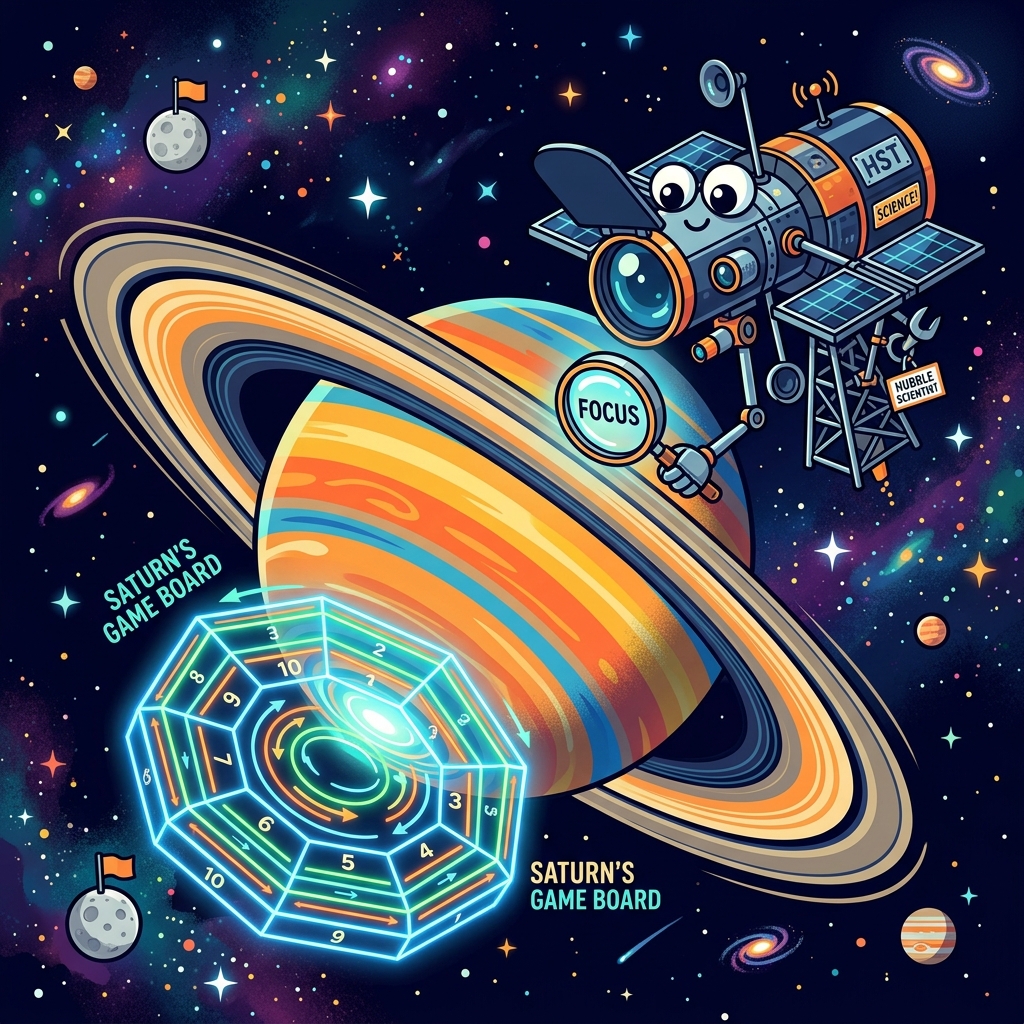
Cosmic D10 Dice: Hubble Discovers a Giant 10-Sided 'Decagon' Encircling Saturn's South Pole
Saturn already boasted a bizarre 6-sided hexagon on its north pole. Now Hubble astronomers spotted a wobbly 10-sided atmospheric decagon spinning around its south pole like a celestial board game piece.
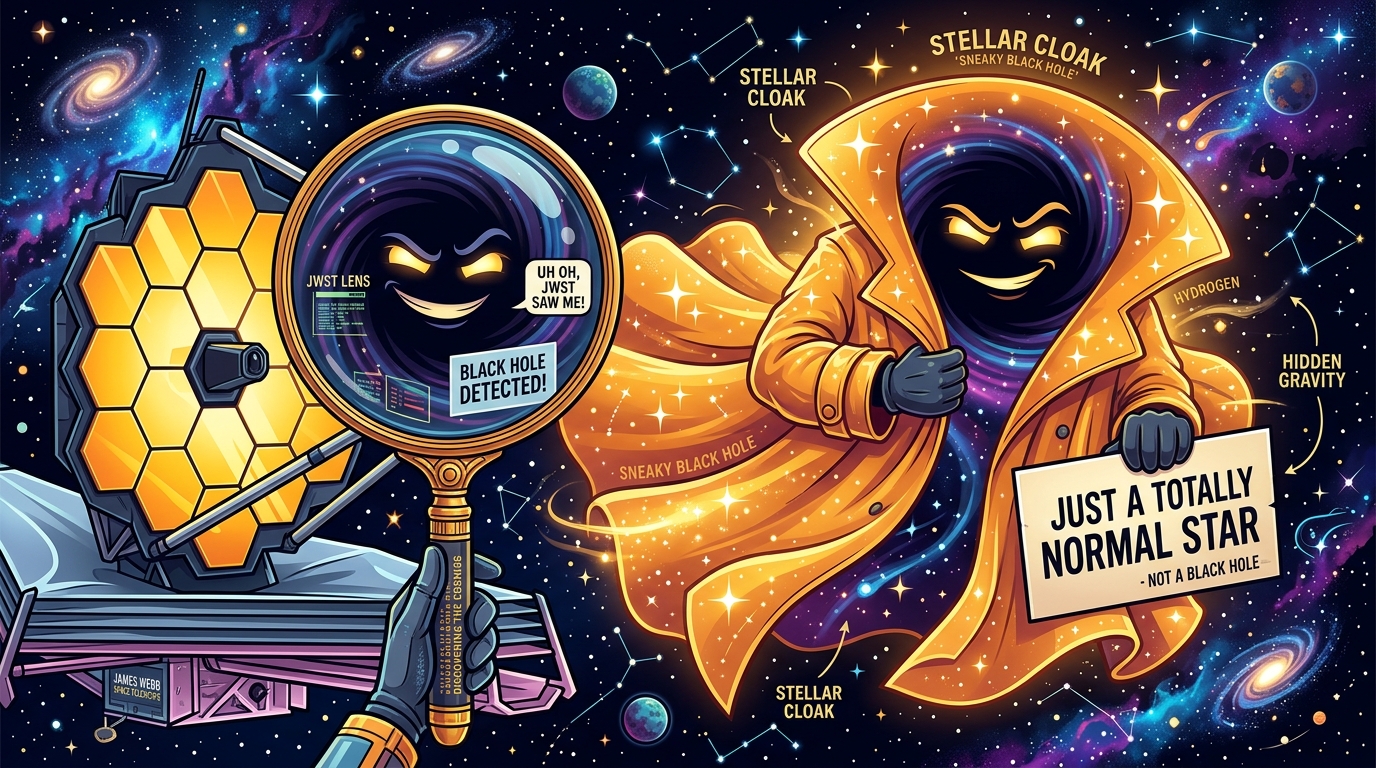
JWST Finds a 'Black Hole Star' Wearing a Solar-System-Sized Gas Trenchcoat
Astronomers discovered object MoM-BH*-1, which shines 100 billion times brighter than a star and looks like a star, but is secretly a supermassive black hole disguised in a giant hydrogen cocoon.

JWST Finds Clay on Neptune's Moons, Uncovering a Cosmic Demolition Derby
The James Webb Space Telescope detected hydrated clay minerals on Neptune's tiny inner moons Larissa, Galatea, and Proteus, proving they are recycled debris from ancient watery worlds smashed to pieces.