JWST Finds Clay on Neptune's Moons, Uncovering a Cosmic Demolition Derby
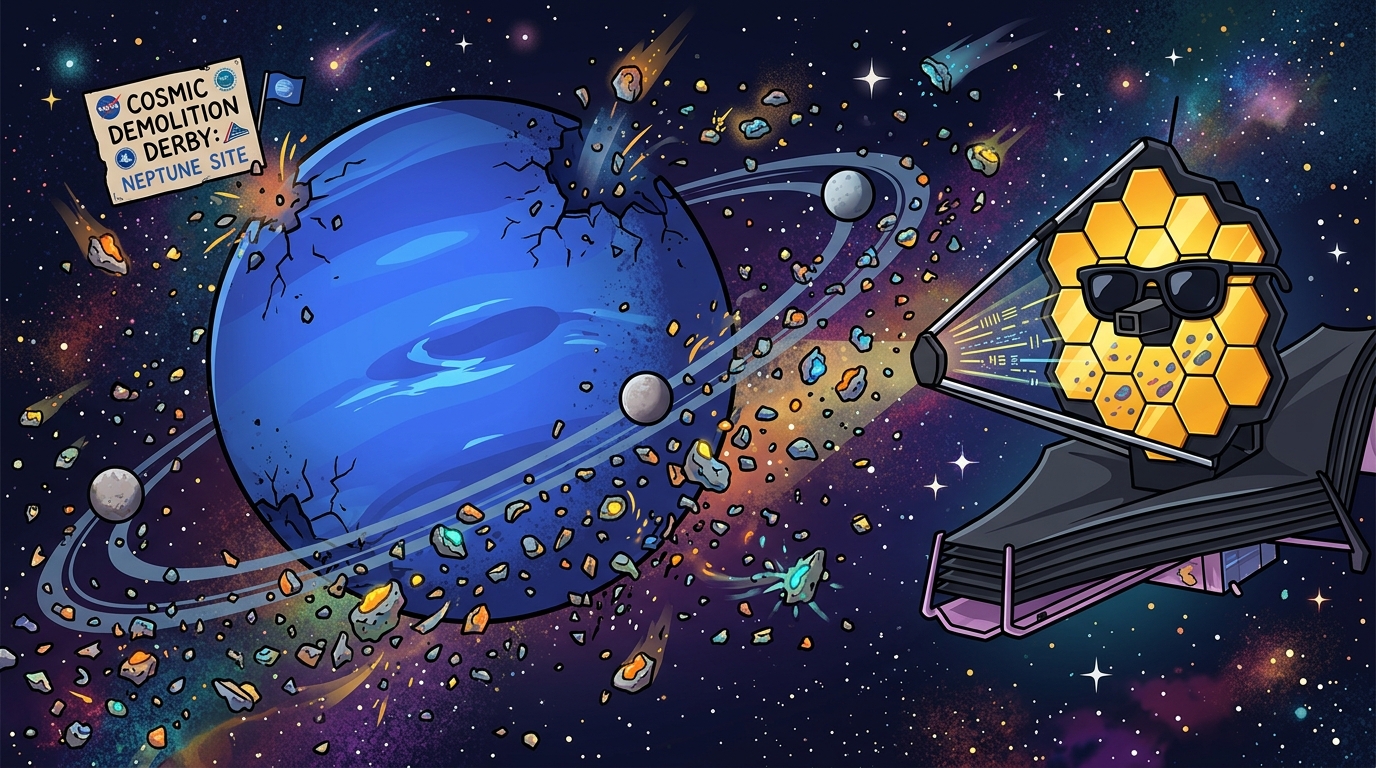
If you thought Neptune’s little inner moons were just peaceful icy pebbles drifting in the deep freeze of the outer solar system, think again. The James Webb Space Telescope just revealed that they are actually the battered graveyard of a catastrophic planetary demolition derby.
In a study published in Science Advances, an international team of planetary scientists analyzing infrared spectra from the James Webb Space Telescope (JWST) detected magnesium-rich phyllosilicates—essentially hydrated clay minerals—across three of Neptune's small inner moons: Larissa, Galatea, and Proteus.
🪐 Why Clay on Neptune Makes Astronomers Gasp
Clay cannot form in the freezing vacuum of space. It requires warm, sustained hydrothermal interactions between liquid water and rock inside a large planetary body with an active internal heat source. Neptune's current inner moons are tiny (barely 100–400 km across) and frozen solid. They could never have held liquid water on their own.
The only scientific explanation? These minerals formed deep inside ancient, full-sized icy worlds billions of years ago. When Neptune gravitationally captured its giant rogue moon, Triton, from the Kuiper Belt, Triton’s chaotic backward orbit acted like a cosmic wrecking ball, pulverizing Neptune’s original moon family into pulverized shrapnel.
🔨 The Ultimate Cosmic Recycling Project
After the dust settled, gravity clumped the shattered planetary remains back together into the deformed inner moons and rings we see today. The team even detected an unknown hydrated mineral that matches nothing in current spectral databases—hinting at exotic chemistry from long-dead ocean worlds.
So next time you gaze at Neptune's faint rings and tiny moons, remember: you’re not looking at pristine celestial sculptures, but the reassembled spare parts of solar system history.
You might also like

Cosmic Wardrobe Malfunction: JWST Catches Asteroid Chariklo's Rings Radically Shifting Opacity in Real Time
Astronomers thought planetary rings were timeless cosmic jewelry. But new James Webb Space Telescope observations reveal that mini-planet Chariklo swapped its ring opacity like mood rings—in just 10 short years.
JWST Finds a 'Black Hole Star' Wearing a Solar-System-Sized Gas Trenchcoat
Astronomers discovered object MoM-BH*-1, which shines 100 billion times brighter than a star and looks like a star, but is secretly a supermassive black hole disguised in a giant hydrogen cocoon.

Cosmic Monster Trucks: JWST Catches 21 Teenage Alien Solar Systems Smashing Planets into Vaporized Glass
The James Webb Space Telescope peeked inside 21 rare 'extreme debris disks' and caught teenage solar systems playing planetary dodgeball, vaporizing Mars-sized worlds into glowing clouds of silica glass.