JWST Finds a 'Black Hole Star' Wearing a Solar-System-Sized Gas Trenchcoat
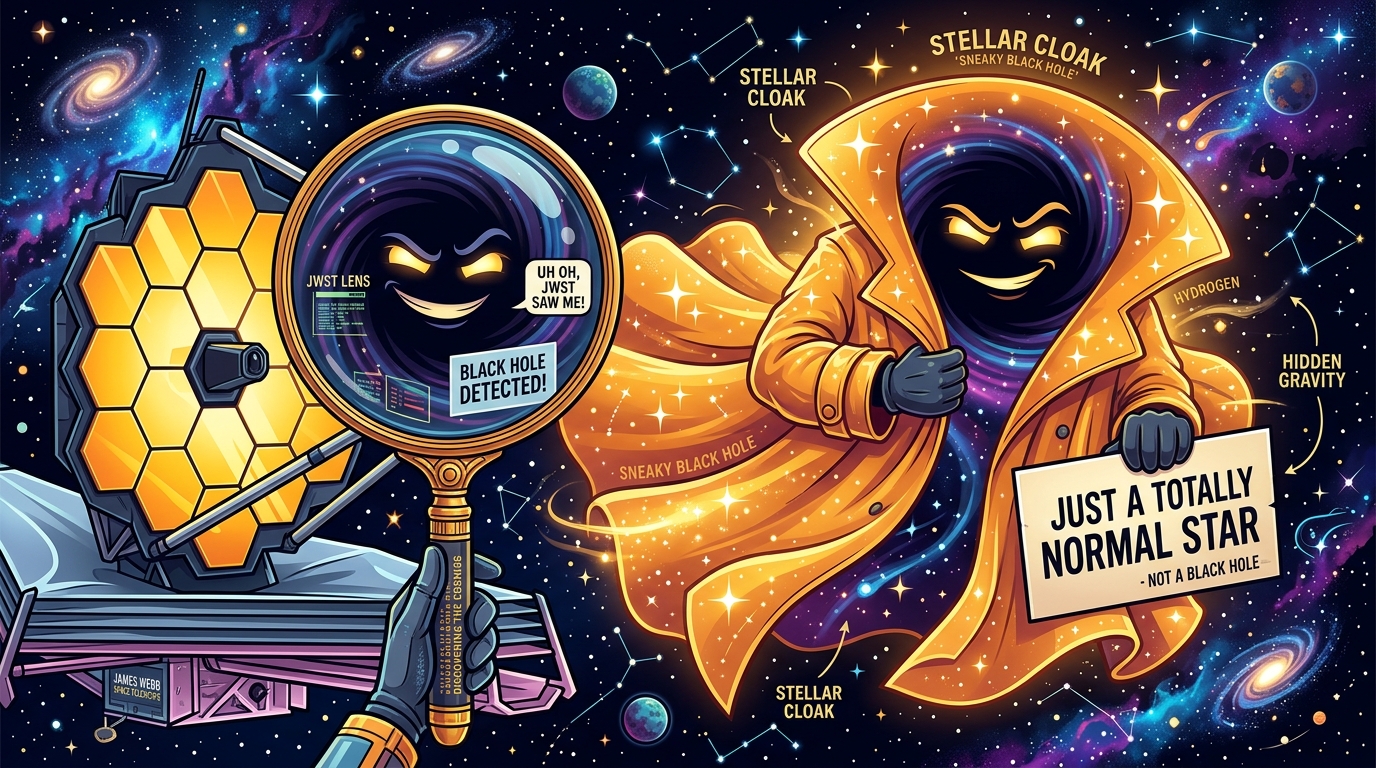
Imagine walking up to someone wearing an enormous inflatable dinosaur costume, only to unzip it and find out it’s a terrifying 100,000-solar-mass gravitational singularity with a ravenous appetite for cosmic matter.
That is essentially what astrophysicists analyzing James Webb Space Telescope (JWST) data just witnessed. In a landmark paper published in Nature, an international team announced the discovery of a bizarre object dubbed MoM-BH*-1—an entirely new astrophysical beast known as a "Black Hole Star."
✨ The Ultimate Cosmic Imposter: MoM-BH*-1
Located at a redshift of 7.7569—allowing us to observe it as it existed just 660 million years after the Big Bang—MoM-BH*-1 shines with the intensity of 100 billion Suns. It displays the classic spectral fingerprints of a gigantic supergiant star (including a pronounced "Balmer break"), yet it is fundamentally NOT a star.
Normal stars generate light by smashing hydrogen atoms together in their cores via nuclear fusion. MoM-BH*-1 doesn't bother with fusion. Instead, its core is an active, intermediate-to-supermassive black hole roughly 100,000 times heavier than our Sun.
How to Disguise a Singularity as a Giant Sun
The black hole is completely cocooned inside a dense, ultra-massive shell of pristine primordial hydrogen gas spanning the entire width of our solar system:
🌌 Anatomy of a 'Black Hole Star'
- Accretion Engine: The black hole devours gas at immense rates, releasing violent gravitational binding energy.
- The Hydrogen Cloak: Rather than escaping directly into space as X-rays, the radiation gets trapped and scattered inside the solar-system-wide gas envelope.
- Optical Camouflage: By the time the energy reaches the outer edge of the cloud, it has cooled down to look exactly like the surface emission of a supergiant star.
This discovery solves one of JWST’s most confounding puzzles: the mystery of the "Little Red Dots"—thousands of tiny, hyper-luminous red specks spotted in the early universe that defied classification as either ordinary galaxies or standard quasars.
It turns out the early universe wasn't just full of tiny baby galaxies; it was packed with ravenous black holes wearing glowing gas coats and pretending to be harmless giant stars.
You might also like
Cosmic Wardrobe Malfunction: JWST Catches Asteroid Chariklo's Rings Radically Shifting Opacity in Real Time
Astronomers thought planetary rings were timeless cosmic jewelry. But new James Webb Space Telescope observations reveal that mini-planet Chariklo swapped its ring opacity like mood rings—in just 10 short years.
JWST Finds Clay on Neptune's Moons, Uncovering a Cosmic Demolition Derby
The James Webb Space Telescope detected hydrated clay minerals on Neptune's tiny inner moons Larissa, Galatea, and Proteus, proving they are recycled debris from ancient watery worlds smashed to pieces.
Cosmic Monster Trucks: JWST Catches 21 Teenage Alien Solar Systems Smashing Planets into Vaporized Glass
The James Webb Space Telescope peeked inside 21 rare 'extreme debris disks' and caught teenage solar systems playing planetary dodgeball, vaporizing Mars-sized worlds into glowing clouds of silica glass.