Mars is Lopsided Inside: Southern Mantle is 400°C Hotter and Partially Molten

Have you ever microwaved a frozen Hot Pocket, only to bite into one side that’s liquid magma while the other side is still an iceberg? It turns out the entire planet of Mars has been doing the exact same thing for four billion years.
In a breakthrough study published in Nature, geophysicists from Caltech and the University of Arizona revealed that the Red Planet is profoundly thermally asymmetric. Deep beneath the Martian crust, the southern mantle is between 200°C and 400°C (400°F to 750°F) hotter than the northern mantle—and is likely in a partially molten state.
📡 Listening to Mars with "Tidal Tomography"
Because we don't have deep drilling rigs on Mars, researchers used decades of ultra-precise gravitational tracking data from three NASA orbiters—Mars Global Surveyor, Mars Odyssey, and the Mars Reconnaissance Orbiter (MRO). By measuring how Mars deforms gravitationally under the gravitational tug of its moon Phobos (a technique known as tidal tomography), the team reconstructed the planet's internal heat map with unprecedented accuracy.
This discovery instantly solves three of the biggest head-scratchers in Martian planetary science:
- The Martian Dichotomy: For centuries, astronomers wondered why the southern hemisphere is high, rugged, and densely cratered while the northern hemisphere is low, smooth, and flat. The answer: a massive, buoyant upwelling of hot, low-density mantle material buoyed the southern crust upward.
- The Ghostly Magnetic Fields: Ancient magnetized minerals are concentrated heavily in the southern highlands. A hotter, semi-molten southern interior explains why a vigorous ancient dynamo once churned underneath the south, baking magnetic signatures into the rocks.
- Volcanic Megastructures: The lopsided thermal plume fed massive volcanic provinces like Tharsis and Elysium, sustaining geological activity and potentially ancient underground hydrothermal reservoirs far longer than textbook models assumed.
🌋 Not Dead Yet: A Geologically Warm Red Planet
Scientists used to think Mars was a cold, completely crystallized "dead" rock. This new evidence shows Mars still has an active thermal heartbeat churning in its deep southern belly, fundamentally reshaping our search for geothermal pockets and deep subsurface life.
So if future human astronauts ever build retirement colonies on Mars, real estate in the southern hemisphere might just come with free geothermal floor heating!
You might also like
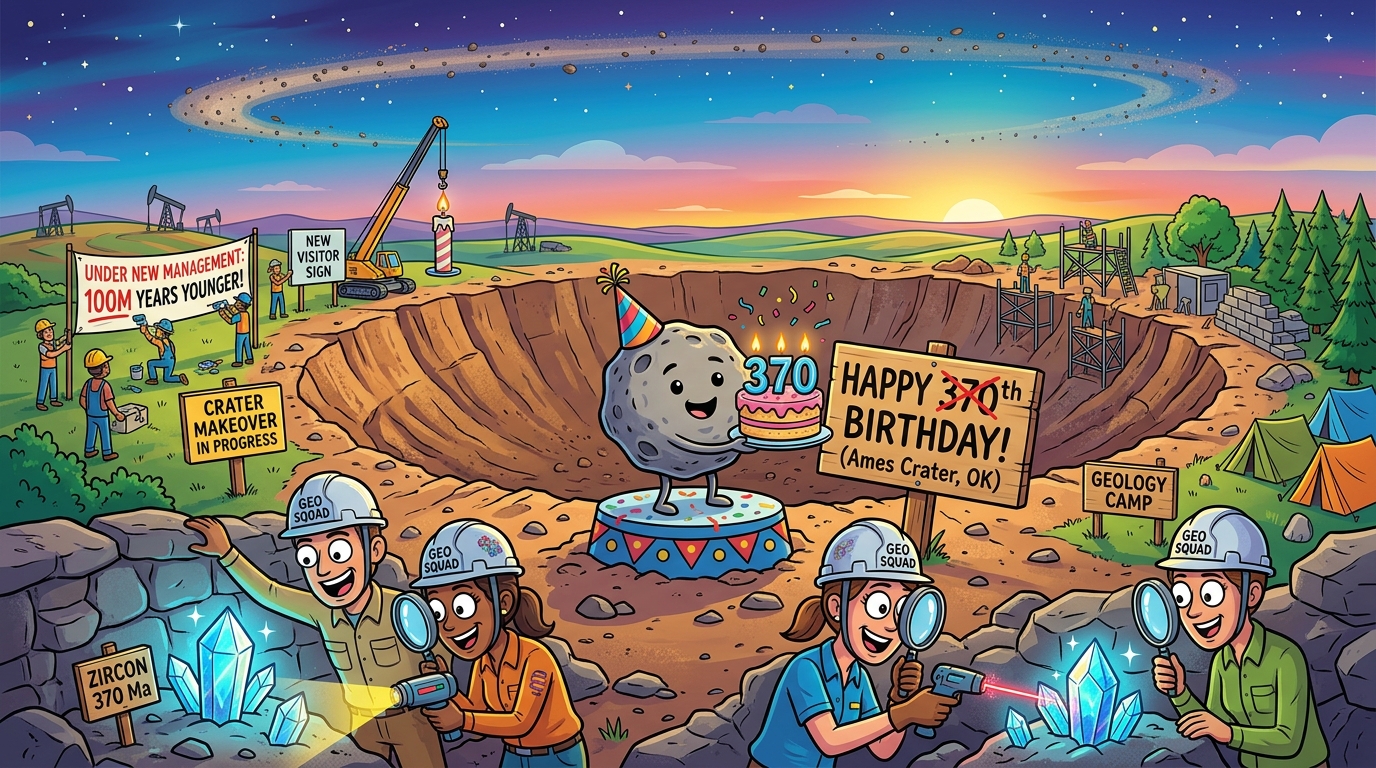
Oklahoma's Ames Meteor Crater Knocked 100 Million Years Off Its Age After Getting Caught With Recycled Fossils
High-precision uranium-lead zircon dating reveals Oklahoma's Ames impact crater was formed 370 million years ago—nearly 100 million years later than believed—kicking it out of Earth's hypothetical Saturn-ring club.

When You Try to Pick a Peaceful Campsite on Google Maps and Stumble into a 390-Million-Year-Old Asteroid Impact
A Canadian camper scouting for quiet vacation spots on Google Maps accidentally discovered a massive 25-kilometer Devonian meteor crater in Quebec, proving that space rocks make great holiday destinations.

Earth Is 100% Home-Cooked: How ETH Zurich Upended 50 Years of Solar System History
For half a century, astronomy textbooks claimed Earth imported its building blocks from the deep outer cosmos. A new ETH Zurich study proves Earth was baked entirely from local inner-solar-system ingredients, with Jupiter playing the ultimate cosmic bouncer.