Perseverance Rover Captures the Ultimate Photobomb: Phobos 'Eclipses' Earth
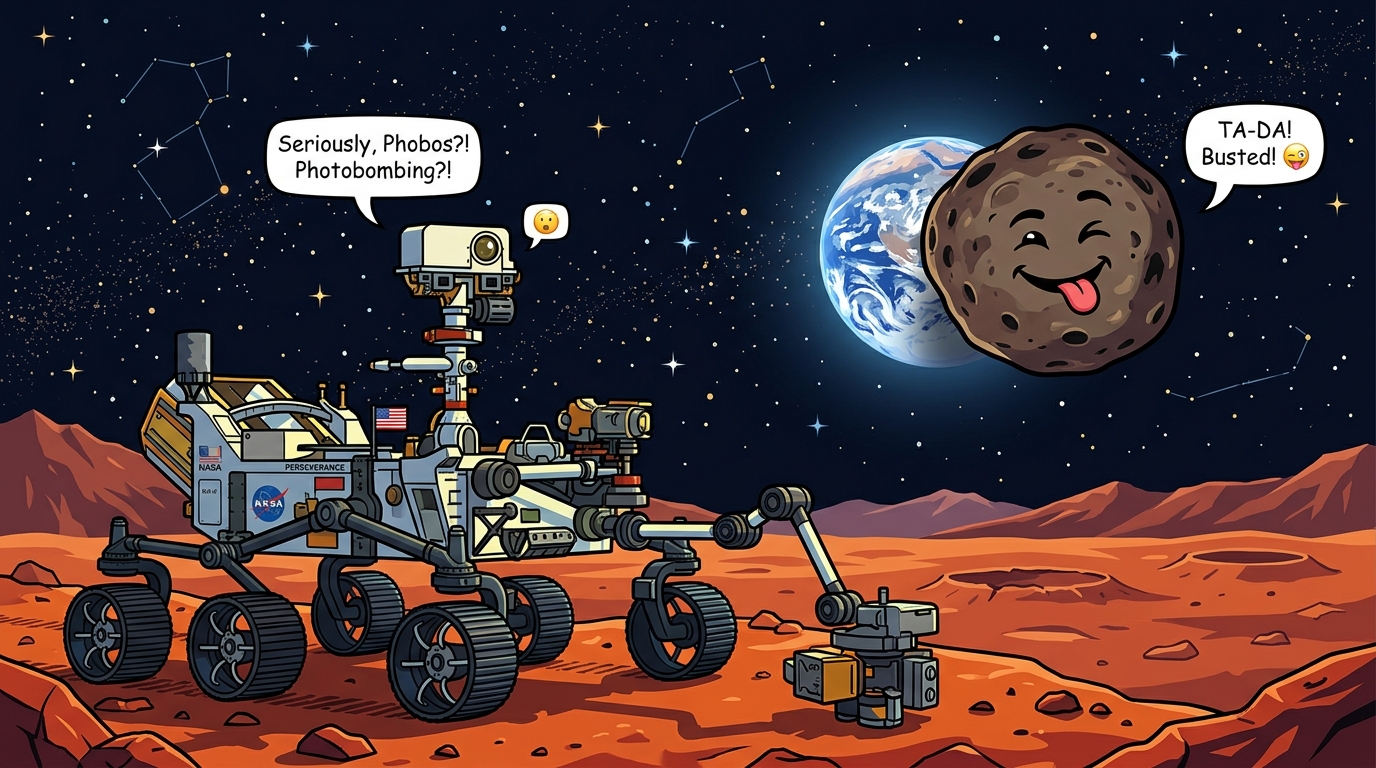
You’ve seen solar eclipses, lunar eclipses, and maybe even your cat walking in front of your Zoom camera. But you’ve never seen an Earth eclipse—until NASA’s Perseverance rover caught Mars’s potato-shaped moon photobombing our entire home planet.
In August 2026, NASA released breathtaking footage captured from the surface of Jezero Crater by the Perseverance rover's Mastcam-Z camera. For the first time in human history, an instrument on another planetary surface recorded Earth winking out behind another celestial body in a phenomenon known as an interplanetary occultation.
🥔 The 10-Second Cosmic Blink
Around 7:00 PM local Martian solar time, Earth appeared as a brilliant, lonely blue-white pixel in the Martian twilight. Suddenly, the craggy, potato-shaped silhouette of Phobos—Mars's innermost moon—glided directly across the field of view, completely blotting out Earth for approximately 10 seconds.
While people on Earth were gearing up to watch the total solar eclipse sweep across Greenland and Spain, Perseverance was having its own VIP cosmic viewing party 140 million miles away.
📸 More Than Just a Cute Postcard
Beyond giving astronomy nerds chills, timing the exact microsecond Earth disappears helps orbital dynamicists refine calculations of Phobos's slow, death-spiral orbit toward Mars with sub-meter precision.
Every single person you know, every argument you’ve ever had, and every line of code you've written was briefly hidden behind a flying Martian space potato. Now that's perspective.
You might also like

NASA Dispatches GIMLI to the Moon: Mining Subterranean Lava Caves for Astronaut Luxury Suites
NASA's PRISM program has officially selected the GIMLI mission to probe the mysterious Marius Hills Pit, verifying whether massive underground lunar lava tubes can shield future astronaut outposts from cosmic doom.

Cosmic Strike! A Building-Sized Asteroid Just Punched the Largest Fresh Crater on the Moon in a Century
NASA’s Lunar Reconnaissance Orbiter caught 'McGetchin,' a monstrous 728-foot impact crater blasted open by a space rock the size of a six-story apartment building—chilling 4 miles of lunar soil by 16 degrees.

Mars is Lopsided Inside: Southern Mantle is 400°C Hotter and Partially Molten
A landmark Nature study reveals that Mars is secretly running a lopsided thermal engine—its southern interior is 200°C to 400°C warmer than the north, solving centuries of Martian mysteries.