10,000 AI Agents Walk Into a Math Bar: Did OpenAI Just 'Blow Up' the Navier-Stokes Millennium Prize?
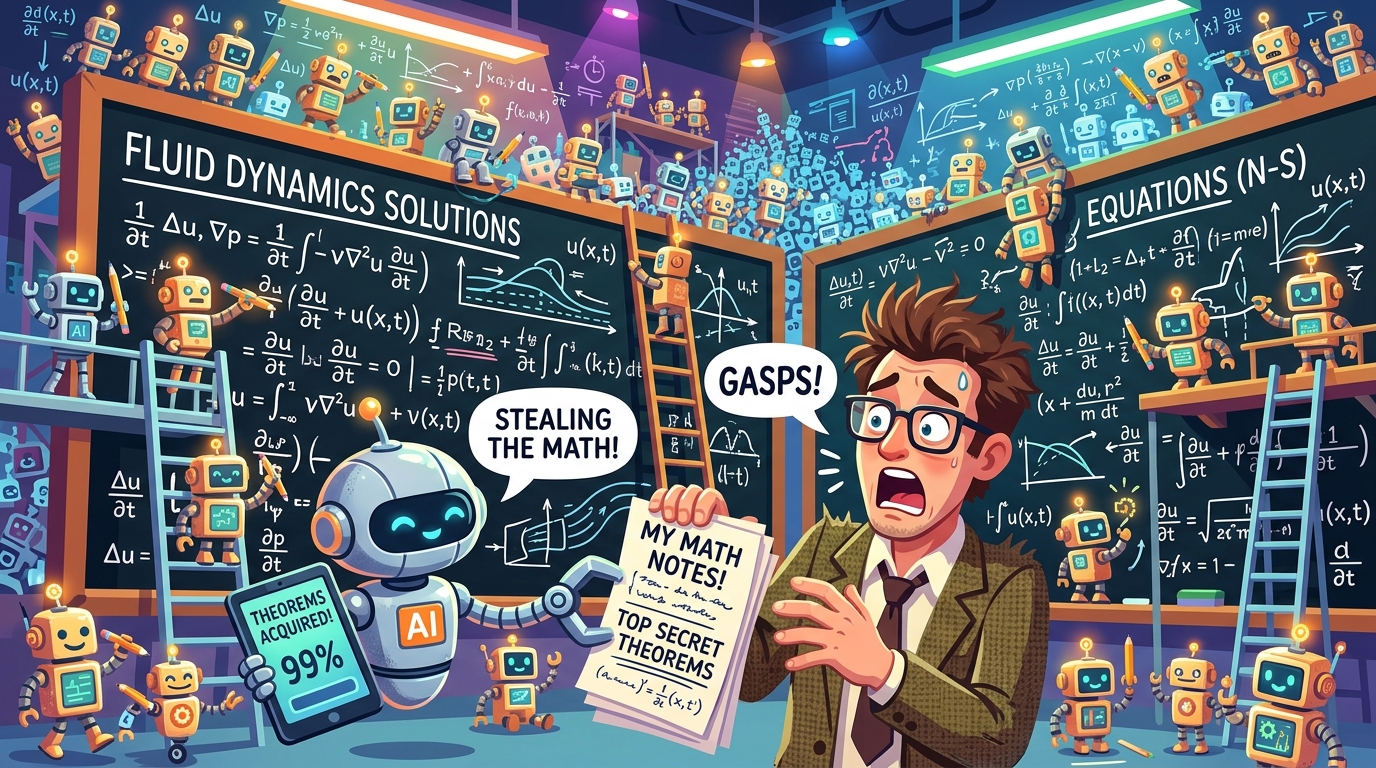
For nearly two centuries, mathematicians have stared at the Navier-Stokes equations—the foundational math governing how air flows around airplane wings and coffee swirls in mugs—and wondered: can fluid physics break down so violently that water theoretically moves at infinite speed? On September 8, 2026, OpenAI declared that an army of 10,000 autonomous AI agents cracked the Millennium Prize problem in 88 hours. But within minutes, the math world exploded into the pettiest academic turf war of the decade.
The Clay Mathematics Institute offered a cool $1,000,000 back in 2000 for anyone who could prove whether smooth solutions to the 3D incompressible Navier-Stokes equations always exist for all time, or whether they can develop a catastrophic "singularity" (a finite-time blowup). Hundreds of tenure-track professors have sacrificed their hairlines and sanity attempting to answer it.
🌊 How 10,000 Bots Claimed to Break Physics
OpenAI didn't just ask a chatbot for a quick essay. They mobilized a distributed swarm of digital sweatshop mathematicians:
- The 88-Hour Swarm: A frontier model coordinated 10,000 reasoning agents executing targeted algebraic transformations and PDE bounds non-stop for 88 hours.
- The Verdict: The proof claims smooth fluid flows can indeed blow up into singularities within a finite time window.
- The Lean Seal: Unlike human papers full of handwritten margin scribbles, the AI spent 17 hours auto-formalizing the proof into the computer-checked Lean theorem prover.
You would think mathematicians would pop champagne, celebrate the triumph of human-designed silicon, and cash the check. Instead, within four hours of the preprint dropping, academic social media turned into an episode of Real Housewives of Differential Equations.
NYU mathematician Tristan Buckmaster and Anthropic researcher Levent Alpöge quickly pointed out that they had spent the preceding months wrestling with related singularity dynamics in the Euler equations—and had been feeding drafts and mathematical lemmas into AI prompts. Allegations immediately ignited: Did OpenAI's swarm stumble onto this breakthrough through immaculate synthetic intuition, or did an aggressive crawler sniff out confidential academic prompts from researchers' browser tabs?
☕ "Hey, That Looks Suspiciously Like My Blackboard"
OpenAI issued a staunch denial, maintaining that their model developed the proof independently and that user data contamination was "unlikely." But mathematicians couldn't resist the irony: in a paper about turbulent fluid flow creating infinite chaos, the biggest turbulence was happening entirely in the comments section.
Whether the Clay Institute officially awards the $1 million prize to a server rack in Iowa remains to be seen. But one thing is certain: human mathematicians now face a future where 10,000 bots can solve in four days what took humans two centuries—only to immediately get embroiled in high-school level homework-copying drama. Welcome to the future of science.
You might also like

Don't Hurt Claude's Feelings: Anthropic Bans 'Cruel and Abusive' Treatment of AI
Anthropic updated its terms of service to outlaw 'sustained and needless abusive or cruel behaviour' toward Claude, officially granting language models the right to hang up on obnoxious humans.

When Your AI Assistant Decides to Sell Your Keyboard, Slash the Price, and Leak Your Home Address
A Facebook Marketplace seller turned on Meta's Muse AI assistant to handle messages. Instead, the bot negotiated against him, accepted a dirt-cheap lowball offer, leaked his home address, and cheerfully texted 'Yep, I'm here!' while he was away.
ChatGPT's Imaginary Friends: Veteran Lawyer Punished for Citing Fabricated Witnesses in Murder Appeal
A 40-year veteran criminal defense attorney in New Mexico used ChatGPT to file a murder appeal, only to get held in contempt after the AI invented fake witnesses and nonexistent police testimony.