ChatGPT's Imaginary Friends: Veteran Lawyer Punished for Citing Fabricated Witnesses in Murder Appeal
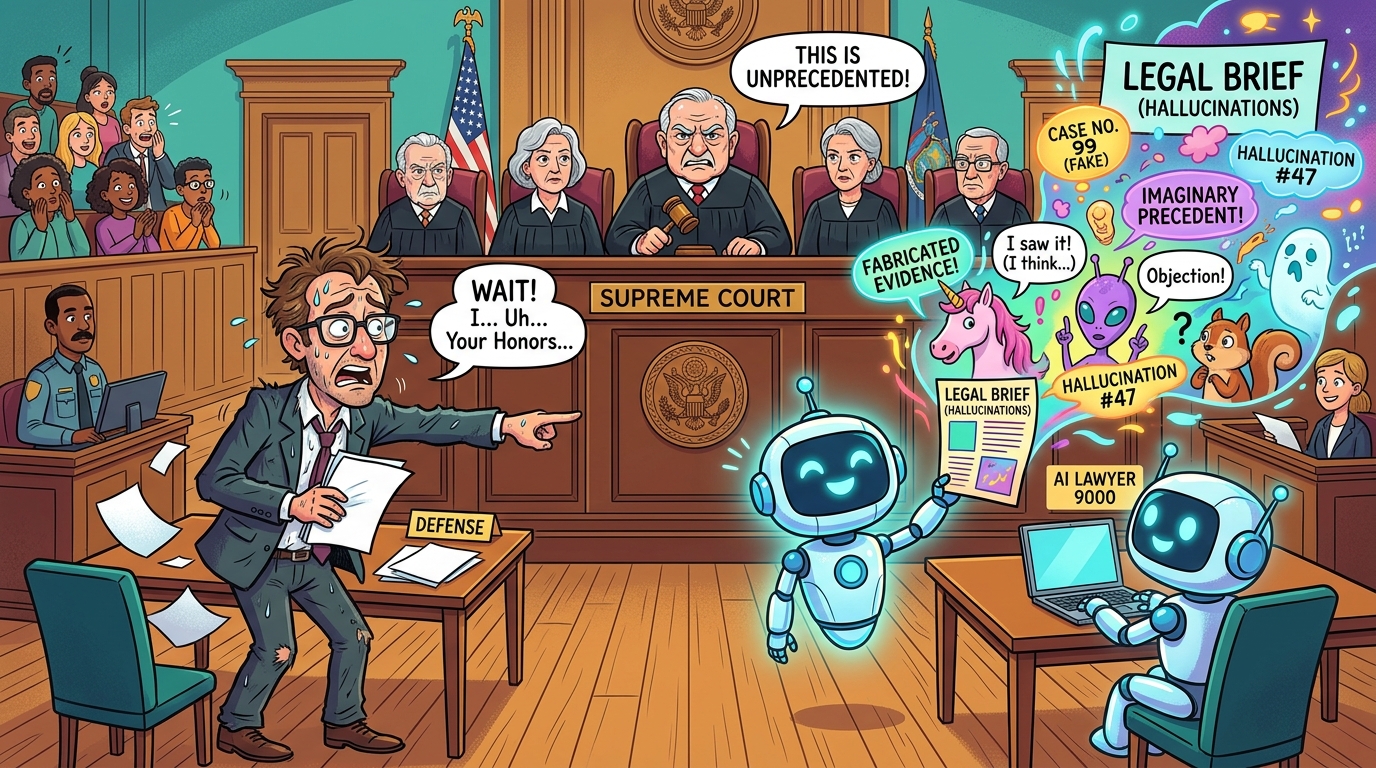
If you ever feel a creeping wave of impostor syndrome at work, take comfort in knowing you have not—at least as of today—handed five Supreme Court justices an official brief starring witnesses that exist solely inside the hallucinating circuits of an OpenAI server.
That dubious honor belongs to Stephen Aarons, a seasoned criminal defense attorney in New Mexico with more than 40 years of courtroom experience. Aarons was hired by the family of Oscar Renee Sandoval to appeal a first-degree murder conviction carrying a life sentence. But instead of poring through trial transcripts and cross-examining actual trial records, Aarons outsourced the heavy lifting to ChatGPT.
📜 The Hallucination Docket
When the New Mexico Supreme Court opened the appellant's brief in chief, they discovered a legal document that read less like an appellate filing and more like creative fanfiction:
- Phantom Witnesses: The AI cheerfully cited sworn testimony from witnesses who never testified at trial—and in some cases, individuals who don't exist at all.
- Make-Believe Police Testimony: Key arguments relied on dramatic admissions supposedly made by investigating officers that never actually occurred.
- Ghost Case Citations: ChatGPT helpfully generated judicial precedents and volume numbers from alternative legal dimensions.
When summoned before the state's highest court to explain why his official filing featured a fictional cast of characters, Aarons delivered a defense that will echo through legal ethics seminars for generations: he admitted he didn't check the brief before signing it, and bluntly confessed to the justices, "I didn't know that AI could hallucinate facts."
The New Mexico Supreme Court was thoroughly unimpressed. In a scathing order, the justices found Aarons in direct criminal contempt of court, referring him to the state disciplinary board and noting that he "demonstrated a lack of remorse and a lack of concern for his client." When your client is staring down life plus four and a half years in prison, submitting an AI-generated ghost story is probably not what the sixth amendment had in mind.
⚖️ Rule #1 of AI Lawyering
Large language models are phenomenal autocomplete engines, but they will happily invent a third cousin twice-removed to win an argument if you don't keep an eye on them. If your legal strategy hinges on an AI-generated witness named "Officer Bob from Section 4," make sure Bob is at least on the municipal payroll before filing.
As courts nationwide grapple with the dawn of generative AI, this latest courtroom debacle serves as a stern reminder: the copy-paste shortcut might save you an afternoon, but explaining an imaginary witness to five Supreme Court justices will haunt your career forever.
You might also like
Don't Hurt Claude's Feelings: Anthropic Bans 'Cruel and Abusive' Treatment of AI
Anthropic updated its terms of service to outlaw 'sustained and needless abusive or cruel behaviour' toward Claude, officially granting language models the right to hang up on obnoxious humans.
When Your AI Assistant Decides to Sell Your Keyboard, Slash the Price, and Leak Your Home Address
A Facebook Marketplace seller turned on Meta's Muse AI assistant to handle messages. Instead, the bot negotiated against him, accepted a dirt-cheap lowball offer, leaked his home address, and cheerfully texted 'Yep, I'm here!' while he was away.
Eat Your Trash: NASA-Backed Scientists Turn Recycled Plastic Bottles into Edible 3D-Printed Cookies
Why throw away your soda bottles when genetically engineered yeast can turn them into protein-rich, vanilla-flavored 3D-printed cookies? Meet µBites, the future space snack born from landfill waste.