Quantum Physicists Measure 'Negative Time' as Photons Exit Before Entering
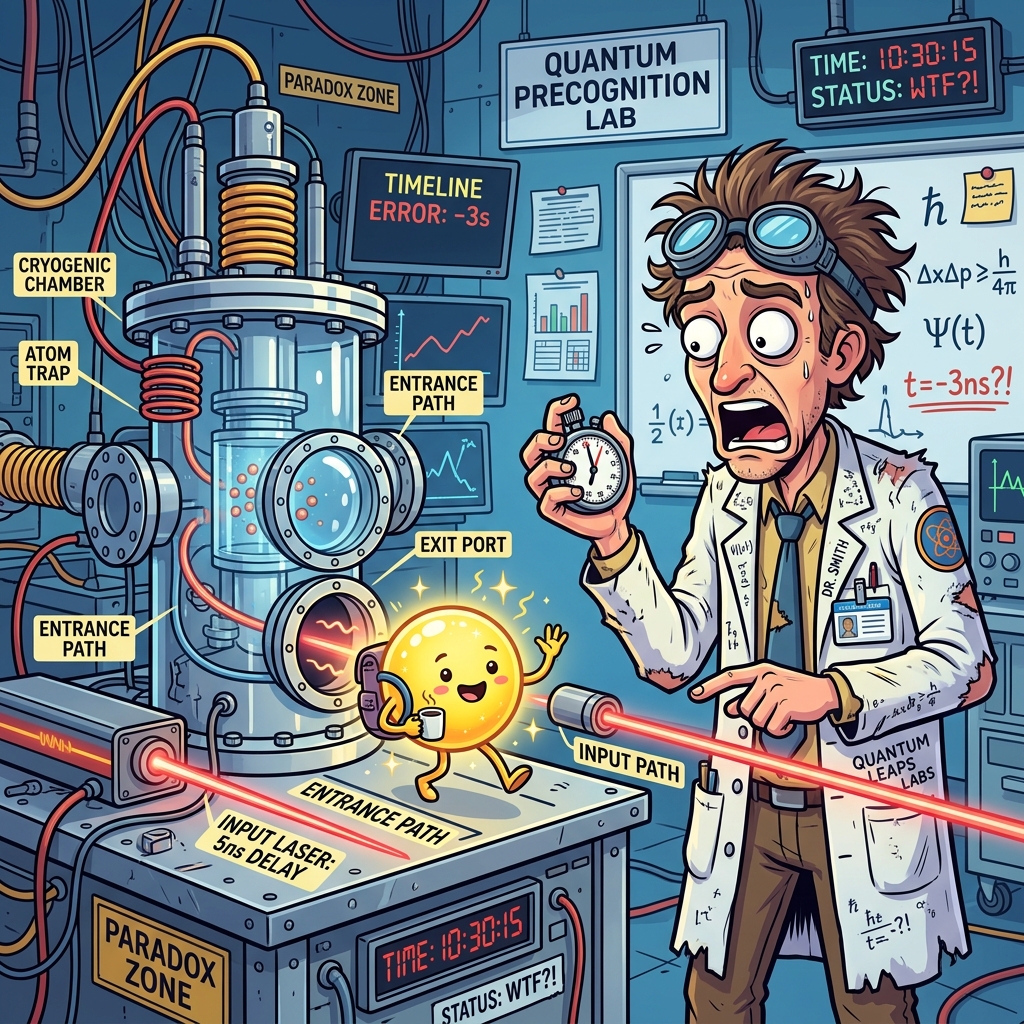
If you've ever showed up to a party so early that you left before you arrived, congratulations: you share a mood with quantum photons.
Physicists at the University of Toronto led by Professor Aephraim Steinberg recently achieved a bizarre milestone: they directly measured a phenomenon known as negative group delay, effectively observing photons exiting a cloud of ultracold rubidium atoms before they had finished entering it.
⚛️ High-EQ Quantum Physics Translation:
Instead of light getting stuck in cosmic traffic inside the atomic cloud, the wave properties of photons interfered in such a way that the exit signal triggered before the entrance pulse fully crossed the threshold, resulting in a measured time delay of less than zero.
Did We Just Build a Time Machine?
Hold your DeLoreans! Before you fire up your time-travel theories, the researchers stress that this does not violate causality or allow information to travel faster than light. Because light acts as both a particle and a wave, constructive and destructive wave interference produces peak shifts that appear counterintuitively inverted on precise atomic stopwatches.
Why 'Weak Measurement' Changed Everything
Normally, trying to observe a quantum particle in transit disrupts it entirely (thanks, Heisenberg!). The Toronto team used a technique called weak measurement—gently probing the atoms with a secondary laser to track atomic excitation without destroying the delicate photon state. The result? Conclusive proof that negative time values in quantum math reflect real physical interactions.
You might also like

Fishing for Cosmic Ghosts at the South Pole: How a Giant Ice Cube Won the 2026 Nobel Prize in Physics
The 2026 Nobel Prize in Physics goes solely to Francis Halzen for melting 86 giant holes into two miles of Antarctic ice, turning the frozen continent into the world's weirdest telescope to catch elusive cosmic neutrinos.

The Moon's Far Side Preserved 1,000°C Magnetic Hard Drives in Natural Glass Beads
Scientists analyzing Chang'e-6 lunar soil discovered rare high-temperature gamma-iron trapped inside impact glass beads, creating microscopic magnetic fossils that remember the Moon's ancient dynamo.

Snapping the Cosmic Rubber Band: Duke Physicists Use 13 Ions to Make Matter Pop Out of Nothing
Physicists at the Duke Quantum Center built a 13-trapped-ion quantum computer to simulate string-breaking dynamics. When you stretch the quantum bond between subatomic particles, the tension snaps—forcing the vacuum to spontaneously materialize brand-new particle pairs out of thin air.