Cosmic Fashion Upgrade: Saturn Grows a 10-Sided 'Decagon' Crown at Its South Pole
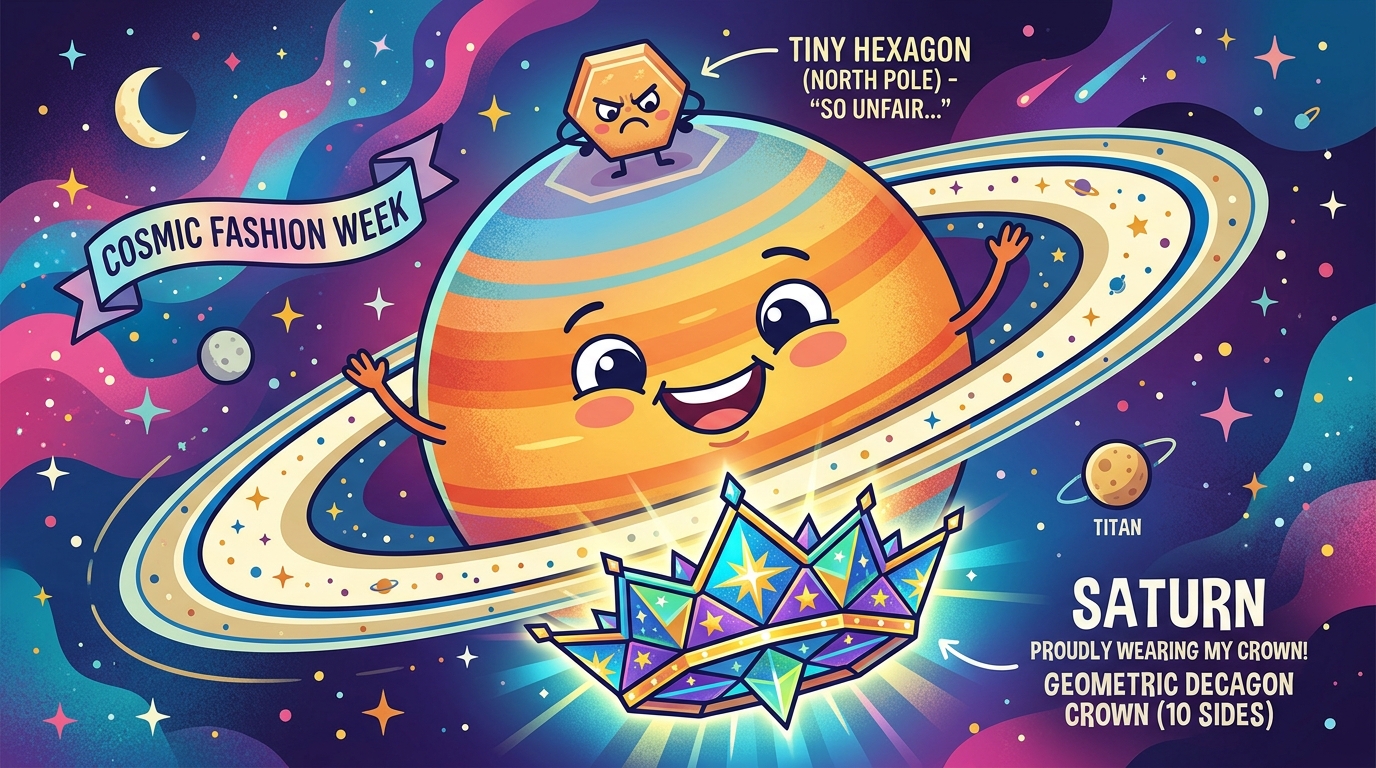
For more than four decades, Saturn has reigned as the solar system's coolest celestial hipster thanks to a bizarre, hyper-stable six-sided storm spinning endlessly over its north pole. But apparently, having just one geometric party trick was not enough. Enter the southern hemisphere with the ultimate celestial upgrade: a glorious 10-sided atmospheric "decagon."
In a study published in Science Advances, an international research team analyzing archival data from NASA's Hubble Space Telescope Outer Planet Atmospheres Legacy (OPAL) program revealed that Saturn's south pole has developed a persistent, regular 10-sided atmospheric wave. Researchers from the University of the Basque Country, NASA Goddard Space Flight Center, and UC Berkeley discovered that this geometric marvel began forming as faint ripples back in 2023 before steadily sharpening into a full-fledged decagonal jet stream.
🪐 Why This Stunned Planetary Scientists
When NASA's Cassini spacecraft orbited Saturn between 2004 and 2017, it mapped every square kilometer of the planet and found zero traces of a southern polygon. The south pole was just an ordinary swirling vortex. Now, Hubble data proves that Saturn's atmosphere spontaneously reorganized itself into a regular 10-sided polygon in under a decade.
Why is the planetary science community so obsessed with this 10-sided newcomer?
- The Hexagon Finally Has a Sibling: While the northern hexagon has baffled physicists since Voyager spotted it in 1980, scientists long wondered if it was a freak cosmic accident. Having a 10-sided sibling proves that planetary jet streams naturally love regular polygons.
- Atmospheric Fluid Dynamics at Scale: The decagon is driven by Rossby waves—massive meanders in atmospheric jet streams caused by the planet's rapid 10.5-hour rotation and intense internal heat flux.
- Rapid Seasonal Metamorphosis: Saturn takes nearly 30 Earth years to orbit the Sun. Observing a massive planetary-scale wave evolve in just a few Earth years reveals that Saturnian seasons harbor dramatic, rapid weather shifts.
📐 Geometry Class on a Gas Giant
If you ever struggled with high school geometry, take solace in knowing that Saturn takes it very seriously. Six sides on top, ten sides on the bottom—it seems the gas giant won't rest until it has demonstrated every polygon in Euclid's textbook across its cloud tops!
Astronomers will keep Hubble and future orbital probes trained on Saturn's south pole to see whether this 10-sided newcomer endures for decades like its northern older brother, or whether it transforms into a dodecagon next season just to show off even more.
You might also like

The 10-Billion-Year-Old Voicemail: Webb and MeerKAT Catch the Most Distant Radio Flash in Cosmic History
Astronomers have detected FRB 20240304B, a fast radio burst that traveled over 10 billion years across the universe, shattering cosmic distance records and proving ancient baby galaxies loved loud fireworks.
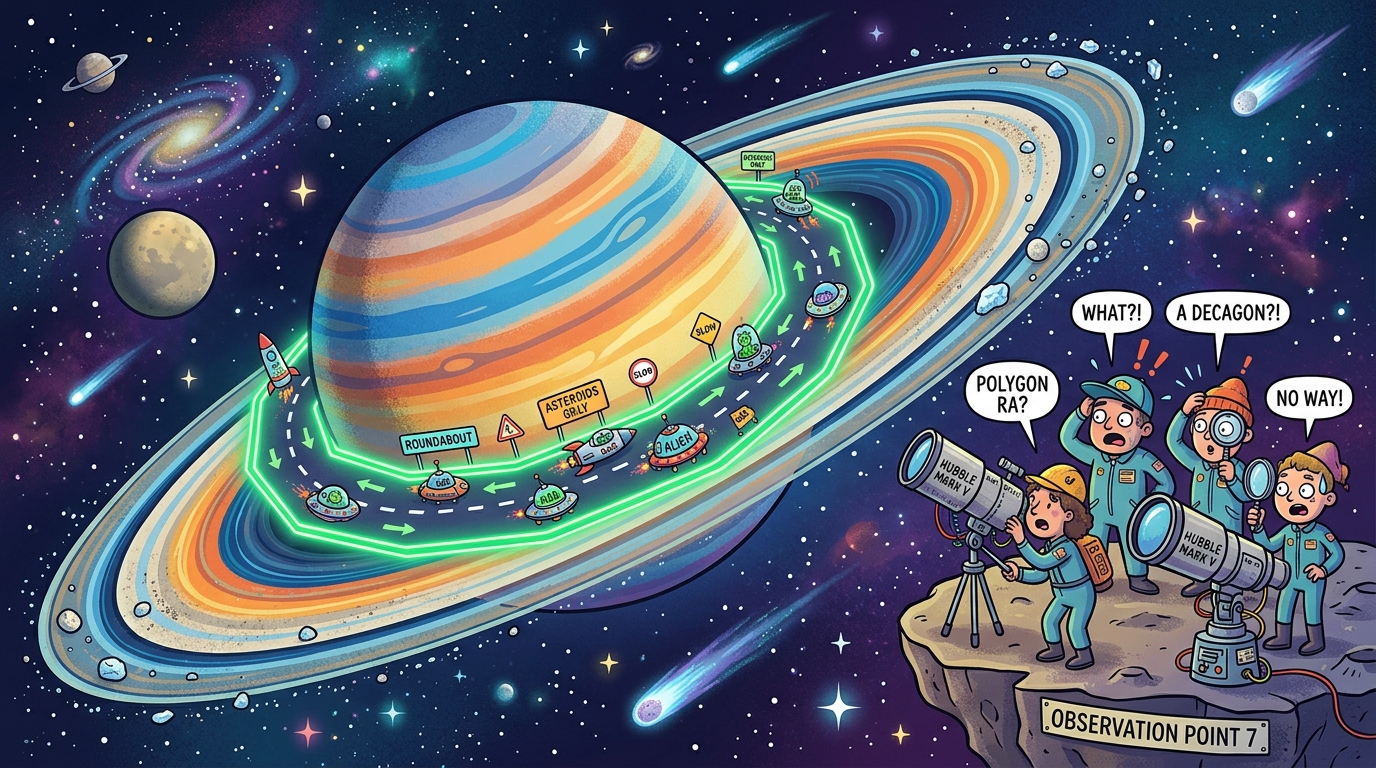
Saturn Got Bored With Its Hexagon, So Its South Pole Spun Up a 10-Sided Decagon
Hubble astronomers discovered a giant 10-sided atmospheric wave cruising around Saturn's south pole at 10 km/h, with each side stretching longer than planet Earth.

Cosmic D10 Dice: Hubble Discovers a Giant 10-Sided 'Decagon' Encircling Saturn's South Pole
Saturn already boasted a bizarre 6-sided hexagon on its north pole. Now Hubble astronomers spotted a wobbly 10-sided atmospheric decagon spinning around its south pole like a celestial board game piece.