Meet the Fish That Walks on Six Legs and Tastes Dinner with Its Feet
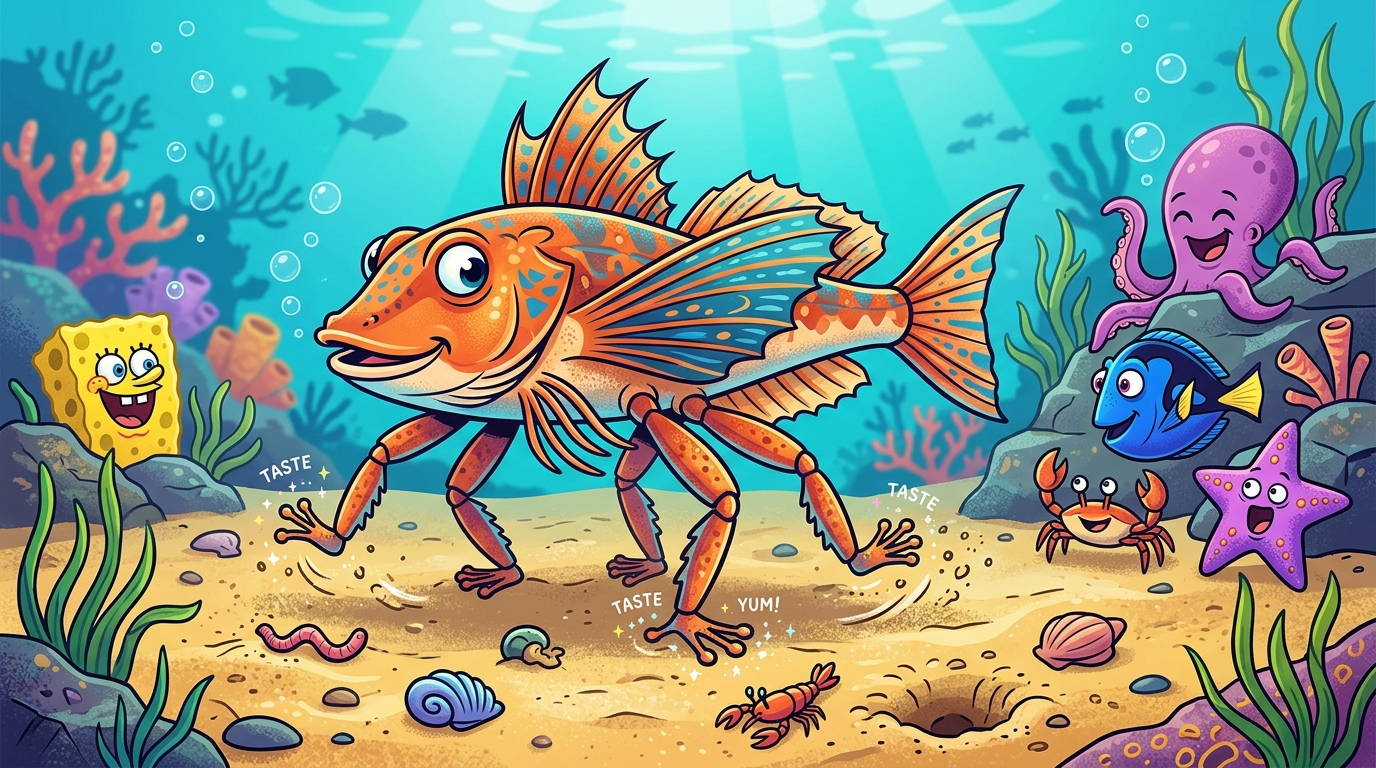
Imagine walking down a bustling street, but instead of stepping into a restaurant to order lunch, you simply kick off your shoes and lick the sidewalk with your toes to locate buried cheeseburgers. Welcome to the everyday life of the northern sea robin.
Mother Nature has designed plenty of weird evolutionary adaptations, from bioluminescent lanterns to venomous platypus spurs. But according to a pair of groundbreaking studies published in Current Biology by researchers at Harvard and Stanford University, the northern sea robin (Prionotus carolinus) might have clinched the gold medal for biological over-engineering. This quirky bottom-dweller didn't just turn its pectoral fin rays into six crab-like walking legs—it loaded those legs with genuine, functioning taste buds.
🦶 The Anatomy of a Six-Legged Sniffer
Led by biologists Nicholas Bellono of Harvard and David Kingsley of Stanford, the international research team cracked the genetic and anatomical blueprints of these bizarre appendages:
- Walking Pectoral Rays: Rather than using its legs solely to scuttle across the seafloor, each leg is an independent, hyper-flexible sensory shovel derived from modified pectoral fin rays.
- Papillae of Flavor: The tips of the sea robin's walking legs are densely coated in microscopic sensory bumps known as papillae—identical in design to the papillae on the human tongue.
- Molecular Tongue-Toes: The legs express specialized taste receptors that detect amino acid plumes leaching from buried clams, crabs, and marine worms hidden inches beneath the sand.
- Zero Vision Needed: When researchers placed disguised bait or buried chemicals in sandy lab tanks, sea robins unhesitatingly sprinted over and accurately dug up treats purely by "tasting" the seafloor with their footsteps.
What makes the discovery even more fascinating is the evolutionary twist. When the team compared the northern sea robin to its close relative, the striped sea robin (Prionotus evolans), they discovered that while both have walking legs, only the northern variety developed sensory papillae and digging superpowers. Striped sea robins just use their legs to strut around like ordinary aquatic stilts.
🧬 The Genetic "Copy-Paste" Masterclass
How did a conventional fish manage to grow crab legs that double as tongues? Through a brilliant trick of evolutionary repurposing:
- Borrowing Limb Transcription Factors: The researchers identified that sea robins hijacked ancient regulatory genes—specifically transcription factor tbx3a—usually responsible for vertebrate limb development.
- Flipping the Taste Switch: Instead of inventing new sensory organs from scratch, evolution simply took the taste bud genetic subroutines from the mouth and pasted them onto the fingertips of the fins.
- An Aquatic Super-Predator: Because they can taste buried prey invisible to other fish, other opportunistic ocean dwellers regularly trail behind sea robins, waiting to steal whatever gourmet shellfish the walking fish digs up.
The next time you complain about stubbing your toe on the coffee table, take a moment of gratitude that your feet don't possess taste buds. For the northern sea robin, every single step is literally a five-star tasting menu—sand grit included.
You might also like
Nature Liked Life So Much It Invented Free-Living Cells Twice
A landmark Science Advances study reveals that the leap from hydrothermal vents to independent free-living cells happened twice—giving rise to pioneer bacteria and pioneer archaea 4 billion years ago.
Octopuses Have Been Using a 100-Million-Year-Old Ribosome Hack to Live-Patch Their Brains
While tech companies struggle with buggy software updates, octopuses evolved a unique split in their ribosomal RNA 100 million years ago, allowing them to rewrite their genetic code on the fly without frying their nervous systems.
Orcas Invent Underwater Day Spas: Killer Whales Caught Manufacturing Kelp Loofahs
Scientists analyzing drone footage discovered that wild killer whales in the Salish Sea chop bull kelp to custom lengths and roll it between their bodies for mutual exfoliation—marking the first known tool-making in marine mammals.