Austrian Engineers 3D-Print Zero-Power Clay Cubes That Chill Rooms by 7°C
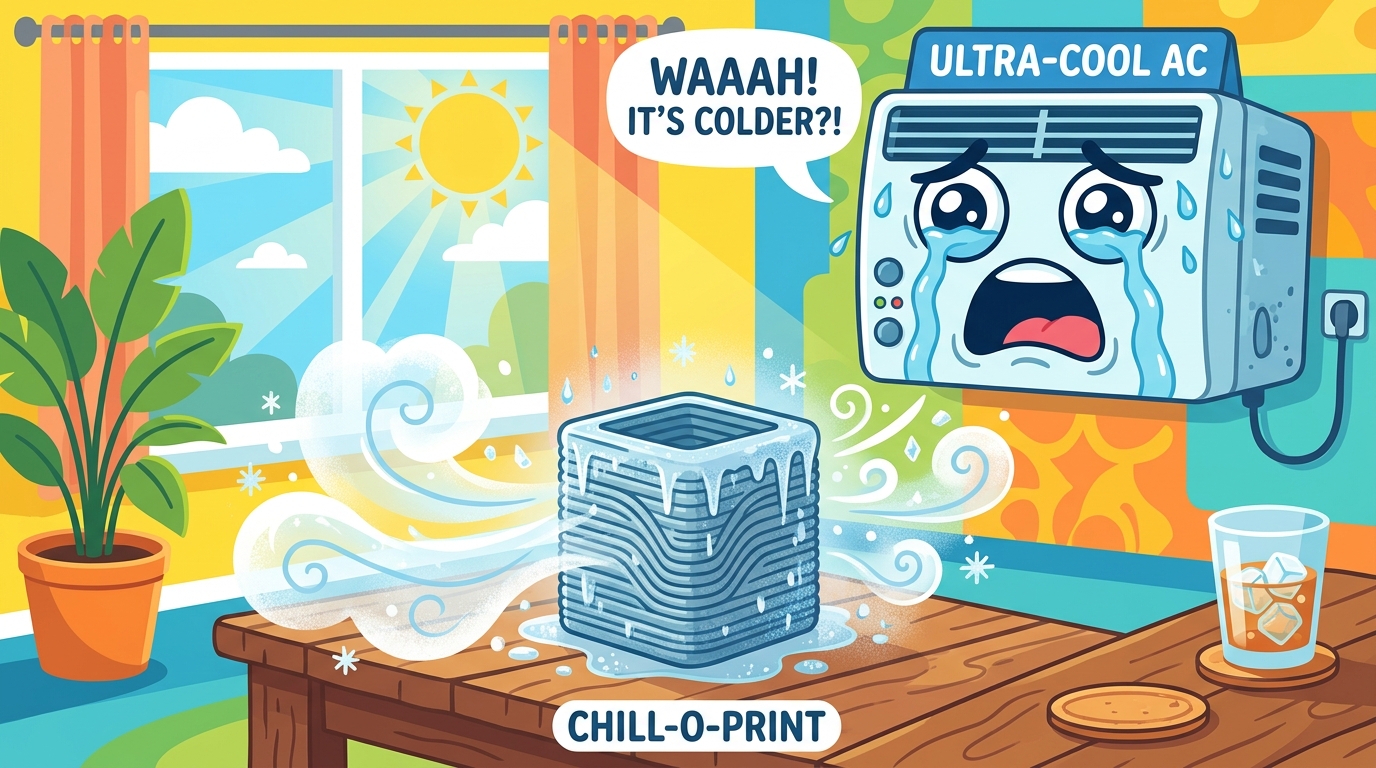
As summer heatwaves turn modern apartments into greenhouse pizza ovens, Austrian scientists have found a bizarrely elegant solution to runaway electric bills: a 3D-printed ceramic block made of mud, sawdust, and mushroom roots that cools your room by 7°C using nothing but water and pure thermodynamics.
Modern air conditioning is a necessary evil—it keeps our bedrooms arctic while guzzling ungodly amounts of grid electricity and spewing exhaust heat right back into city streets. But researchers at Graz University of Technology (TU Graz) in Austria decided to look back several thousand years to ancient Persian windcatchers and terracotta water jugs, giving them a 21st-century additive manufacturing makeover.
🧊 The Science of the "Cooling Cube"
Developed at TU Graz's Shape Lab, the prototype ceramic cube (measuring approximately 23 cm on each side) relies on the latent heat of vaporization. When filled with water, the specially formulated ceramic structure wicks moisture across an intricate maze of surface channels, pulling heat directly out of passing air and dropping the immediate ambient temperature by up to 7°C (12.6°F).
The Secret Sauce: Sawdust, Fungi, and Complex Geometry
You can't just slap normal bricks on a table and expect a blizzard. The TU Graz engineering team achieved this dramatic temperature drop through two clever tricks:
🛠️ How 3D Printing & Bio-Materials Create Super-Evaporation
- TPMS Minimal Surface Math: The cubes are 3D-printed with Triply Periodic Minimal Surface (TPMS) gyroid geometries, packing massive evaporative surface area into a lightweight, compact footprint.
- The "MyCera" Bio-Pore Recipe: The raw clay is blended with fine sawdust and living fungal mycelium. When kiln-fired at low temperatures, the organic matter burns away, leaving behind microscopic pore networks that suck up water like an ultra-dense capillary sponge.
- Zero Refrigerant Chemicals: Unlike conventional AC units loaded with ozone-depleting hydrofluorocarbons (HFCs), these cubes require only tap water or captured rainwater.
Because the cubes can be stacked into architectural walls, building facades, or placed on tabletops as decorative room chillers, architects envision entire city plazas and high-rise apartments lined with passive clay radiators to combat urban heat islands.
Your loud, rattling window AC unit might still be safe for another year or two, but the days of trading half your monthly salary for cool air are officially numbered.
You might also like

Taming the 50,000-Year Beast: How Chaos and Disorder Smashed Semiconductor's Worst Greenhouse Gas
KAIST and Samsung researchers harness the 'power of disorder' to create an entropy-stabilized catalyst that pulverizes CF₄—a gas 6,000 times worse than CO₂ that outlives civilizations.

The Ultimate Battery Paradox: Surrey Engineers Discover Leaving Water Inside Sodium Batteries Doubles Their Power
For decades, battery manufacturers treated water like literal poison. Now, materials scientists at the University of Surrey have proven that trapping water molecules inside sodium battery cathodes acts like an atomic superhighway, nearly doubling energy output!

The Ultimate Water Slide: KAIST Engineers Nanoscale Polymer Coating Delivering 5.5x Boost in Condensation Heat Transfer
By turning microscopic manufacturing 'defects' into hyper-efficient water-droplet trampolines, KAIST researchers engineered an ultrathin polymer coating that supercharges heat transfer in copper tubes by up to 550%!