Hey DNA, 'U Up?': UC Berkeley Unveils GPN-Star AI to Text Your Non-Coding Genome
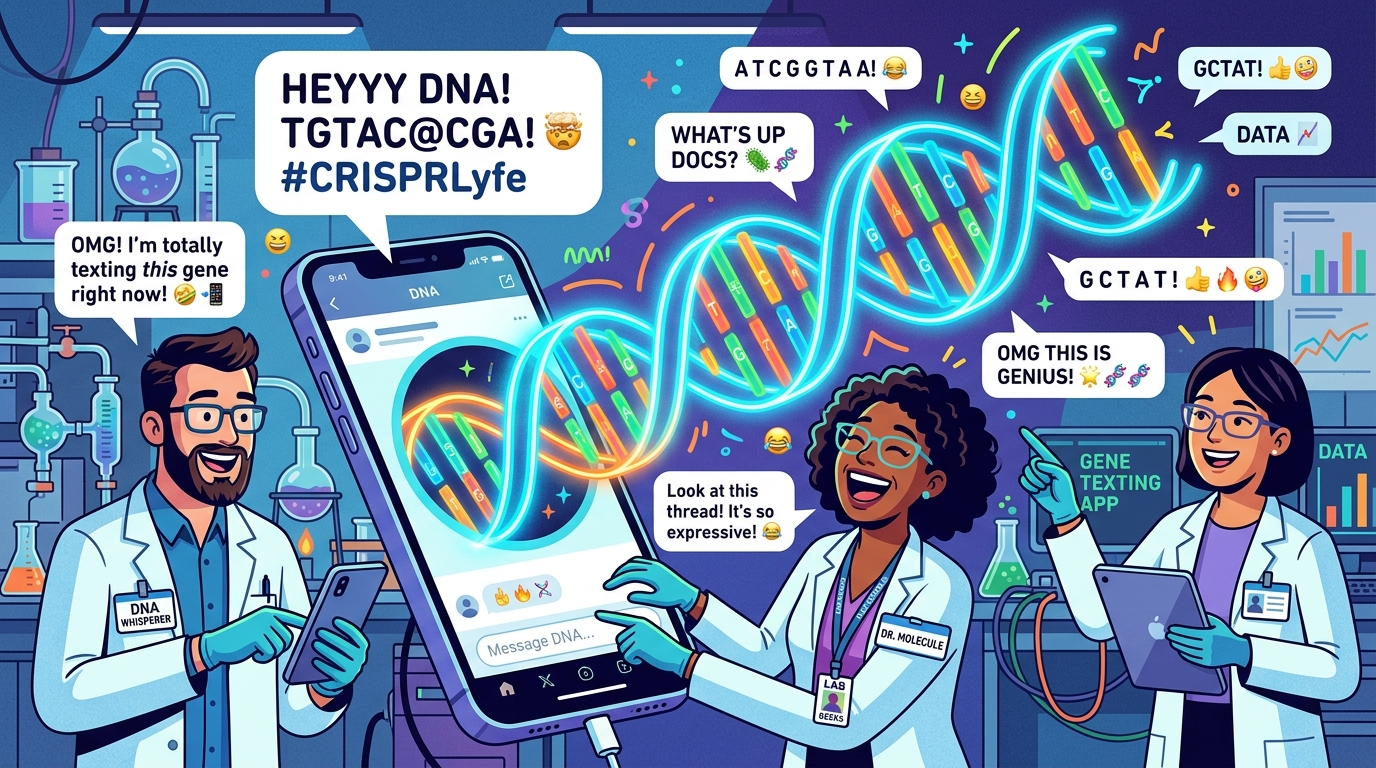
For decades, geneticists treated roughly 98% of the human genome the same way you treat the terms-of-service agreement on a software update: they completely skipped reading it and assumed it was harmless filler. Dubbed "junk DNA," these non-coding wildernesses baffled scientists because nobody could decipher their cryptic rules. But on September 9, 2026, researchers at UC Berkeley published GPN-Star in Nature—a nimble AI model that essentially gives our DNA a chat interface.
Led by senior author Yun Song, the Berkeley team trained GPN-Star not like a lumbering brute-force supercomputer burning through small city power grids, but as an elegant linguistic scholar of evolutionary history. Instead of guessing how DNA spells out proteins, GPN-Star learned the actual grammar, punctuation, and secret syntax that regulates when and where genes switch on.
🧬 How to Chat with 3 Billion Base Pairs
GPN-Star treats evolutionary biology as the ultimate training prompt:
- Evolutionary Grammar: By studying DNA across hundreds of species, the model deduced which genetic letters are strictly protected by natural selection versus which ones are just biological typos.
- Unlocking "Junk" Territory: Over 98% of your genome doesn't code for proteins; it acts like an overwhelmingly complex electrical circuit board. GPN-Star pinpoints exactly which switches control disease susceptibility.
- Lean and Mean Efficiency: Unlike bloated multi-billion parameter giants, GPN-Star runs circles around competing models while requiring a fraction of the compute time and hardware.
The practical implications are staggering. By decoding subtle point mutations inside regulatory DNA, GPN-Star can pinpoint pathogenic variants linked to heart disease, complex neurological conditions, and oncology targets that previously looked like meaningless static on clinical sequencing readouts.
It turns out Mother Nature wasn't writing gibberish in that 98% of our code after all. She was just using a dialect so sophisticated that human biochemists needed a custom AI translator to finally read her texts.
📱 Next Up: Group Chat with Mitochondria?
With GPN-Star proving that evolutionary sequence modeling can predict functional disease variants with surgical precision, synthetic biologists are already dreaming of the next frontier: designing custom genetic switches from scratch. Just don't leave your genome on "read."
You might also like
The Accidental Fountain of Youth: First Generative AI Drug Shaves 6 Years Off Biological Age
Scientists trained AI to design a pill for deadly lung fibrosis. When they analyzed patient blood with six independent proteomic clocks, they found the drug accidentally reversed biological aging by up to 6 years!
Baking Biology from Scratch: David Baker's $95M AI Bakery for Alien Proteins
Why settle for the proteins Mother Nature slapped together over four billion years? Nobel laureate David Baker just secured $95 million to build generative AI models that bake custom proteins and synthetic genes that never existed.
Catching AI Red-Handed: Stowers Institute Builds a DNA 'Lie Detector' for Deep Learning
In Nature Communications, researchers introduce PISA, an explainable AI tool that traces genomic deep learning predictions down to single DNA bases, separating lab noise from true biology.