Cosmic Bowling: CERN Smashes Light Atoms to Cook Up Microscopic Big Bangs in Bowling-Pin Shapes
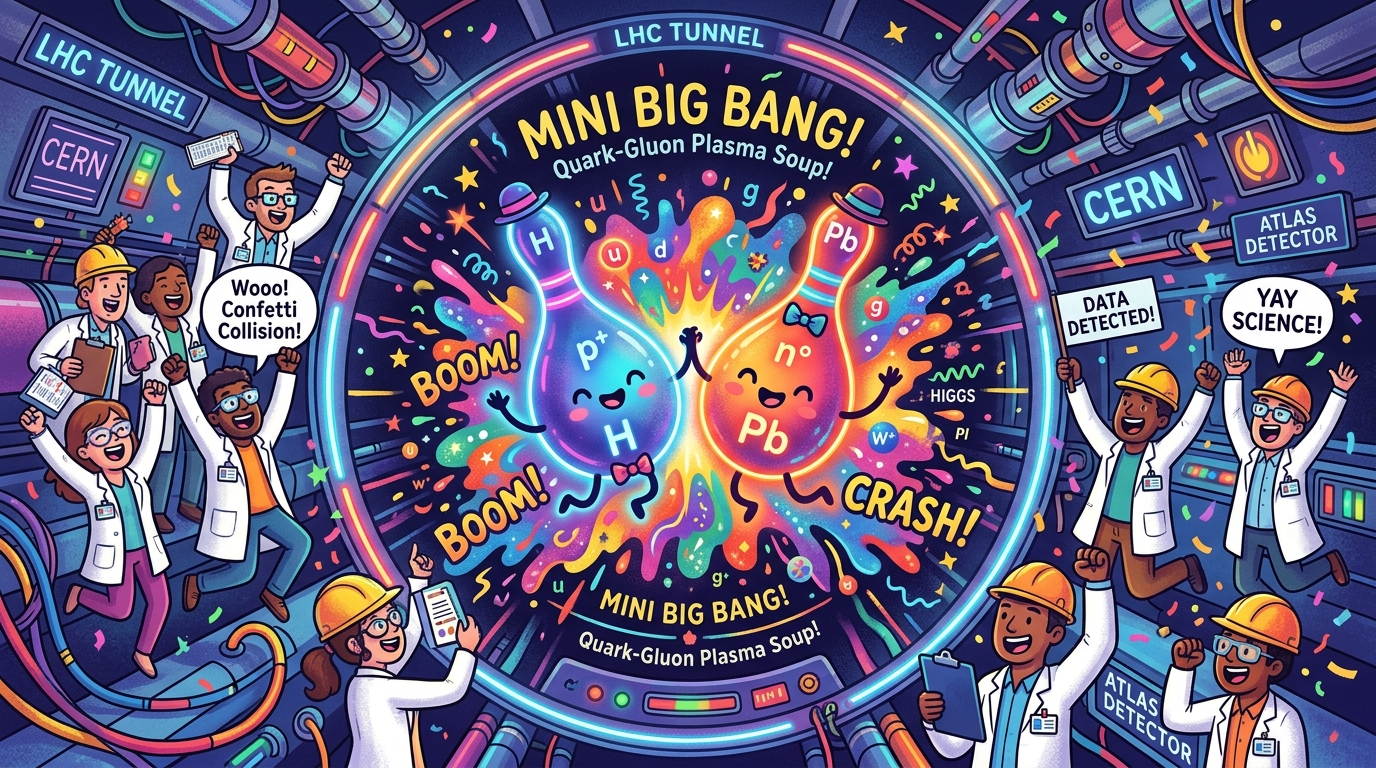
For decades, particle physicists operating the Large Hadron Collider (LHC) at CERN lived by a simple, brutal rule: if you want to recreate the primordial, trillion-degree "quark-gluon plasma" that filled the cosmos a microsecond after the Big Bang, you have to smash the heaviest atomic sledgehammers you can find—namely, massive lead ions. But in an extraordinary series of runs, CERN's ALICE collaboration shattered that dogma. By colliding lightweight oxygen and neon nuclei, they proved that nature can cook up a "microscopic Big Bang" in surprisingly tiny packages, while revealing that neon nuclei look suspiciously like subatomic bowling pins.
Published in Physical Review Letters by researchers from the Niels Bohr Institute and the international ALICE collaboration, the study marks a paradigm shift in high-energy nuclear physics. Quark-gluon plasma (QGP) is an exotic fluid where protons and neutrons melt apart, allowing fundamental quarks and gluons to roam freely as a near-frictionless, perfect liquid.
🎳 Subatomic Bowling at 99.999999% Light Speed
How CERN turned atomic collisions into a cosmic shape-detection game:
- Ditching Heavy Metal: Instead of smashing heavy lead-208 nuclei (which pack 208 nucleons), researchers accelerated light oxygen-16 and neon-20 beams into head-on collisions.
- The Primordial Droplet: Even with vastly fewer nucleons, the energy density at the collision point briefly exceeded the threshold needed to melt hadrons into bona fide quark-gluon plasma.
- The Shadow Technique: Because the QGP fireball lasts less than a sextillionth of a second before freezing back into ordinary particles, physicists reconstruct its geometry by tracking thousands of flying debris tracks—much like deducing an object's 3D shape from the shadow it casts.
- Bowling Pins vs. Spheres: While oxygen-16 collisions produced nearly symmetric, spherical debris bursts, neon-20 collisions blasted out elongated, distinctly asymmetric patterns, confirming theoretical predictions that neon-20 has a bizarre, pear- or bowling-pin-like nuclear geometry.
Why does this matter? For one, it challenges the long-held assumption that quark-gluon plasma requires a large "critical mass" of nucleons to exhibit collective fluid behavior. If tiny droplets of light nuclei can act like perfect liquid soups, it means collective quantum phenomena can emerge in far smaller physical systems than standard cosmological models ever anticipated.
Furthermore, using high-energy collisions as a "femtometer camera" gives physicists an unprecedented way to image the actual ground-state quantum shapes of atomic nuclei. It turns out the subatomic world isn't an orderly collection of neat little spheres—it's filled with pear-shaped wobbles, tetrahedral clusters, and bowling pins.
💥 "Strike! 100 Billion Degrees in the Gutter"
Leave it to CERN physicists to spend billions of euros on a 27-kilometer underground cryogenic supercollider just to discover that when you throw subatomic bowling pins at each other near light speed, the universe's oldest primordial soup splashes all over the detector scoreboards.
As the LHC prepares for even lighter ion collision campaigns, physicists are eager to see how small a Big Bang can get before quantum mechanics pulls the plug. Turns out, the universe's first recipe was far more flexible than anyone dared imagine.
You might also like
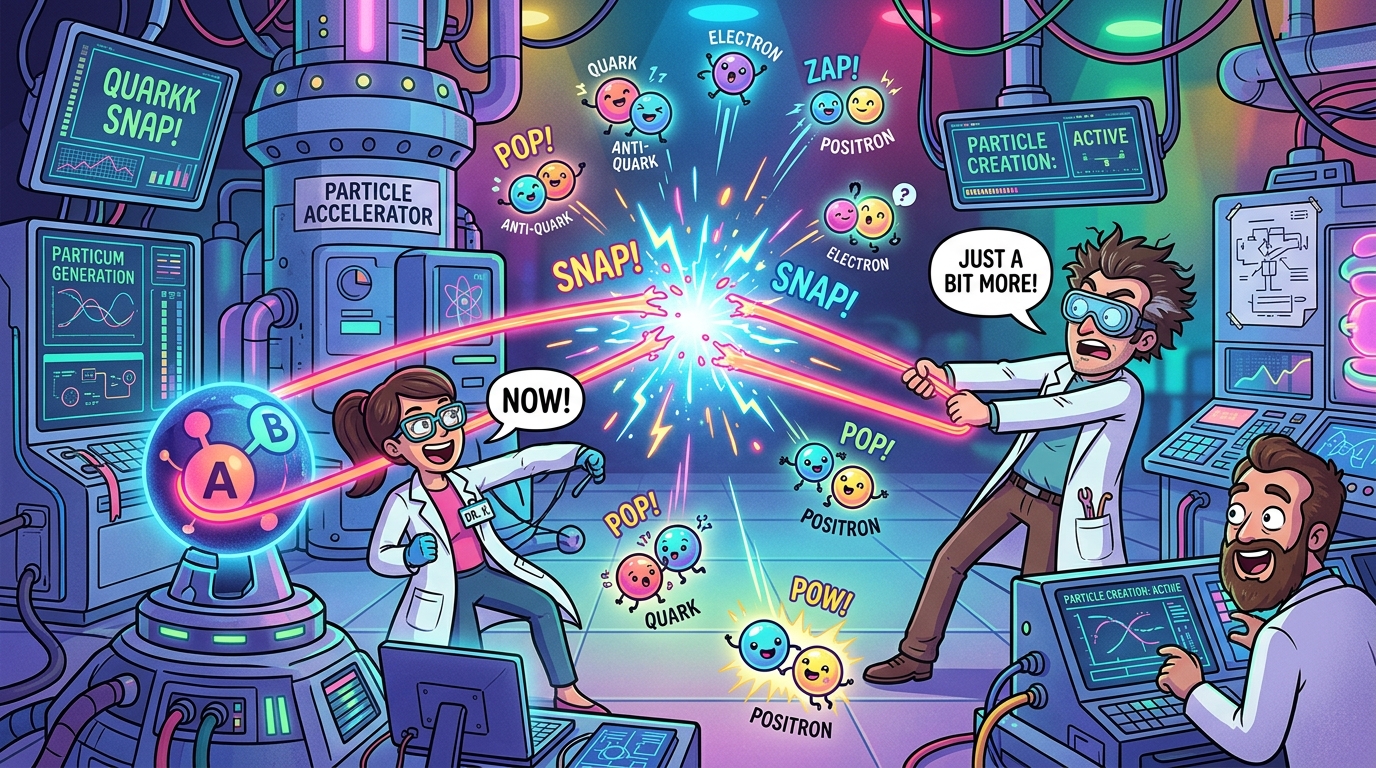
Snapping the Cosmic Rubber Band: Duke Physicists Use 13 Ions to Make Matter Pop Out of Nothing
Physicists at the Duke Quantum Center built a 13-trapped-ion quantum computer to simulate string-breaking dynamics. When you stretch the quantum bond between subatomic particles, the tension snaps—forcing the vacuum to spontaneously materialize brand-new particle pairs out of thin air.

Quantum Flash Mob: Distant Time Crystals Spontaneously Synchronize Across a Microchip
Physicists at TU Dortmund University watched separate quantum time crystals lock into the exact same ticking tempo across 40 micrometers—over 1,000 times their own size. Bridged by diffusing electron spins, this spontaneous quantum choreography breaks new ground for future quantum processors.

The Quantum Pisa Drop: Physicists Split an Atom and Dropped Half to Test Einstein's Ghost
In 1589, Galileo supposedly dropped cannonballs from the Tower of Pisa. In 2026, physicists built a 'Quantum Galileo' device that split an atom's wave function in two—holding one half in midair while dropping the other—to test general relativity at the quantum scale!