Fram2 Mission: Humanity Just Took a Polar Shortcut in Orbit
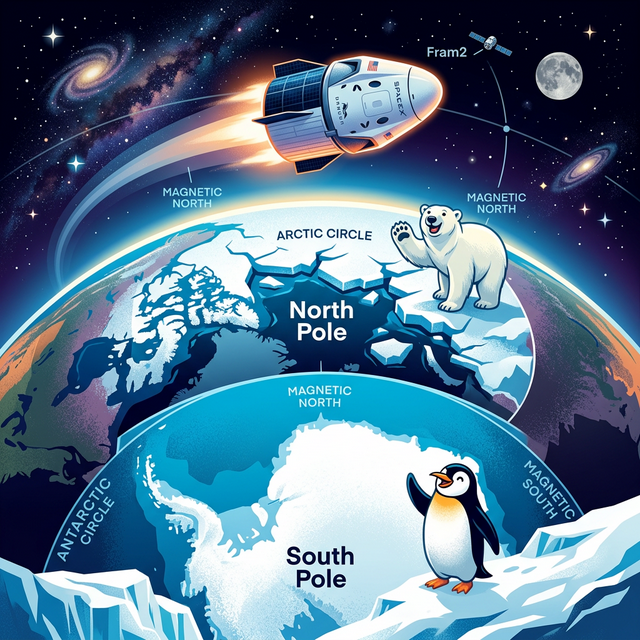
Humans have been orbiting Earth’s equator for decades like children on a merry-go-round. Now, Fram2 decided it was time to check out the poles.
The Ultimate Polar Shortcut
For the first time in human history, a civilian crew onboard a SpaceX Dragon capsule has successfully completed a polar human spaceflight mission. Flying directly over the North and South Poles, the Fram2 mission broke the equatorial-only orbital pattern and proved that private companies can manage the most demanding orbital mechanics.
❄️ Why the Polar Route?
Polar orbits provide near-total coverage of the planet's surface. While typically reserved for specialized imaging satellites, humans can now study polar environment changes directly from space. It’s also the ultimate "cold-weather" test for future space habitats.
The mission shows that the frontier of space is expanding vertically. If you’re at the North Pole and see a streak of light, it’s not Santa—it’s probably just SpaceX doing another victory lap.
You might also like

SpaceX Sets Fast-Food Speed Record: Two Orbital Rockets in 38 Minutes
SpaceX just launched two separate Falcon 9 orbital missions from Florida and California within 38 minutes, landing both boosters and proving rocket launches now have shorter wait times than coffee shops.

SpaceX Starship's Third Flight: Fireworks and Orbital Speeds
SpaceX hit orbital velocity, did some neat tricks, and then naturally went entirely out of contact in a blaze of glory.

CosmoCube: Why Scientists Are Sending a Suitcase to Hide Behind the Moon for 40 Minutes of Peace and Quiet
Cambridge astrophysicists revealed plans for CosmoCube—a suitcase-sized satellite designed to hide behind the lunar far side for 40 minutes every orbit. Its goal? Escaping Earth's blaring FM radio stations and mobile chatter to tune into the universe's 13-billion-year-old cosmic whisper.