The Ultimate Plot Twist: Rattlesnakes Carried a 10x More Potent Antidote in Their Blood All Along
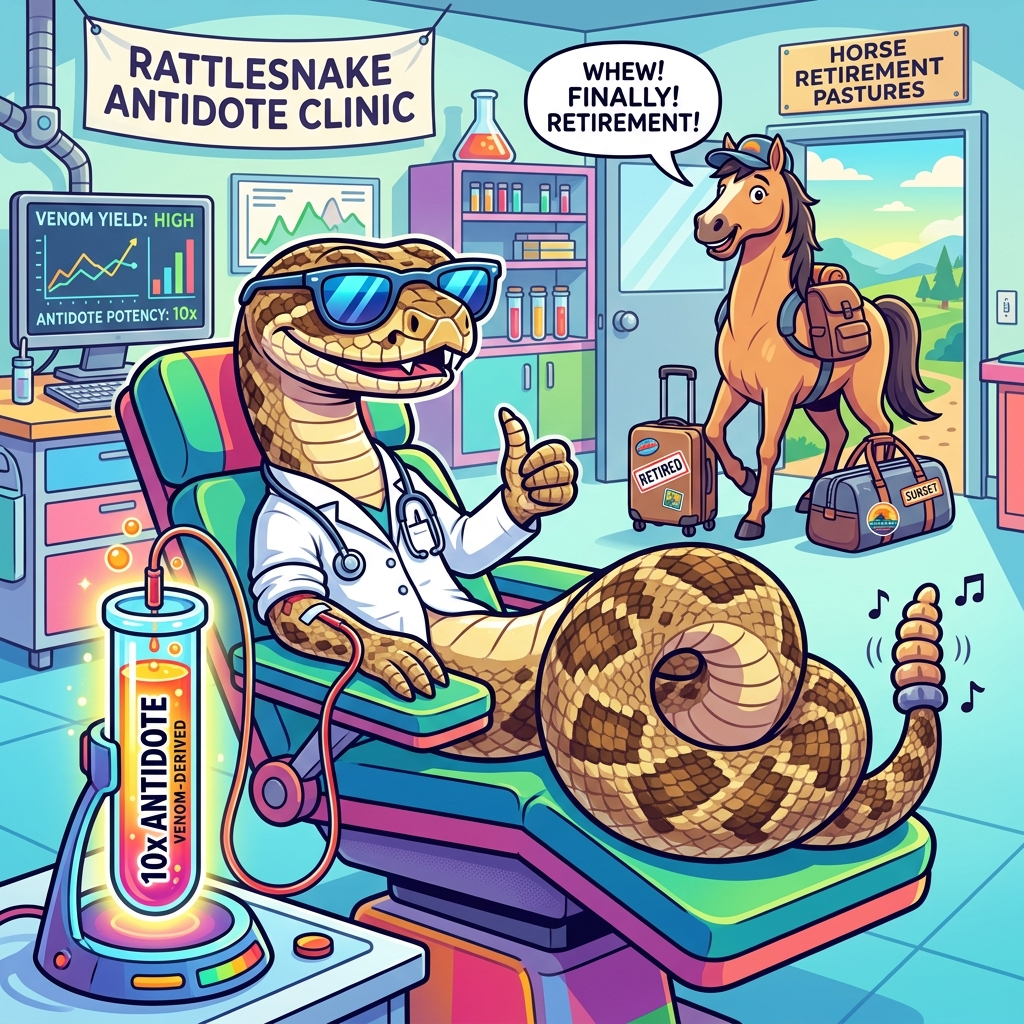
For more than 125 years, our strategy for making snake antivenom has felt suspiciously medieval: find a terrifying, venomous viper, milk its fangs into a jar, inject tiny sublethal doses into innocent horses or sheep, wait for the animal to make antibodies, draw their blood, and bottle it. It’s expensive, causes violent allergic reactions, and horses would frankly prefer not to be involved. But in a study published in PNAS, researchers revealed that rattlesnakes have been carrying the ultimate antidote in their veins the entire time.
Led by renowned evolutionary biologist Sean B. Carroll at the University of Maryland, the research team set out to solve a long-standing question in venom biology: how do western diamondback rattlesnakes (Crotalus atrox) avoid dying from their own hyper-toxic venom during territorial wrestling matches and mating fights?
🧪 Meet the FETUA Avengers
The secret to rattlesnake immunity isn't a single magic molecule, but a family of blood proteins called FETUAs (descendants of the ancestral glycoprotein Fetuin-A):
- The Lone Ranger Problem: Individually, each FETUA protein is only mediocre at shutting down venom enzymes.
- The Synergistic Super-Team: When scientists mixed specific FETUA variants together, their neutralizing power skyrocketed exponentially.
- 10x By Mass: By weight, this recombinant snake-protein cocktail is roughly ten times more potent than standard horse-derived commercial antivenom.
- Broad-Spectrum Shield: The cocktail successfully disarmed venoms not just from diamondbacks, but from diverse, distantly related viper species across the globe.
Traditional horse-derived antivenoms come with massive baggage. Because humans don't particularly enjoy having large quantities of foreign equine proteins pumped into our veins, up to 10% to 20% of snakebite patients suffer from acute anaphylaxis, and many develop delayed "serum sickness." Producing it also requires keeping herds of donor animals on standby in specialized facilities.
By contrast, synthetic FETUA proteins can be grown inside clean bioreactor vats using standard recombinant technology. Because they specifically target the metalloproteinases and toxins common to all viper venoms rather than relying on blunt animal antibodies, they could yield stable, cheap, room-temperature antivenoms that don't trigger human immune flare-ups.
🐎 Horses Everywhere Are Filing for Early Retirement
Somewhere out in a pasture, a retired thoroughbred is reading this paper, wiping a tear from its eye, and whispering: "Thank goodness. Now go make the snakes do their own homework."
While clinical trials are still on the horizon, this discovery could revolutionize treatment for the 1.8 to 2.7 million venomous snakebites that occur globally each year. Sometimes the best shield against a predator’s weapon is already written in the predator's own genetic blueprints.
You might also like
Savannah Apothecary: Kenyan Elephant Moms Caught Chewing Herbal Remedies to Nurse Sick Calves
A landmark study in Kenya reveals that African elephants practice zoopharmacognosy by selecting 35 medicinal plants to treat illnesses—with mother elephants chewing bitter roots and mixing herbal extracts into milk for their ailing calves.
Meet the Tilcayo: The First New Wild Cat Species in 100 Years Was Hiding as a House Pet
A Bolivian family adopted what they thought was an energetic stray kitten named Tigrino. DNA testing just revealed he belongs to Leopardus tilcayo—a 3-pound jungle carnivore, a 1.4-million-year-old evolutionary branch, and the first new living cat species discovered in over a century.
Mammals Can Breathe Through Their Backsides: How 'Butt Gills' Won an Ig Nobel and Just Passed Human Trials
Forget lungfuls of fresh air: scientists proved mammals can absorb oxygen enterally via the rectum using oxygenated liquid, and clinical trials show our rears might actually be emergency backup gills.