Why Thousands of Ancient Skeletons Have Intact Brains: The Science of Accidental Bio-Plastics
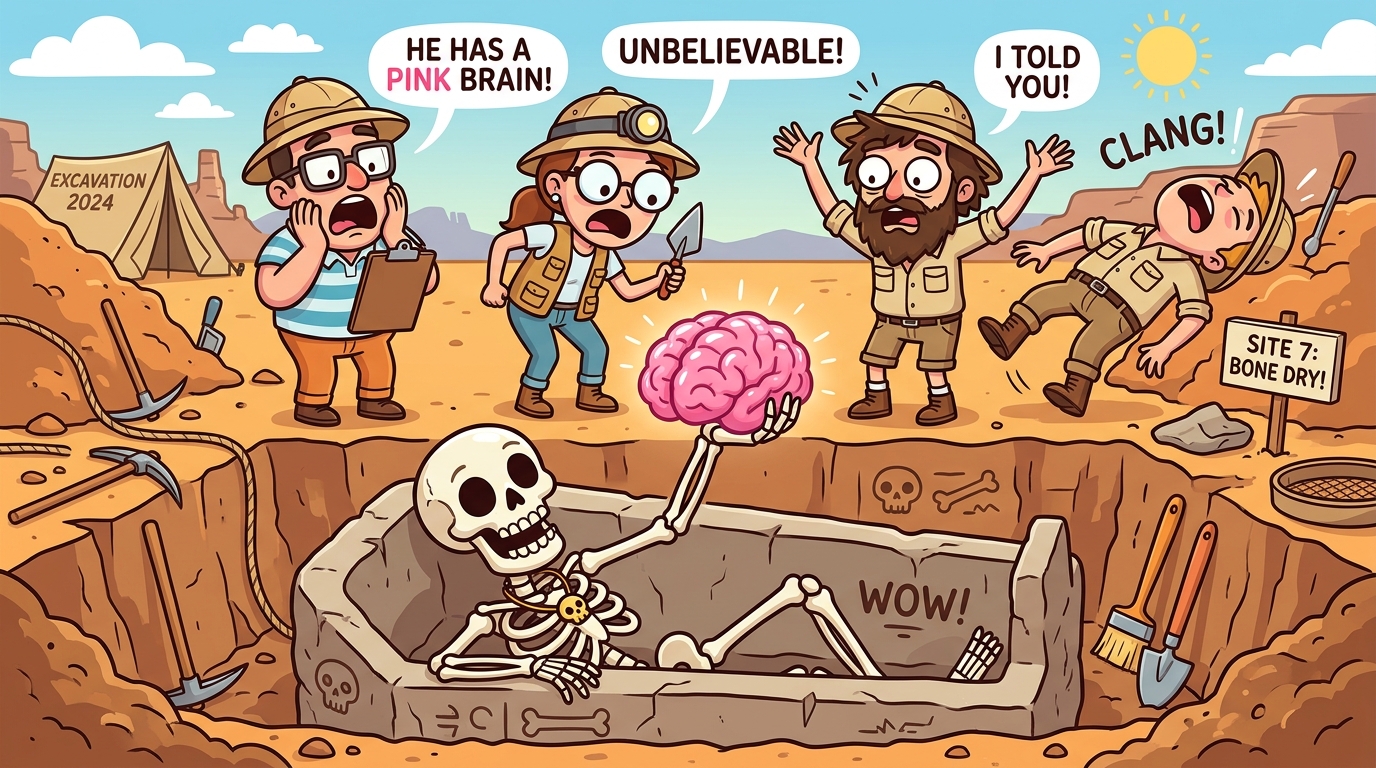
If you dig up a 4,000-year-old grave, you generally expect to find clean, white bones. Muscle, skin, liver, and intestines vanish into dust within months. Yet across archaeological digs worldwide, researchers keep finding one bizarre exception: thousands of pristine human brains, resting quietly inside completely skeletonized skulls.
For decades, scientists treated preserved brains as flukes—the freak results of extreme mummification, ice freezes, or acidic peat bogs. But a comprehensive global census led by Oxford paleobiologists cataloged over 4,400 preserved brains spanning 12,000 years, many excavated from damp, waterlogged graves where all other soft tissue had completely dissolved.
🧠 The Biological Paradox
The brain is about 80% water and is packed with fat, enzymes, and autolytic bacteria. Under normal conditions, it is actually the very first internal organ to liquefy post-mortem. Why, then, would thousands of brains survive millennia of damp burial when heart and muscle tissue vanished?
Nature's Accidental Plastic Welding
In a breakthrough study published in the Journal of Proteome Research, researchers used mass spectrometry and paleoproteomics to analyze the famous 2,600-year-old Heslington Brain from England, cracking the molecular mystery wide open.
🔬 The Chemical Recipe for Millennia-Old Brains
- Hypoxic Wet Burial: When a corpse is sealed in wet, oxygen-starved clay or mud, aerobic putrefaction is arrested before autolytic enzymes can completely digest the neural architecture.
- Metal Ion Catalysts: Iron and aluminum ions leaching from surrounding soil permeate the skull, catalyzing a cascade of lipid peroxidation and protein cross-linking.
- Spontaneous Polymerization: Intermediate filament proteins (like GFAP and neurofilaments) form tight covalent bonds with decomposed brain lipids, effectively transforming soft nervous tissue into a durable, insoluble biological polymer (essentially natural plastic).
This molecular armor protects ancient neural proteins from bacterial digestion, environmental humidity, and chemical decay for thousands of years.
So if you ever worried that your thoughts might be forgotten by history, take comfort in the chemistry: under the right muddy conditions, your brain might literally plastic-weld itself into eternity to confuse future archaeologists.
You might also like
The Great Molecular Arm Wrestle: Why the 2026 Nobel Prize in Chemistry Won't Shake Your Right Hand
The 2026 Nobel Prize in Chemistry honors Henri B. Kagan and Kenso Soai for cracking homochirality—explaining how a microscopic nudge can cause one mirror-image molecule to mercilessly bully its twin out of existence.
The Great Worm Pub Crawl: Scientists Win Ig Nobel for Sorting Drunk Worms in an Obstacle Maze
University of Amsterdam physicists got thousands of aquatic worms tipsy on beer-strength ethanol, built a tiny hexagonal pegboard maze, and proved that sober worms make vastly superior life choices.
Seasoned for Eternity: Proteomics Reveals Ancient Egyptians Glued Mummies with Sesame and Moringa Seeds
A breakthrough proteomics study in Science Advances discovered that ancient Egyptian artisans didn't just use animal glue on sacred mummy masks—they whipped up high-tech adhesives spiced with sesame and moringa seeds.