Curiosity Rover Discovers Vast 'Alien Bathroom Tile' Honeycomb Sea on Mars

If you ever wondered what Martian interior decorators would choose for flooring, NASA's Curiosity rover just gave us the answer: an endless, perfectly geometric sea of hexagonal honeycomb tiles stretching across the valley floor.
While exploring the rugged terrain of Valle Grande on the slopes of Mount Sharp, NASA's Curiosity rover (which has been patiently crawling across the Red Planet since 2012) rolled right into an astonishing geologic spectacle: thousands of small, geometric polygons measuring between 1.5 and 3 inches (4 to 8 cm) across, forming an unbroken patterned mosaic as far as the camera can see.
🪐 The Discovery at Valle Grande & Butte Miraflores
Captured during sols 4,930 and 4,931 of the mission, the images show a "sea of polygons" wrapping seamlessly around the base of Miraflores, a 20-foot-tall sand-capped butte. Curiosity project scientist Ashwin Vasavada noted that the sheer scale and uniformity of the discovery literally took the science team's breath away.
Did Aliens Tile the Floor, or Is Physics Just Showing Off?
Geologists know that nature loves hexagons—just look at basalt columns like the Giant's Causeway on Earth or bee hives. But seeing an entire Martian valley covered in crisp polygonal fractures gives scientists crucial clues about the ancient Red Planet climate:
🔍 How Did the Honeycomb Floor Form?
- Ancient Wet-Dry Cycles: Billions of years ago, when Valle Grande held muddy lake beds, repeated cycles of wetting and drying shrank the mud, causing it to crack into neat geometric junctions.
- Extreme Thermal Stress: Relentless Martian temperature swings—from scorching daytime highs to freezing subzero nights—may have repeatedly contracted and expanded the rock over millions of years.
- Burial & Compaction: Heavy layers of overlying sediment squeezed out trapped moisture, cementing the fractures with resistant minerals that weathered into raised ridges.
These distinct patterns are some of the clearest evidence yet that ancient Mars experienced sustained seasonal shifts between wet and dry conditions—the exact cyclic environment astrobiologists believe is ideal for prebiotic chemistry and the emergence of microbial life.
So while Curiosity hasn't found alien grout or an interplanetary plumbing catalog just yet, it has confirmed that Mars had all the right cyclic conditions to cook up the basic ingredients of life billions of years ago.
You might also like
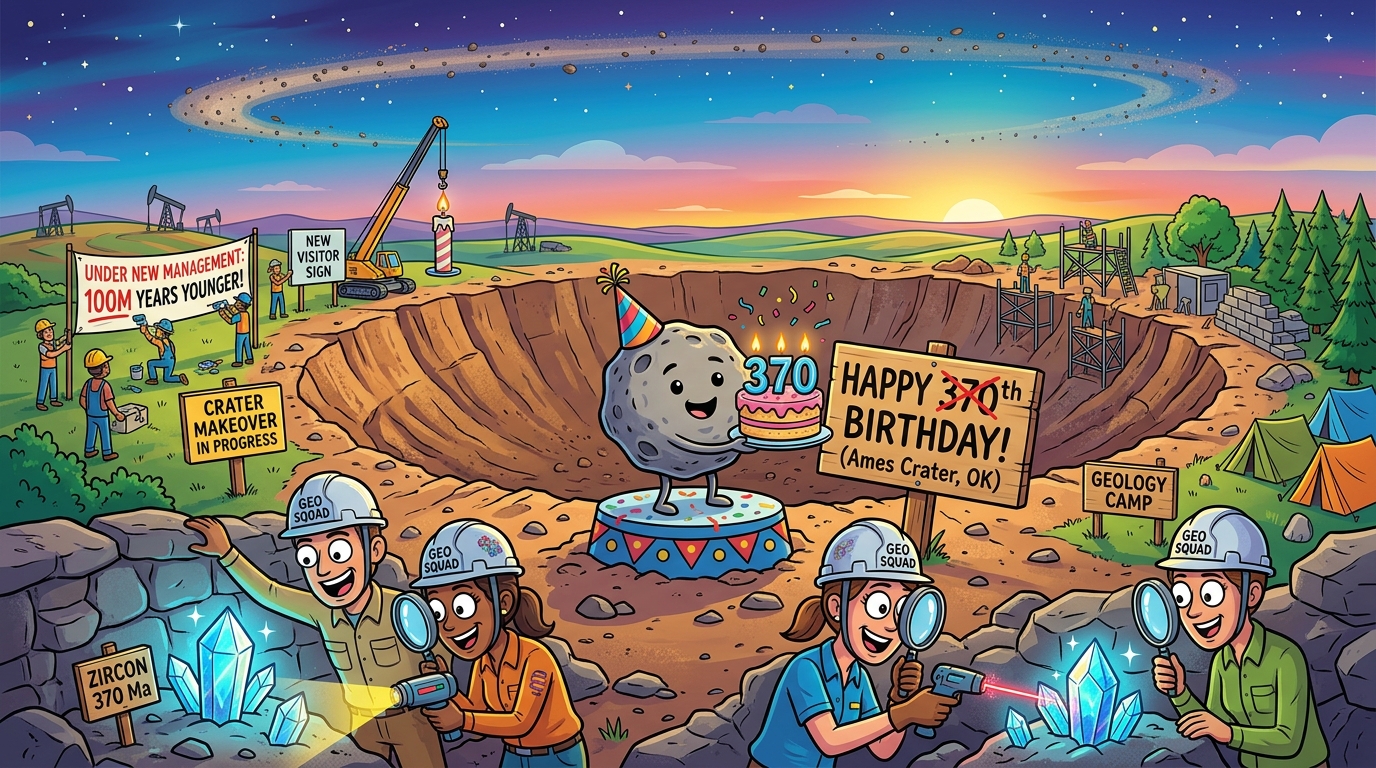
Oklahoma's Ames Meteor Crater Knocked 100 Million Years Off Its Age After Getting Caught With Recycled Fossils
High-precision uranium-lead zircon dating reveals Oklahoma's Ames impact crater was formed 370 million years ago—nearly 100 million years later than believed—kicking it out of Earth's hypothetical Saturn-ring club.

When You Try to Pick a Peaceful Campsite on Google Maps and Stumble into a 390-Million-Year-Old Asteroid Impact
A Canadian camper scouting for quiet vacation spots on Google Maps accidentally discovered a massive 25-kilometer Devonian meteor crater in Quebec, proving that space rocks make great holiday destinations.

Earth Was an Extreme Localvore: Why Geologists Have No Idea Where Our Water Came From
ETH Zurich planetary scientists proved Earth was forged almost 100% from inner Solar System materials, with less than 2% coming from outer asteroids. That completely detonates the textbook theory that icy comets brought our oceans—leaving geologists scratching their heads.