Submerged 6,000-Year-Old Stone Bridge in Spanish Cave Rewrites Mediterranean Human History
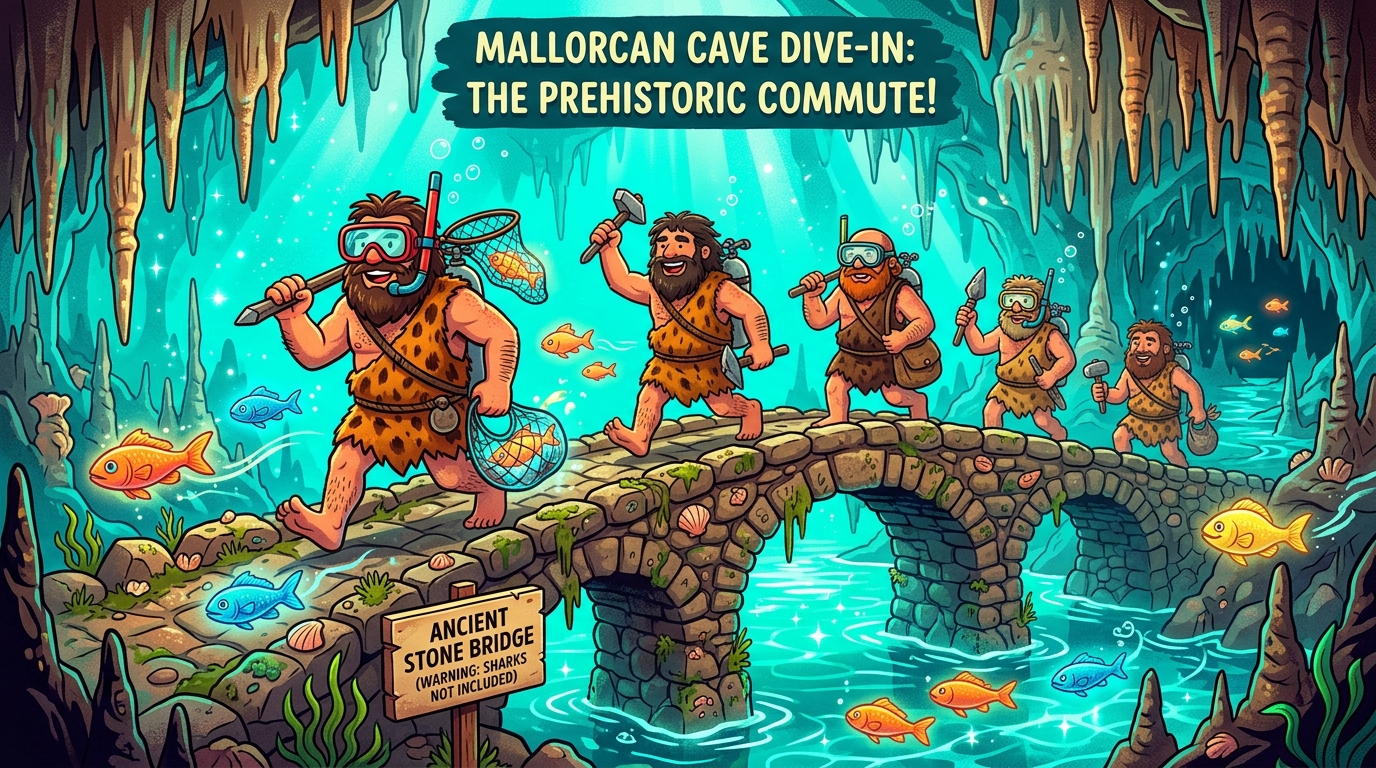
For decades, historians believed that the sunny Mediterranean island of Mallorca remained an untouched wilderness until roughly 4,400 years ago. But underwater cave divers just found a prehistoric stone highway that blows that timeline completely out of the water.
In a landmark discovery published in Communications Earth & Environment, a research team led by the University of South Florida explored the submerged corridors of Cova de Genovesa on Mallorca's eastern coast and dated an astonishing 25-foot (7.6-meter) limestone block bridge built by ancient humans.
🏛️ The Prehistoric Shortcut Over Cave Lakes
Constructed from heavy limestone boulders fitted together without mortar, the bridge linked the dry entrance of the cavern across a subterranean lake to an elevated inner chamber. By analyzing the calcite mineral "bathtub ring" encrusted on the stones—formed when ancient sea levels were temporarily stable—geologists pinpointed the construction date to between 5,600 and 6,000 years ago.
Why is a simple stone walkway in a flooded cave such a massive archaeological bombshell?
- 1,000+ Years Earlier: Previous island timelines relied on scattered pottery fragments and goat bones dating to 4,400 years ago. The Genovesa bridge pushes confirmed human colonization back by over a millennium.
- Master Engineers of the Stone Age: These weren't lost castaways hiding under palm leaves. Early settlers surveyed complex underground cave systems, valued freshwater reserves, and hauled massive stone slabs into dark subterranean chambers to build durable infrastructure.
- Sea-Level Time Capsule: Because rising Mediterranean waters flooded the cave thousands of years ago, the bridge was sealed in a pristine underwater time capsule, shielded from erosion and human tampering.
🔍 Rewriting the Story of Island Colonization
Mallorca was one of the very last large Mediterranean islands thought to be settled by humans, supposedly because its rugged terrain and limited resources repelled early seafarers. The Genovesa bridge proves early Mediterranean explorers were far more adventurous, daring, and architecturally capable than history books ever gave them credit for.
So next time you take a Mediterranean beach holiday, remember that six thousand years ago, stone-age civil engineers were already building paved bridges in the caves below your lounge chair!
You might also like

The Sickle and the Padlock: Scientists Solve the Tragic Mystery of Poland's 'Vampire' Zosia
When archaeologists in Pień uncovered the 17th-century grave of a young woman with a sharp iron sickle across her neck and a padlock on her big toe, sensational headlines screamed 'Vampire!' Now modern forensics revealed the heartbreaking truth behind the superstition.

Why Thousands of Ancient Skeletons Have Intact Brains: The Science of Accidental Bio-Plastics
Archaeologists have cataloged over 4,400 ancient human brains that survived for millennia while every other organ rotted away. A new molecular study reveals how wet decay turns neural tissue into indestructible biological polymers.

Catching a 300lb Boulder: Archaeologists Find First Verified Victim of the 'Warwolf' Trebuchet
Bioarchaeologists examining a 700-year-old skeleton from Stirling Castle found 167 brutal bone fractures—the first physical evidence of a direct hit from King Edward I's mega-trebuchet.