Catching a 300lb Boulder: Archaeologists Find First Verified Victim of the 'Warwolf' Trebuchet
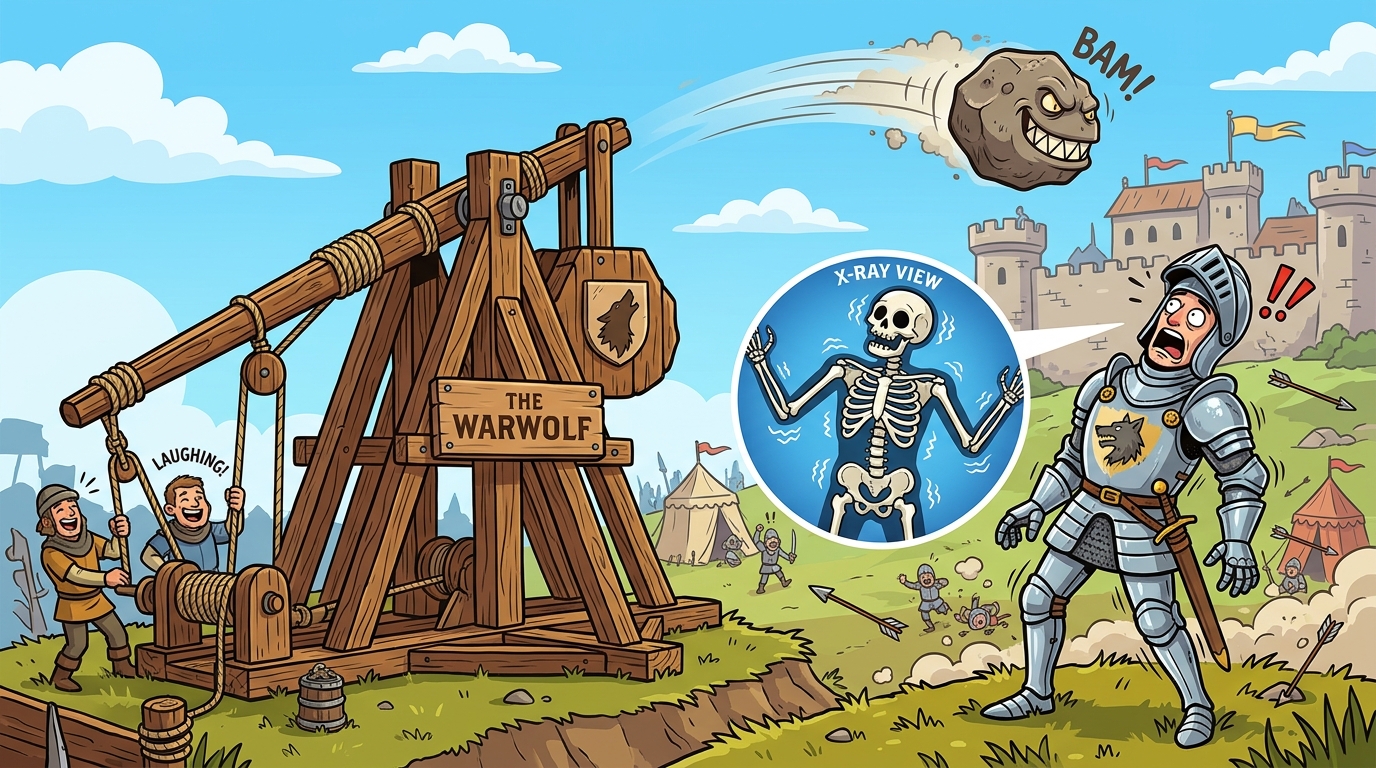
If you ever complain about having a bad Monday at work, take solace in knowing that you have never been tasked with defending a Scottish castle wall while a 400-foot-tall wooden contraption hurls a 300-pound boulder directly at your ribcage.
Bioarchaeologists at the University of Bradford, led by Dr. Jo Buckberry, have published a groundbreaking forensic analysis of "Skeleton 150," an unfortunate young man excavated from beneath the chapel of Scotland's famed Stirling Castle. The verdict? A staggering 167 peri-mortem fractures—making him the world’s first scientifically confirmed direct casualty of a medieval counterweight trebuchet.
💥 The Forensic Trauma Breakdown
- 61 Skull Fractures: Extensive radiating cranial trauma consistent with a massive blunt-force wave.
- 57 Broken Ribs: Rare high-energy "zigzag" shatter patterns never seen in standard sword or arrow wounds.
- Impact Energy: Equivalent to being struck by a modern high-speed freight train or head-on SUV collision.
Meet 'Warwolf': The Nuclear Bomb of 1304
During the 1304 Siege of Stirling Castle, King Edward I of England ("Longshanks") commissioned English master carpenter Master James of St. George to build the largest siege engine ever devised: Warwolf (Loup-de-Guerre).
It took five master carpenters, 49 laborers, and three months to assemble. Warwolf stood nearly 400 feet tall and could fling 300-pound stone spheres at high velocities. In fact, when the Scottish defenders inside Stirling Castle saw Warwolf finally assembled, they immediately offered unconditional surrender.
King Edward I, however, famously refused their surrender, replying essentially: "We spent three months building this magnificent monster, and I am definitely firing it at your wall at least once."
🎯 The Fate of Skeleton 150
Skeleton 150 belonged to a robust man in his 20s. The biomechanical simulation reveals he wasn't killed by collapsing masonry or falling from a parapet—his injuries match the direct blast wave and impact of an incoming high-speed kinetic siege boulder.
Seven centuries later, modern forensic science has finally given closure to medieval Europe's most overpowered artillery strike. Let this be a reminder to keep your hard hat on whenever someone brings a 50-ton siege engine to your doorstep.
You might also like

Submerged 6,000-Year-Old Stone Bridge in Spanish Cave Rewrites Mediterranean Human History
A 25-foot submerged limestone bridge in Mallorca's Genovesa Cave proves humans built sophisticated island infrastructure 6,000 years ago—a millennium earlier than textbooks claimed.

The Sickle and the Padlock: Scientists Solve the Tragic Mystery of Poland's 'Vampire' Zosia
When archaeologists in Pień uncovered the 17th-century grave of a young woman with a sharp iron sickle across her neck and a padlock on her big toe, sensational headlines screamed 'Vampire!' Now modern forensics revealed the heartbreaking truth behind the superstition.

Why Thousands of Ancient Skeletons Have Intact Brains: The Science of Accidental Bio-Plastics
Archaeologists have cataloged over 4,400 ancient human brains that survived for millennia while every other organ rotted away. A new molecular study reveals how wet decay turns neural tissue into indestructible biological polymers.