Venus's Polygonal Cracks Tell a Tale: The Solar System's Hottest Planet Once Had Oceans

Today, Venus is a 900°F (475°C) pressure-cooker hellscape wrapped in sulfuric acid clouds where lead melts on the rocks. But under all that scorched crust lies evidence of a long-lost beach vacation paradise.
In a study published in Earth and Planetary Science Letters, planetary geologists from the University of London and Imperial College London have re-examined radar data of Venus's vast lowland plains. They discovered that the enigmatic networks of giant polygonal fractures covering thousands of square kilometers are not volcanic cooling scars, but rather ancient desiccated seafloor mud cracks.
🏖️ From Tropical Lagoon to Cosmic Air Fryer
On Earth, when a muddy lakebed dries under the summer sun, clay contracts into distinctive hexagonal and polygonal tile patterns. The mathematical spacing and fracture depth of Venus's geometric terrain match terrestrial marine sediment desiccation almost perfectly—implying that waterlogged clay slowly dried out over millions of years as the planet succumbed to a runaway greenhouse catastrophe.
For decades, scientists debated whether Venus ever possessed surface liquid water or if it was bone-dry from day one. These mud cracks provide some of the most compelling structural evidence yet that oceans didn't just exist—they lingered long enough to deposit deep layers of marine sediment.
🚀 DAVINCI & VERITAS Get Their Target Maps
Upcoming missions like NASA's VERITAS and DAVINCI will have their sensors aimed straight at these ancient ocean basins. If chemical signatures of hydrated minerals or marine clays are confirmed, Venus will officially take the title of the Solar System's ultimate climate cautionary tale.
So remember: if you think your summer heatwave is unbearable, at least your local beach hasn't evaporated into 90 atmospheres of corrosive carbon dioxide. Yet.
You might also like

Cosmic Monster Trucks: JWST Catches 21 Teenage Alien Solar Systems Smashing Planets into Vaporized Glass
The James Webb Space Telescope peeked inside 21 rare 'extreme debris disks' and caught teenage solar systems playing planetary dodgeball, vaporizing Mars-sized worlds into glowing clouds of silica glass.
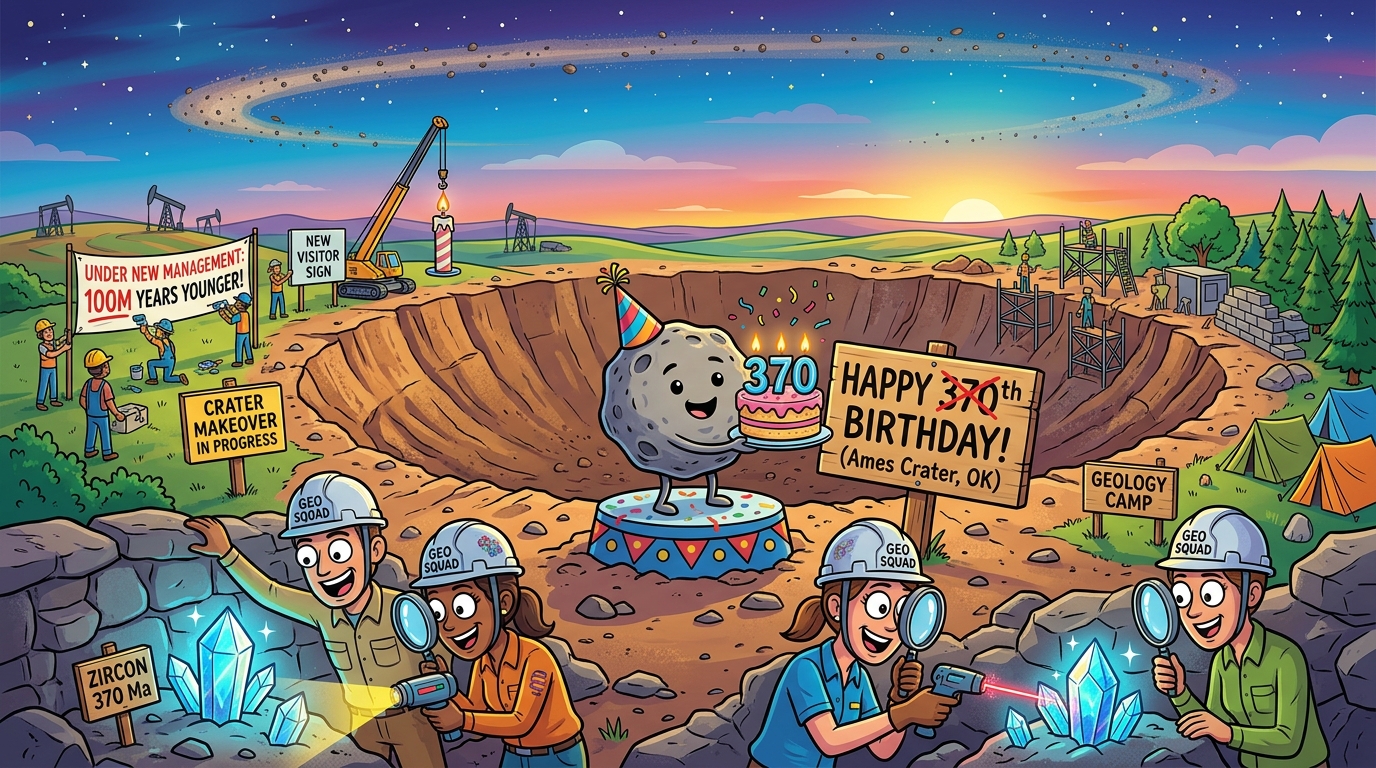
Oklahoma's Ames Meteor Crater Knocked 100 Million Years Off Its Age After Getting Caught With Recycled Fossils
High-precision uranium-lead zircon dating reveals Oklahoma's Ames impact crater was formed 370 million years ago—nearly 100 million years later than believed—kicking it out of Earth's hypothetical Saturn-ring club.

Earth Was an Extreme Localvore: Why Geologists Have No Idea Where Our Water Came From
ETH Zurich planetary scientists proved Earth was forged almost 100% from inner Solar System materials, with less than 2% coming from outer asteroids. That completely detonates the textbook theory that icy comets brought our oceans—leaving geologists scratching their heads.