Cosmic Indigestion: Giant Black Hole Unleashes Delayed Radio Burp 300 Days After Feasting
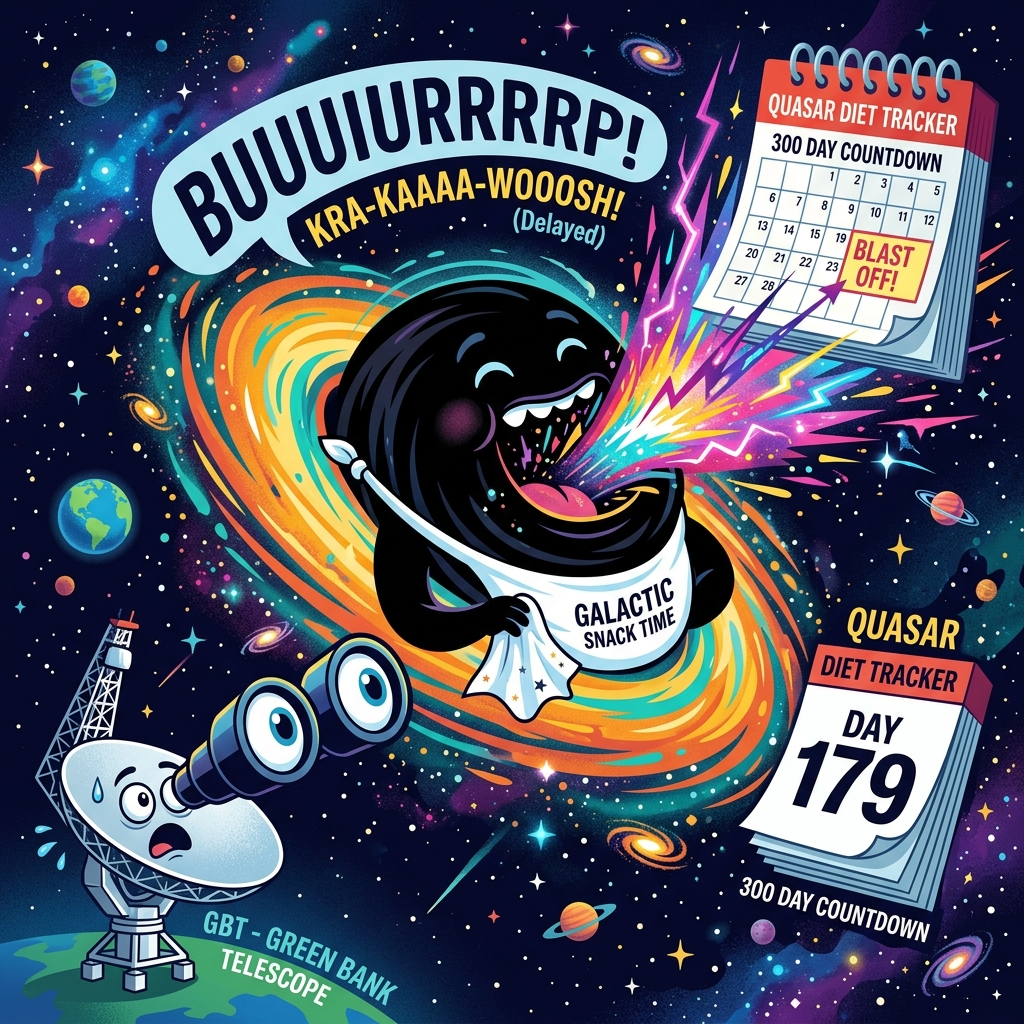
If you ever felt embarrassed about burping after a heavy meal, take comfort in the fact that supermassive black holes have far worse table manners. Astronomers just caught a monster black hole throwing a colossal two-stage cosmic tantrum—and it took a whopping 300 days for its relativistic burp to travel from its stomach to the exit door.
In a study accepted by The Astrophysical Journal Letters, University of Michigan astronomer Sarah Ketchum and her team combed through nearly two decades of high-cadence X-ray data from NASA's Neil Gehrels Swift Observatory. Their target was NGC 1275, the central titan galaxy anchoring the Perseus Cluster roughly 240 million light-years away, powered by an 800-million-solar-mass gravitational behemoth.
⏱️ The 300-Day Cosmic Pipeline
On February 21, 2023, the black hole went on an unprecedented feeding spree, unleashing the brightest X-ray flare ever recorded from NGC 1275. But the real punchline arrived nearly 10 months later: approximately 300 days after the initial feeding frenzy, 43 GHz radio telescopes detected a massive jet flare blasting outward at near light speed.
Why is astrophysicists' excitement over a 300-day cosmic burp reaching fever pitch?
- Direct Proof of Disk-Jet Coupling: Theorists have long predicted that the swirling accretion disk around a black hole feeds matter into magnetic funnels that launch relativistic jets. Ketchum's team clocked the exact transit time of this gravitational plumbing for the first time.
- The Power of the Swift Marathon: While flagship observatories like Chandra capture ultra-sharp snapshots, Swift’s tireless 20-year surveillance made it possible to spot short 5-day bursts and connect the dots across months.
- Cosmic Scale Meal: The initial X-ray flash doubled the core brightness of the black hole in under two months, showing that even 800-million-sun giants experience sudden, chaotic gluttony.
🍔 Black Holes: Just Like Toddlers
It turns out black holes are chaotic eaters. They stuff themselves full of infalling gas, choke on the excess radiation, and then spend 300 days winding up before shooting out a relativistic plasma cannonball across intergalactic space.
So next time your stomach gurgles after dinner, just tell everyone you are simulating relativistic disk-jet coupling. If an 800-million-solar-mass black hole can take 300 days to digest its lunch, you deserve at least an afternoon nap!
You might also like

The Universe's Ultimate Disco Ball: Magnetar Proves 'Empty Space' Acts Like a Prism
In Nature, astrophysicists using NASA's IXPE observe 80% polarized X-rays from magnetar 1E 1547.0-5408, providing the strongest evidence yet for quantum vacuum birefringence.
AI Catches Rogue Supermassive Black Hole Wandering the Suburbs and Eating a Star
Astronomers' AI caught a 1,000,000-solar-mass supermassive black hole 30,000 light-years from its galaxy center after it gave itself away by violently shredding an innocent star.

The 10-Billion-Year-Old Voicemail: Webb and MeerKAT Catch the Most Distant Radio Flash in Cosmic History
Astronomers have detected FRB 20240304B, a fast radio burst that traveled over 10 billion years across the universe, shattering cosmic distance records and proving ancient baby galaxies loved loud fireworks.